Swedish Research Team Successfully Deploys 303 km QKD Link
en.Wedoany.com Reported - A research team comprising Linköping University, KTH Royal Institute of Technology, Stockholm University, and Chalmers University of Technology has successfully deployed a long-distance trusted-node quantum key distribution (QKD) link spanning a total distance of 303 kilometers in southeastern Sweden, integrating it into a dynamically reconfigurable telecommunications network. The network topology connects a university laboratory in Linköping with the National Quantum Center in Stockholm via an intermediate trusted node, combining standard long-distance single-mode fiber (SMF) and multi-core fiber (MCF) access segments to simulate a heterogeneous enterprise infrastructure.
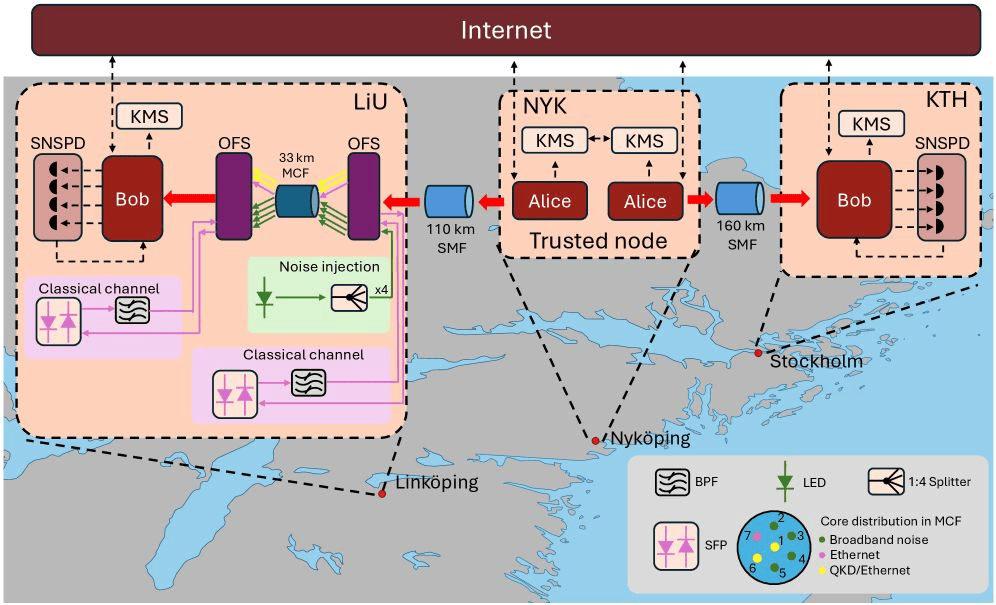
The experimental architecture bridges a 270 km deployed dark fiber link leased from GlobalConnect with a 33 km coiled seven-core multi-core fiber access link. To overcome the high transmission losses of the two main spans—a 110 km sub-link from Linköping to Nyköping (23 dB loss) and a 160 km segment from Nyköping to Stockholm (36 dB loss)—the researchers modified a commercial ThinkQuantum (QuKy EDU Pro) system. The receiver was retrofitted to connect external superconducting nanowire single-photon detectors (SNSPDs), replacing the standard internal gated-mode indium gallium arsenide (InGaAs) avalanche photodiodes. The SNSPDs provided detection efficiencies of up to 93% and ultra-low dark count rates as low as ≤1 count per second, directly boosting the secret key rate (SKR) on the initial 110 km segment from 0.16±0.02 kbit/s to 4.75±0.71 kbit/s.
In the space-division multiplexed Linköping access link, quantum channels were actively routed to fibers via a multi-port Polatis fiber optic switch. The system maintained a positive key rate while dynamically switching the QKD channel to two designated low-loss cores, forcing the automatic polarization controller to autonomously realign the polarization state within tens of seconds mid-session. This quantum traffic coexisted with an active classical 10 Gbps Ethernet data channel (operating at 1546.12 nm with 0 dBm transmit power), and continuous broadband optical noise was injected via a 1550 nm light-emitting diode (LED) to simulate crosstalk contamination from parallel telecommunications services.
Operating continuously for over 92 hours, the physical layer fed raw key blocks into integrated key management systems (KMS), which were configured to automatically execute trusted-node key relay protocols. As the Linköping-Nyköping span maintained a higher average key generation throughput than the high-loss Nyköping-Stockholm span, local KMS storage buffers absorbed the rate disparity. This buffering capability prevented key depletion on the end-to-end virtual link during local hardware pauses, such as the 24-hour helium condensation cycle inherent to adsorption-cooled SNSPDs at the Linköping node.
To verify the practical utility of fluctuating key rates, the generated keys were applied to information-theoretically secure one-time pad (OTP) image transmission within a limited 100-second window. The researchers compared the performance of classical wavelet-based JPEG 2000 compression with a deep learning-based JPEG AI codec on a subset of 2100 images from the NUS-WIDE database. Tests showed that under highly constrained key budgets, the neural network-driven JPEG AI codec minimized the bit allocation required per payload, preserving higher perceptual similarity metrics (LPIPS) and peak signal-to-noise ratio (PSNR) compared to traditional transform-based methods, even under severe network noise injection of up to 3.4 µW. A complete technical manuscript describing the hardware configuration, fiber crosstalk modeling, and image encryption parameters is available via the open-access arXiv repository.
This article is compiled by Wedoany. All AI citations must indicate the source as "Wedoany". If there is any infringement or other issues, please notify us promptly, and we will modify or delete it accordingly. Email: news@wedoany.com
Related Products


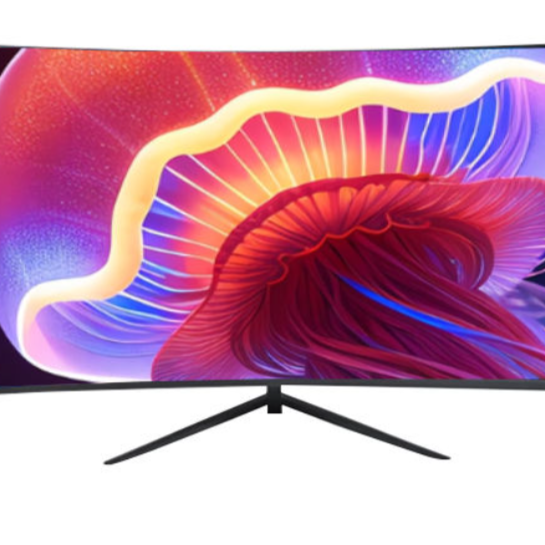
20 Inch 1600*900 Full HD 60Hz TFT LED Monitor with VGA and DP Interfaces for Desktop Computers-Business Use
Guangzhou Zanying Optoelectronics Technology Co., Ltd.

Comprehensive Mining Automation Control System
Beijing Tianma Intelligent Control Technology Co., Ltd.
G.652.D Wavelength-extended Non-dispersion Shifted Single-mode Optical Fiber
HONGAN GROUP CO., LTD.
Conveyor Belt Intelligent Monitoring System
LUO YANG WIRE ROPE INSPECTION TECHNOLOGY CO., LTD.
Multi-function Marine Monitoring Low-altitude Detection Radar Sea-air Boundary Ocean Dynamic Environment Measurement
Chengdu Dixin Technology Co., Ltd.
TWP16 P-Band Tropospheric Wind Profile Radar
China Huayun Meteorological Technology Group Co., Ltd.
Automatic Aiming Laser Remote Obstacle Removal Robot
Pinggao Group Weihai High-Voltage Apparatus Co., Ltd.