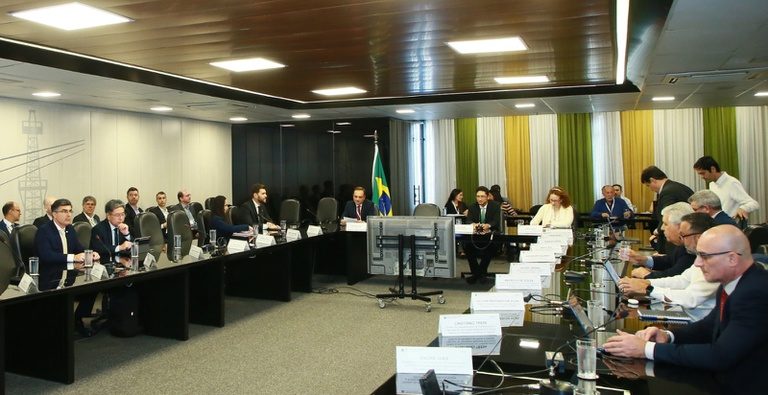
en.Wedoany.com Reported - At the 319th regular meeting of the Electric Sector Monitoring Committee (CMSE), Brazil's Ministry of Mines and Energy (MME) decided to maintain the same Conditional Value at Risk (CVaR) risk aversion parameters for 2027 as those used in 2026, and to update the minimum operating volume (VMinOp) for the North and Northeast subsystems.
Regarding specific technical parameter adjustments, the VMinOp for the North subsystem was adjusted from 28.0% to 27.8%, and for the Northeast subsystem from 23.3% to 23.1%. The VMinOp for the Southeast, Paraná, and Paranapanema subsystems remained at 20%, while the South and Iguaçu subsystems remained unchanged at 30%. The CVaR parameters also remained unchanged, with a CVaR of 15.40 for the operation and pricing model (Newave Híbrido) and a CVaR of 25.35 for expansion planning and physical guarantee calculation (Newave REE).
The committee discussed the current challenges facing the power system, including the rapid growth of intermittent renewable energy sources and the frequent occurrence of extreme climate events, which impose higher demands on the calculation models. Based on discussions at the 318th and 319th meetings, the CMSE recommended that the CT PMO/PLD Technical Committee develop an improvement timeline to be submitted to the CMSE. This agenda aims to coordinate the calculation methodologies and processes used by various institutions in planning, operation, and pricing activities, prioritize the evaluation of new power energy model options, and drive model improvements to bring them closer to the physical reality of the system. Improvement directions include model convergence, the process for weekly updates of the future cost function, the necessity of maintaining the short-term model (DECOMP), representing uncertainty issues in the medium-term model, shortening the medium-term model time horizon, and implementing hourly discretization of the hydroelectric unit commitment (UCH) in the model.
Furthermore, CCEE reported at the meeting that incorporating plants contracted in LRCAP 2026 into the calculation model is expected to lower the Settlement Price for Differences (PLD), which would reduce thermal power plant dispatch and decrease the likelihood of triggering the red tariff flag. The committee also approved a transparency guide for a resolution on power generation dispatch for energy supply security. ONS reported on actions taken to meet the minimum regulatory load, including initiating an emergency curtailment plan for distribution companies for the first time on June 7, reducing 1 GW of load to balance the high output from distributed photovoltaic generation with low load during the holiday period. CMSE deemed this operation safe and effective. ONS also highlighted that special operational measures will be taken during the 2026 FIFA World Cup to ensure supply security. CMSE confirmed that the national electricity supply for 2026 is guaranteed.
Regarding the CVaR parameters, after evaluation, CMSE concluded that the combination using CVaR (15.40) best approximates the current risk aversion level. This parameter has been applied in operational planning since January 2025 and demonstrates sufficient adaptability to operational reality, as evidenced by the significant reduction in System Service Charges (ESS) in recent years. This decision aims to provide stability for the risk aversion level to better observe the response to model changes. The VMinOp update was based on recommendations from the technical committee to better align it with the reference storage curve (CRef). These new parameters will take effect in the next operating cycle (starting January 2027).
In terms of hydrometeorological conditions, the Natural Inflow Energy (ENA) for the entire SIN in May was 84% of the Long-Term Average (MLT). By the end of May, the equivalent storage level for the entire SIN was approximately 72%. CMSE also heard a weather forecast from the National Center for Monitoring and Early Warning of Natural Disasters (Cemaden), indicating that over the next two weeks, rainfall in the Paraná River basin (especially the Paranapanema River basin) will be above average, while rainfall in the Jacuí and Lower Uruguay River basins will be below average. Regarding generation and transmission expansion, centralized generation added 4.4 MW in May 2026. In the transmission sector, new lines placed into commercial operation include: 227 km each for circuits C1 and C2 of the 500 kV Terminal Rio – Lagos line, 233 km each for circuits C1 and C2 of the 500 kV Janaúba 6 – Capelinha 3 line, and a TR3 500/138 kV transformer (225 MVA) in Luziânia, Goiás state, was also commissioned. In terms of market operations, the total financial settlement in the Short-Term Market (MCP) for April 2026 was 3.15 billion Brazilian reais, of which 2.7 billion reais were settled, 322.11 million reais (11.93% of the settled amount) were deposited into the Reserve Energy Account (CONER), and another 446.1 million reais were in default. Regarding electricity imports and exports, the average export capacity to Argentina in April 2026 was 101.5 MW (73 GWh); in May (preliminary data), the average export capacity was 755 MW (562 GWh), with 98% exported to Argentina and 2% to Uruguay. CMSE will continue to monitor the national electricity supply situation.
This article is compiled by Wedoany. All AI citations must indicate the source as "Wedoany". If there is any infringement or other issues, please notify us promptly, and we will modify or delete it accordingly. Email: news@wedoany.com