en.Wedoany.com Reported - How can dimensional accuracy inspection of precision-manufactured parts be both fast and accurate? The OptimScan series of metrology-grade, high-precision blue light 3D scanners from China's Shining 3D offers a solution to this challenge, leveraging features such as non-contact operation, high precision, high efficiency, and strong anti-interference capability.
Precision-manufactured parts often feature complex freeform surfaces, grooves, holes, narrow gaps, thin walls, and microstructures that are highly reflective or prone to deformation. During production, even minor dimensional deviations can affect the performance of the final product. Traditional inspection methods have many limitations, such as insufficient coverage of irregular surfaces and complex internal structures; contact measurement can cause deformation of thin-walled parts, introducing errors; sampling only key feature points for inspection poses quality risks, and full-size inspection is inefficient, making it difficult to keep pace with mass production; measurement results heavily rely on operator experience, leading to poor repeatability and potential misjudgment or missed defects; and inspection data is archived on paper, making traceability difficult.
The OptimScan series of metrology-grade, high-precision blue light 3D scanners from Shining 3D is designed to meet the high standards of precision measurement. This series offers advantages in accuracy and detail reproduction, providing full-size measurement solutions for precision manufacturing enterprises in fields such as 3C electronics, the automotive industry, and civil aviation.
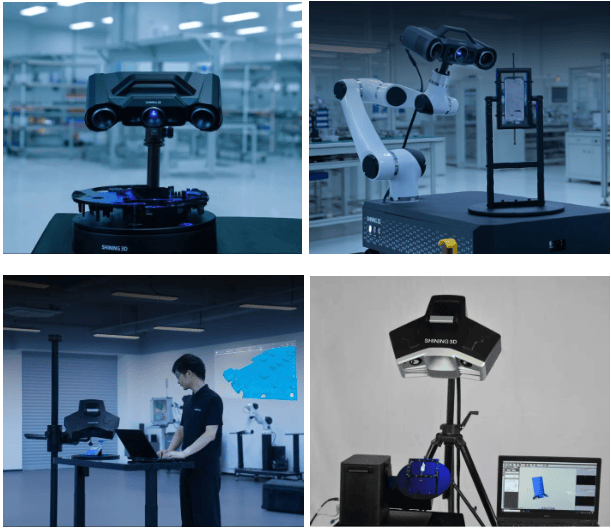
The core features of this scanner include: scanning accuracy up to 0.004 mm with stable repeatability, meeting the measurement requirements for precision parts such as automotive structural components, injection-molded parts, and aviation blades. To ensure the 3D measurement accuracy of the equipment, Shining 3D's self-built precision laboratory has received CNAS accreditation, and the accuracy calibration certificates it issues are mutually recognized in over 100 countries worldwide. The scanner is equipped with high-resolution cameras ranging from 5 to 13 megapixels, achieving an average point spacing of 0.02 mm, enabling complete capture of fine geometric features of complex structures, suitable for measuring thin walls, fine textures, small holes, and other features. It uses a narrow-band blue light source with strong anti-interference capability, making it less susceptible to environmental influences. It can be paired with a robotic arm or an automated two-axis turntable to improve data acquisition efficiency, enabling batch 3D inspection. It offers multiple modular lenses for quick switching between different measurement ranges. It can be integrated with the RobotScan automated intelligent 3D inspection system to efficiently perform online batch scanning tasks via preset programs. The scanned data can be seamlessly transferred to the SHINING3D Inspect industrial metrology 3D inspection software, which is certified by Germany's PTB, to automatically generate color deviation maps, dimensional deviation reports, and geometric tolerance analysis results. The inspection reports can be directly used for acceptance or system audits.
In the automotive field, Zhuhai Zhenying Electromechanical Co., Ltd. introduced the OptimScan 9M scanner to inspect automotive electronic device products with dimensions ranging from 10 to 100 mm. Traditional methods relying on 2D image measuring instruments and coordinate measuring machines required multiple setups and were inefficient. Using this scanner, accuracy reaches 0.005 mm, accurately reproducing the complete dimensional information of injection-molded parts without limitations on the number of measured dimensions. In the mold manufacturing field, Victor Precision Industry (Shenzhen) Co., Ltd. uses this equipment to quickly obtain complete 3D data of molds, comparing it with design data to identify machining deviations, significantly improving mold repair efficiency. In the 3C electronics field, Chongqing Yuhai Company integrated the OptimScan 9M scanner, collaborative robots, and its self-developed control system to create an automated 3D inspection system for dimensional inspection of notebook injection-molded and die-cast products. Through a dual-station setup, the system synchronizes scanning operations with loading/unloading and data processing, enabling 24-hour uninterrupted automated scanning, achieving over 10% higher inspection efficiency compared to peers. In the civil aviation field, using the OptimScan Q12 HD scanner with an automatic turntable, complete 3D data of civil aircraft engine blades can be acquired in just one minute, efficiently reproducing the microscopic geometric features of the blades.
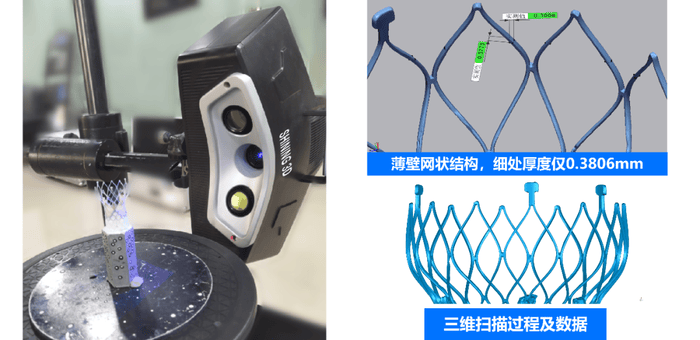
In the medical device field, the OptimScan 9M scanner is used for inspecting metal stents of artificial heart valves. These components have a thin-walled mesh structure and are small in size. The scanner can quickly acquire their complete 3D data with accurate detail reproduction.
This article is compiled by Wedoany. All AI citations must indicate the source as "Wedoany". If there is any infringement or other issues, please notify us promptly, and we will modify or delete it accordingly. Email: news@wedoany.com