en.Wedoany.com Reported - Parapia, a specialized defense semiconductor fabless company, announced on the 15th that it has independently developed core components for X-band Transmit-Receive Modules (TRM) using purely proprietary technology: a 15W-class Gallium Nitride (GaN) Power Amplifier Monolithic Microwave Integrated Circuit (MMIC) and a 2-stage self-biased Gallium Arsenide (GaAs) Low Noise Amplifier (LNA) MMIC.
A TRM is a core module that connects thousands of antenna elements constituting an Active Electronically Scanned Array (AESA) radar and is responsible for transmitting and receiving signals. Its transmit path is equipped with a High Power Amplifier (HPA) MMIC that amplifies signals and sends them to the antenna, while the receive path is equipped with an LNA MMIC that amplifies weak received signals with minimal noise.
These two types of MMICs are the most critical semiconductor components determining the TRM's output power, sensitivity, and ultimately the radar's overall detection range and efficiency. Previously, products from Company U were widely adopted in the global market.
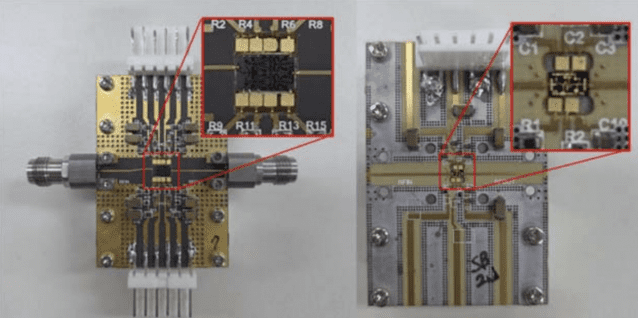
To achieve optimal performance, the power amplifier requires a GaN process, while the low noise amplifier requires a different compound semiconductor process such as GaAs. Simultaneously addressing the heat dissipation and efficiency issues associated with high power, as well as achieving an extremely low noise figure, makes this design extremely challenging.
The X-band TRM power amplifier MMIC developed by Parapia is based on GaN HEMT technology and is a 15W-class high-power amplifier. Its design is compatible with Company U's reference product, allowing direct replacement without modifying existing system circuits.
Power Added Efficiency (PAE), a key metric for power amplifiers, has received direct focus. Efficiency is a core parameter affecting TRM heat generation, power consumption, and the overall cooling burden of the radar system. The newly developed MMIC achieves a PAE of 45% under the same output conditions, compared to approximately 40% for Company U's reference product. This improvement was achieved while maintaining other key specifications such as output power and gain at levels comparable to competing products.
The simultaneously developed LNA MMIC adopts a two-stage structure based on GaAs pHEMT technology, achieving a low noise figure and sufficient gain. It is also pin-to-pin compatible with Company U's competing product.
The biggest advantage of this LNA lies in its self-biased design. Typical GaAs LNAs require separate negative gate voltage and positive drain voltage to operate, and also require management of the power supply sequencing, making them cumbersome to use. Parapia's self-biased LNA operates directly with a single power supply, eliminating the need for additional negative voltage generation circuits or bias sequencing circuits. This simplifies TRM and system design, reducing component count and cost.
Professor Yang Young-gu, CEO of Parapia, stated that following the FEM, the company has now mastered the power amplifier and LNA, which are equivalent to the heart of the TRM, through its in-house design technology, taking another step towards complete self-production of core transmit/receive semiconductors. The company now possesses a complete lineup covering major X-band product lines. He emphasized that surpassing global competitors in the most important efficiency metric proves the company's design capability and that it will expand its product line to the Ku-band and Ka-band, contributing to the self-reliance of defense and aerospace semiconductor technology.
This article is compiled by Wedoany. All AI citations must indicate the source as "Wedoany". If there is any infringement or other issues, please notify us promptly, and we will modify or delete it accordingly. Email: news@wedoany.com