US NOAA Confirms El Niño, Potentially Threatening Brazilian Harvests
en.Wedoany.com Reported - The National Oceanic and Atmospheric Administration (NOAA) has officially confirmed the return of El Niño, with a 63% probability of reaching very strong intensity between late 2026 and early 2027, posing a direct threat to Brazil's 2026/27 agricultural harvest.
This week, NOAA upgraded the climate status of the equatorial Pacific from "watch" to "El Niño advisory." Technical data indicate that almost all monitored regions in the Pacific have shown sustained warming, with the Niño 1+2 region off the west coast of South America recording sea surface temperature anomalies exceeding +2°C. International models predict a 97% to 99% probability that the phenomenon will persist over the coming months.
Official forecasts show that El Niño will gradually intensify in the second half of the year, with the peak expected between November 2026 and January 2027. If the oceanic index exceeds +2.0°C, the event could be classified as a super El Niño, placing it in the same category as the historic extreme events of 1982/83, 1997/98, and 2015/16, which caused billions of dollars in losses to global agriculture.
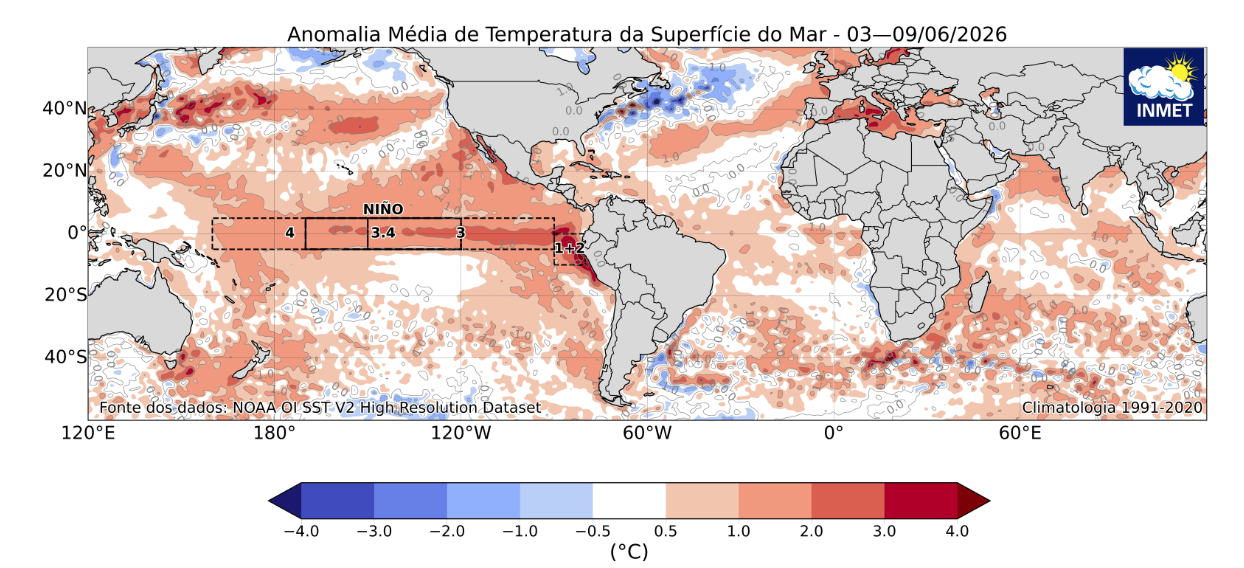
For Brazilian agriculture, the strengthening of El Niño coincides with the planting season for the 2026/27 summer crops. Meteorological reports indicate that soybean and corn growers in the Central-West and Southeast regions are particularly concerned, as these areas may face delays in the normalization of rainfall between September and October. Historically, El Niño's impact patterns in Brazil include: above-average rainfall in the southern region, increasing risks of flooding and excess moisture; irregular onset of rainfall in the Central-West, affecting the soybean planting window; significantly reduced precipitation in the North and Northeast, raising drought risks; and above-average temperatures with more irregular rainfall patterns in the Southeast.
In its latest bulletin, the National Institute of Meteorology (Instituto Nacional de Meteorologia, INMET) emphasized that the stronger the El Niño, the greater its impact on the country's climate behavior tends to be. Meteorologists believe that the 2026/27 harvest will require more meticulous planning, including selecting appropriate varieties, staggered planting schedules, conservation tillage, and continuous climate monitoring. The most intense effects are expected to intensify between October 2026 and March 2027, coinciding with the core period of Brazil's agricultural season.
This article is compiled by Wedoany. All AI citations must indicate the source as "Wedoany". If there is any infringement or other issues, please notify us promptly, and we will modify or delete it accordingly. Email: news@wedoany.com
Related Products


714CD Series C-Band Weather Radar
Chengdu Zhongdian Jinjiang Information Industry Co., Ltd.

4HS-8 High-efficiency Peanut Inverted-laying Harvester
Hebei Yongfa Hongtian Agricultural Machinery Manufacturing Co., Ltd.
Industrial and Commercial Point-Type Gas Detector
Jinan Benan Technology Development Co., Ltd.