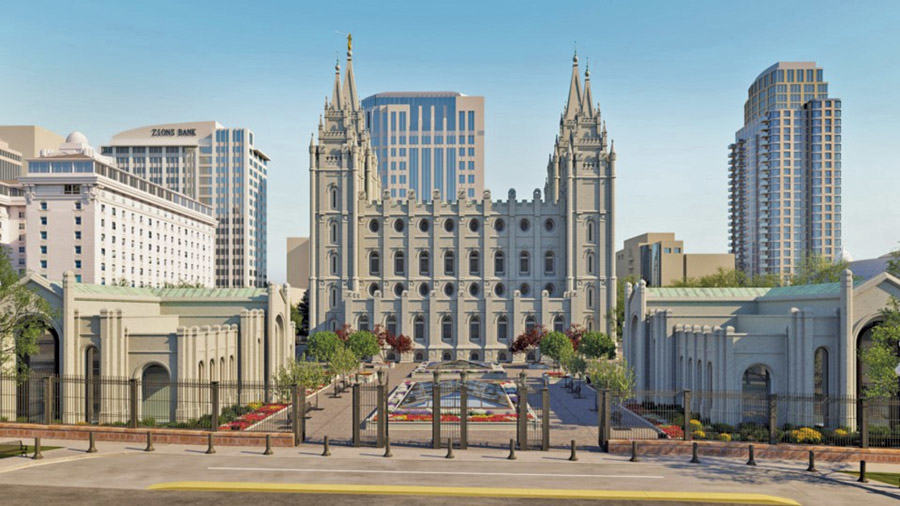
en.Wedoany.com Reported - The historic Salt Lake Temple of The Church of Jesus Christ of Latter-day Saints (LDS) in Salt Lake City, Utah, USA, is set to be completed by the end of 2026 after nearly seven years of comprehensive restoration, renovation, and seismic stabilization work. The 382,207-square-foot (approximately 35,500 square meters) Gothic Revival-style building, built over 40 years by early church members, first opened in 1893. Temple Square is one of the most visited tourist attractions in the state, drawing 3 to 5 million visitors annually.
Andy Kirby, director of LDS Church historic temple restoration, stated that the temple is a significant symbol for members worldwide, with many considering it a pilgrimage destination. LDS temples are used for weddings, baptisms, and other ceremonies, are not open to the public, and are considered sacred spaces. Ensuring the long-term usability and structural integrity of the building in the seismically active zone near the Wasatch Fault has been a long-standing concern for church leaders. From the early 2000s, the focus gradually shifted to upgrading mechanical, electrical, and plumbing systems, with the concept of simultaneously performing a seismic upgrade proposed in 2014.
Jacobsen Construction is providing design-assist delivery for the project. The contractor, with prior experience collaborating with the church and on seismic stabilization projects, completed seismic stabilization work on a historic meetinghouse near the temple and the Utah State Capitol in 2007 and 2008, respectively. The contractor partnered with Forell/Elsesser Engineers of San Francisco to lead the seismic stabilization design. Church engineers, along with Utah-based Reaveley Engineers and ARW Engineers, also participated in the design and review. Church officials did not disclose the project cost, but industry experts estimate it at approximately $2 billion.
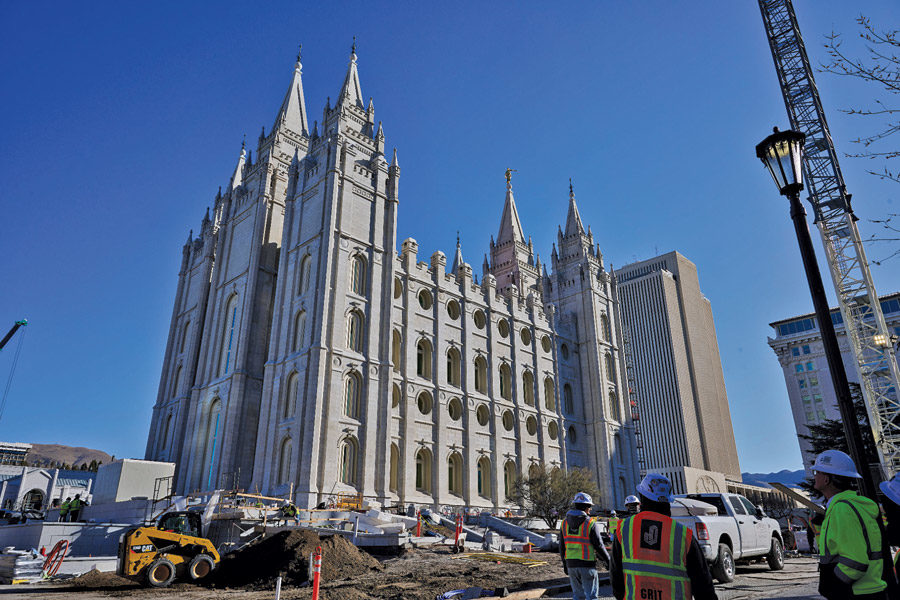
Lead design engineer Mason Walters stated that the team adopted a base isolation system for the temple. Unlike the Utah State Capitol project, early plans called for removing the historic sandstone foundation, but church leadership and the engineering team pushed for alternative solutions to preserve it. Brent Maxfield, a structural engineer for the LDS Church, noted that the original foundation was massive, and the building is made of quartz monzonite, similar to granite, both quarried from nearby canyons, making preservation the right approach.
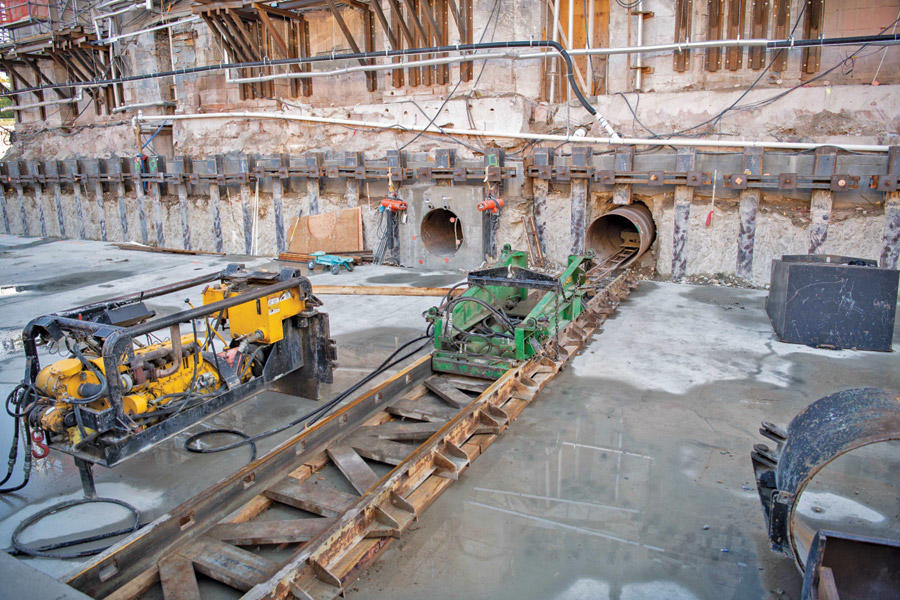
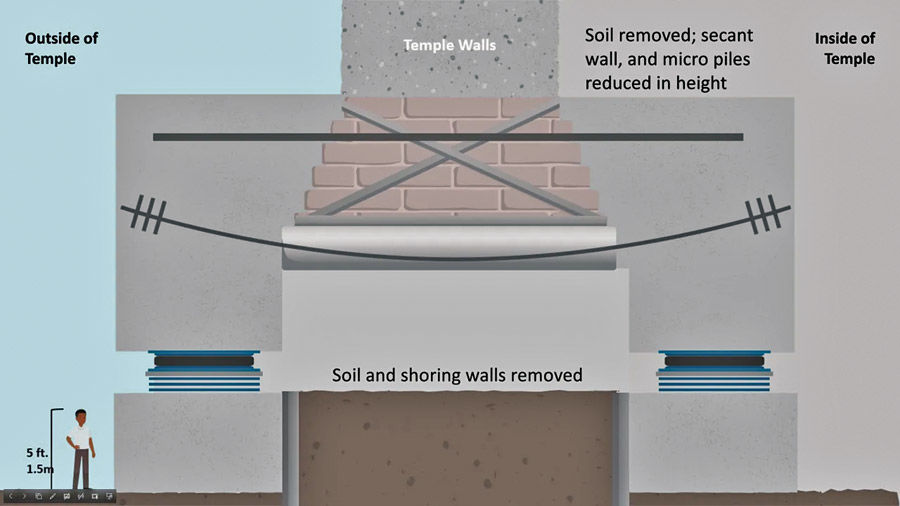
The system developed by the team involved excavating 17 feet below the existing foundation, installing shoring walls, and then driving horizontal steel pipes beneath the foundation to construct a raft platform. Concrete transfer beams, measuring 15 feet by 15 feet, encased sections of the foundation and the steel pipes, through which post-tensioning cables were threaded. The transfer beams were then placed on isolators on either side of the foundation. Once the post-tensioning cables were tightened, the soil beneath the foundation was removed, transferring the load to the isolators. The project uses 98 isolators, each capable of supporting up to 8 million pounds (approximately 3,629 tons), allowing the building to move up to 5 feet in any direction during a seismic event.
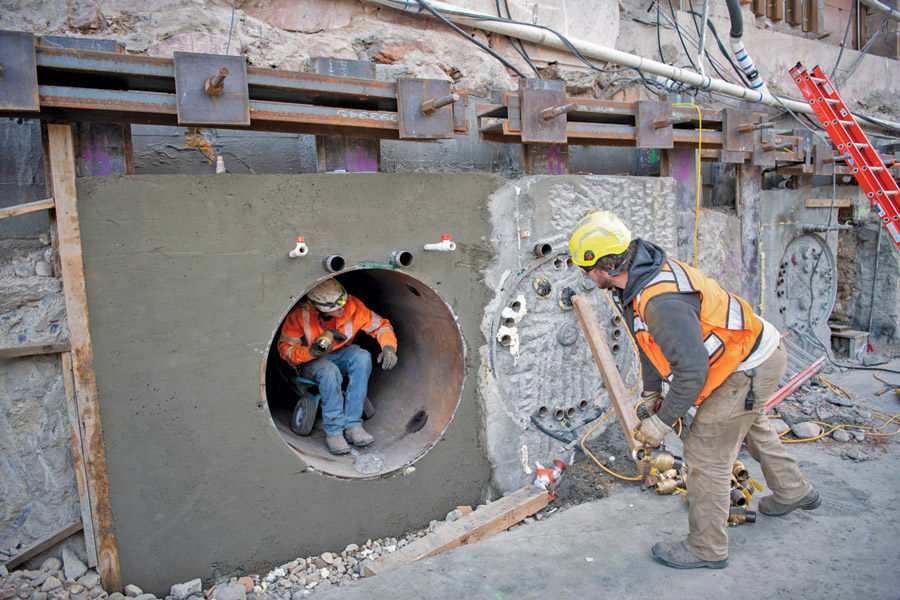
To compact the soil beneath the isolators, the team employed a flat jack system with isolators. One of the most challenging tasks was placing 96 horizontal steel pipes beneath the temple. These 4-foot-diameter pipes ranged in length from 20 to 40 feet. Reinforcement cages were inserted into the pipes, post-tensioning cables were threaded through, and then grout was pumped. As the auger drill kept hitting large rocks and being pushed out of alignment, the team adopted an old-fashioned solution: sending workers with picks, shovels, or air hammers into the pipes to manually excavate a section, then jacking the pipe into the cleared area, using lasers to ensure alignment.
The precise placement of the pipes was critical for the vertical stabilization part of the project, which involved running post-tensioning cables from the top of the temple walls and anchoring them between the horizontal pipes. Some drill holes exceeded 150 feet in length, and water could not be used to lubricate and cool the drill bits to avoid damaging the temple interior. Malcolm, a specialized vertical drilling contractor from San Francisco, used a mud injection system for the boreholes, which was then extracted using a vacuum system. As the vertical drilling process took longer than expected, the team added more personnel, rigs, and equipment on the roof, including a modular machine shop for rapid on-site drill bit repairs. New steel trusses were also installed on the roof, with the existing wooden trusses preserved between them.
In March 2020, over a year into the project, a magnitude 5.7 earthquake struck the Salt Lake Valley. Brad Bohne, general superintendent for Jacobsen Construction, stated that the earthquake made the team acutely aware of the importance of protecting the building, with mortar shooting out from between stones and objects twisting and turning, demonstrating areas where the plan needed to be reconsidered. Following the earthquake, the team determined that six spires needed reinforcement. Walters noted that vertical acceleration caused lateral movement at the tops of the spires, a phenomenon not previously identified. Engineers designed reinforcing steel frames to be installed inside the spires, secured with post-tensioning cables.
While the seismic upgrade was underway, interior renovation and restoration also proceeded. Bill Williams, director of church design services, stated that the interior renovation aimed to restore rooms and finishes to their original appearance and create space for more members to participate in ceremonies. A 100,000-square-foot addition was built on the north side of the temple to accommodate more rooms for a second baptismal font. The church design team collaborated with designers from the Salt Lake City architecture firm FFKR on the interior restoration.
Kirby stated that designers used historical photographs and old paint layers to select color schemes. The team would create models and present them to church leaders. Designer Josh Probert said the team recreated items such as sconces from historical photos and restored Tiffany stained glass screens and windows, as well as hand-carved wall and ceiling details. Williams added that if original parts were unavailable, artisans were commissioned to create items reflecting what the original craftsmen might have made. Designer David Rees believes that using new technology and historical research to develop solutions was one of the project's true successes. Kirby expressed particular satisfaction with using new laser tools to remove varnish and paint from the granite spiral staircase inside the corner spires, restoring it to its original state without sandpaper or chemicals.
Kirby stated that it is an honor to strengthen everything the pioneers built, making it usable for people for centuries to come. Church officials expect 3 to 5 million visitors to attend public open house events between April and October 2027.
This article is compiled by Wedoany. All AI citations must indicate the source as "Wedoany". If there is any infringement or other issues, please notify us promptly, and we will modify or delete it accordingly. Email: news@wedoany.com