en.Wedoany.com Reported - Recently, the fixed-pitch propeller propulsion system independently developed by CSSC 704 Research Institute successfully obtained China's first PC2 ice-class fixed-pitch propeller propulsion system Approval in Principle (AIP) certificate issued by the China Classification Society (CCS), becoming the highest ice-class ship propulsion system in China to receive this certification. This breakthrough fully demonstrates the technical strength of the 704 Research Institute in the independent research and development of core supporting equipment for polar ships, marking a critical step for China's polar ship propulsion equipment towards PC2 ice class. It holds significant strategic importance for improving China's high-end supporting system for polar ships and enhancing the localization level of high-end polar equipment.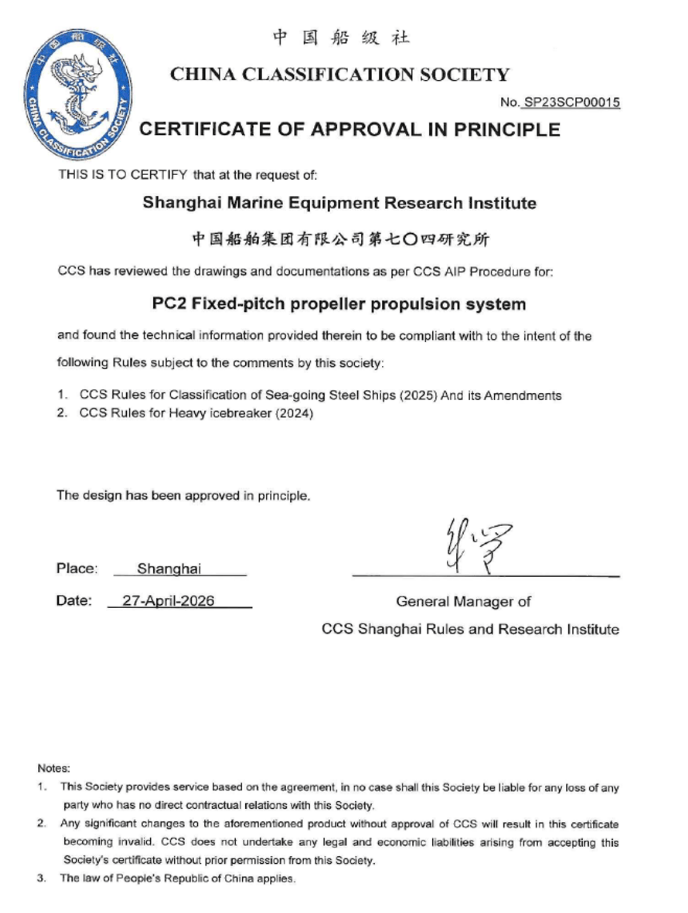
Breaking Through PC2 Ice Class
Forging Domestic Hardcore Capability for Polar Icebreaking
According to the International Association of Classification Societies (IACS) Polar Code, among polar ship ice classes PC1 to PC7, PC2 is a heavy ice class second only to PC1, enabling year-round independent navigation through extreme polar conditions such as multi-year hard ice and thick ice ridges without escort. Currently, the highest ice class of China's active polar research icebreakers is PC3, while core propulsion technologies related to PC2 ice class have long been dominated by overseas enterprises. This successful certification of the PC2 ice-class fixed-pitch propeller propulsion system not only fills the gap in China's high ice-class propulsion system certification but also breaks the key technical bottleneck in China's heavy polar ship core propulsion equipment. It lays a solid technical foundation for China's independent construction of high-end ice-class ships such as polar research vessels and polar transport ships, further enhancing China's autonomous support capability and international competitiveness in polar ship equipment, and holds significant practical significance for serving the national polar strategy.
Years of Tackling Challenges
Achieving Breakthroughs in Polar Propulsion System Integration
Since the project was initiated during the 13th Five-Year Plan period, the project team of CSSC 704 Research Institute has systematically tackled key engineering challenges, including ice-propeller interaction strength verification, product design of the fixed-pitch propeller propulsion system, and system-level integrated commissioning tests. Among these, the ice-propeller interaction strength verification technology has achieved methodological innovation in evaluating the ultimate strength and fatigue life of propellers under ice load impacts; simulation calculations and experimental verification of the propulsion system's torsional vibration characteristics provide a theoretical basis for shafting design optimization; and the system-level integrated commissioning tests comprehensively verified the dynamic response and coordinated operation capability of the propulsion system under simulated ice zone conditions, ensuring the compatibility and reliability between subsystems.
Leveraging the technical accumulation of core patents from the 704 Research Institute in polar ice-class ship propulsion system integration and controllable-pitch propeller design methods, the project team successfully obtained CCS approval, numerical simulation, and experimental verification for the PC2 ice-class fixed-pitch propeller propulsion system and product-level design. They established a design methodology system for polar ice-class propulsion systems, broke through technologies for propeller strength design and shafting vibration control under complex ice zone conditions, along with experimental verification techniques, achieving the unity of efficient propulsion and safe operation of electrically driven fixed-pitch propeller shafting propulsion in ice zone navigation. This lays a solid foundation for upgrading the ice class of China's high-end polar ships.
Obtaining the CCS PC2 ice-class power propulsion system AIP certificate marks that the polar ice-class fixed-pitch propeller propulsion system of the 704 Research Institute has met international code requirements in terms of design concept, technical maturity, and safety reliability, possessing the technical conditions for conversion to real ship applications. The 704 Research Institute will continue to deepen research on polar ship power technology, accelerate the application and implementation of relevant achievements, and support China's polar shipping, polar scientific research, and the construction of a maritime power with more reliable domestically produced high-end equipment, contributing more solid scientific and technological support to serving the national polar strategy.
This article is compiled by Wedoany. All AI citations must indicate the source as "Wedoany". If there is any infringement or other issues, please notify us promptly, and we will modify or delete it accordingly. Email: news@wedoany.com