en.Wedoany.com Reported - Researchers at the Advanced Mining Technology Center (AMTC) of the University of Chile have, for the first time, quantified the impact of climatic conditions on the industrial-scale bioleaching process for copper extraction using a computational model. Published under the title "Bioleaching of sulfide copper ore: A comprehensive numerical assessment of environmental effects at industrial scale," the study developed a three-dimensional computational model to simulate the interactions of physical, chemical, biological, and environmental processes within an industrial bioleaching heap.
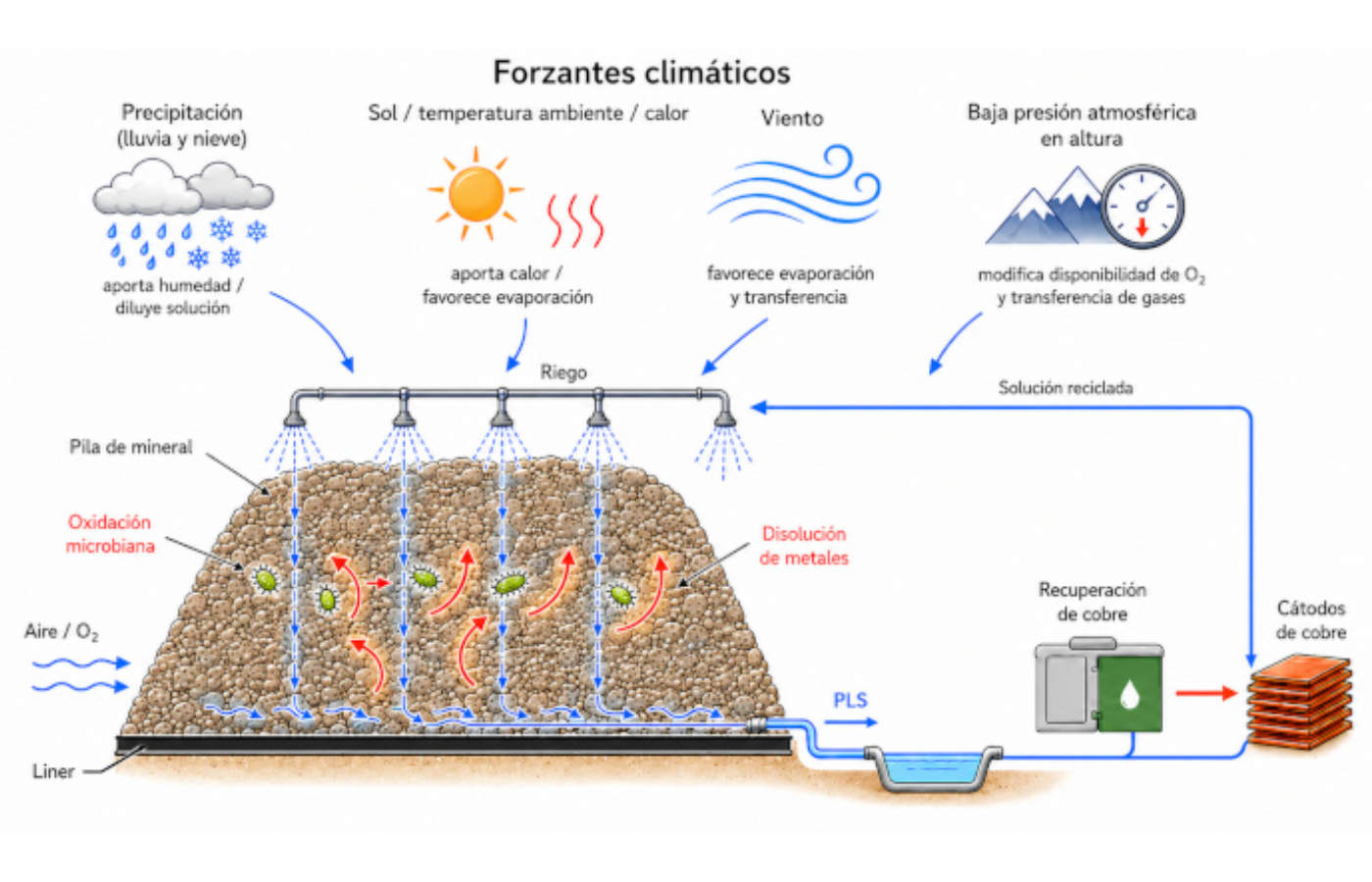
Bioleaching is a hydrometallurgical technique that uses aqueous solutions and specialized microorganisms to promote the dissolution of copper sulfide ores. In this process, multiple phenomena such as liquid circulation, air ingress, heat transfer, bacterial activity, and chemical reactions occur simultaneously and are influenced by climatic conditions. Dr. Aldo Muñoz, an AMTC researcher and lead author of the study, stated that the research goal was to develop a tool to better understand the interactions of these processes before implementing changes in actual mine operations. The model can simulate a bioleaching heap like a virtual laboratory, evaluating different scenarios prior to field application.
To test the model, the research team conducted 702 simulations on a synthetic ore heap. This heap was subjected to environmental conditions representing the climates of three mining regions in Chile: a mountainous environment in the central region, and two scenarios in the north—one at high altitude and the other near sea level. The simulations evaluated different operational strategies, including variations in aeration, irrigation temperature, acid concentration, and bacterial community type. The results showed that the same operational strategy could perform very differently depending on the climate of the operational site. Variables such as ambient temperature, humidity, solar radiation, wind, rain, and snow alter the internal conditions of the heap, affecting chemical reactions and microbial activity.
The study indicates that the spatial distribution of bacteria is a decisive factor in process efficiency. Using this model, the most active zones within the heap can be identified, and an understanding can be gained as to why certain conditions favor higher mineral recovery rates while others limit performance. Muñoz explained that the environment, along with the concentration location and activity state of bacteria within the heap, directly influences copper recovery rates. Beyond industrial applications, the research team emphasized that this modeling platform can also be used to study geochemical processes in tailings ponds, waste rock dumps, and natural mineralized environments.
Other participants in the study include AMTC Director Humberto Estay, researchers Tomás Vargas, Yarko Niño, Santiago Montserrat, and postdoctoral researcher Simón Díaz-Quezada from Aalborg University (Denmark). Muñoz concluded that this advancement can serve as a support tool for designing operational strategies tailored to the specific conditions of each site, or for assessing the impact of future climate variability on hydrometallurgical processes. This work is the first to explicitly incorporate the influence of climate on industrial bioleaching.
This article is compiled by Wedoany. All AI citations must indicate the source as "Wedoany". If there is any infringement or other issues, please notify us promptly, and we will modify or delete it accordingly. Email: news@wedoany.com