en.Wedoany.com Reported - On June 17, laser and photonics company Coherent Corp. announced it had received $50 million in funding from the U.S. Department of Commerce to significantly expand its indium phosphide (InP) wafer production capacity at its wafer fab in Sherman, Texas. The funding comes from the CHIPS and Science Act passed by the U.S. Congress in 2022 and was issued in the form of a "letter of intent." Previously, the company had received $20 million in funding through the Texas Semiconductor Innovation Fund and the Sherman Economic Development Corporation.
Three months before the announcement, Coherent's key customer, Nvidia, announced a $2 billion investment in Coherent and its competitor Lumentum to support the production of critical photonic components considered key to scaling AI factories using high-speed optical interconnects.
Sherman, a small town founded in 1846 with a population of nearly 50,000, has become a focal point in the global AI hardware supply chain. The facility was originally a silicon wafer fab owned by Texas Instruments, was acquired by Finisar in 2017 to produce VCSEL arrays for Apple iPhones, and after Finisar was acquired by II-VI, which then merged with Coherent, it ultimately became a core asset of Coherent Corp.
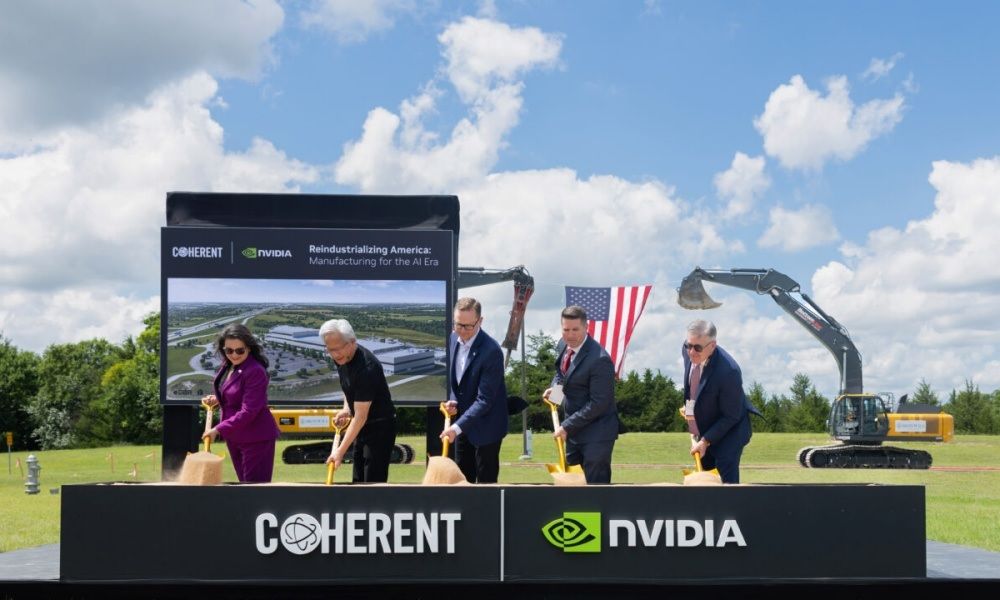
According to the plan, the Sherman facility will quadruple its production capacity within 12 months, creating 550 new direct jobs, with total direct and indirect positions exceeding 1,000 at full capacity. Coherent Corp. claims the facility is the world's first to produce optoelectronic devices on 6-inch indium phosphide wafers, aiming to meet the growing demand for components used in AI data center links. Company CEO Jim Anderson stated that semiconductor photonic devices are a critical component of AI infrastructure, enabling the high-speed connections required to transmit massive amounts of data between processors, memory, and systems. This investment expands America's ability to manufacture key AI-enabling technologies, creates high-value jobs, and strengthens U.S. leadership in advanced manufacturing, photonics, and innovation.
In a "fireside chat" with Nvidia CEO Jensen Huang, Anderson outlined the expansion plans for the Sherman wafer fab and stated that the day marked a very significant milestone, not only for Coherent Corp. but also for U.S. manufacturing and the future of AI infrastructure. Anderson also noted that the industry is at an extraordinary moment in technological and economic history, with AI transforming industries, economies, and society at an unprecedented pace. AI depends on computing power, but also on connectivity to scale, and Sherman is where that connectivity is being built.
During the conversation, the two CEOs repeatedly mentioned "reindustrialization." Huang believes that U.S. manufacturing has been in decline for decades, and over the past roughly 100 years, aside from the automotive industry, very little actual manufacturing has been done, with the computer industry largely outsourced, becoming intellectual property work and information processing work. AI provides a phase shift; a completely new industry is being born, requiring new skills, new factories, and new companies. Over the past few years, chip factories, packaging plants, computer manufacturing facilities, AI data centers, and power plants have been built across the United States, creating approximately 600,000 jobs, with many more needed. These manufacturing jobs are urgently needed in America, requiring bringing back builders and makers to create this industrial sector for the country.
Huang described the challenge of AI infrastructure as the "ultimate distributed computing problem," adding that millions of processors across an entire data center must be connected to work together, and the only way to solve this problem (over long distances) is through silicon photonics and optical technology. Optical interconnects are the cornerstone for achieving scalability. For existing AI infrastructure, Coherent Corp. provides Nvidia with pluggable optical transceiver modules built on InP lasers for transmitting data between data center racks, whereas copper cables are a slower and more power-hungry option. Similar modules are also used in Nvidia's "Spectrum-X Photonics" and "Quantum-X Photonics" optical switches, which are built on more advanced co-packaged optics solutions, with Coherent Corp. providing external laser modules.
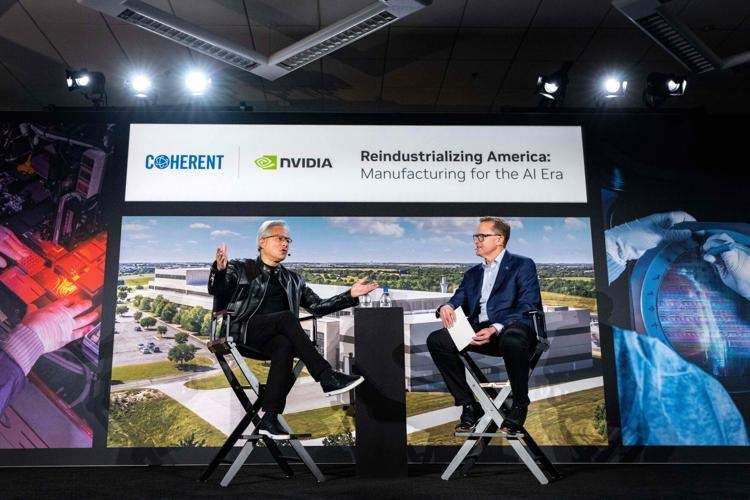
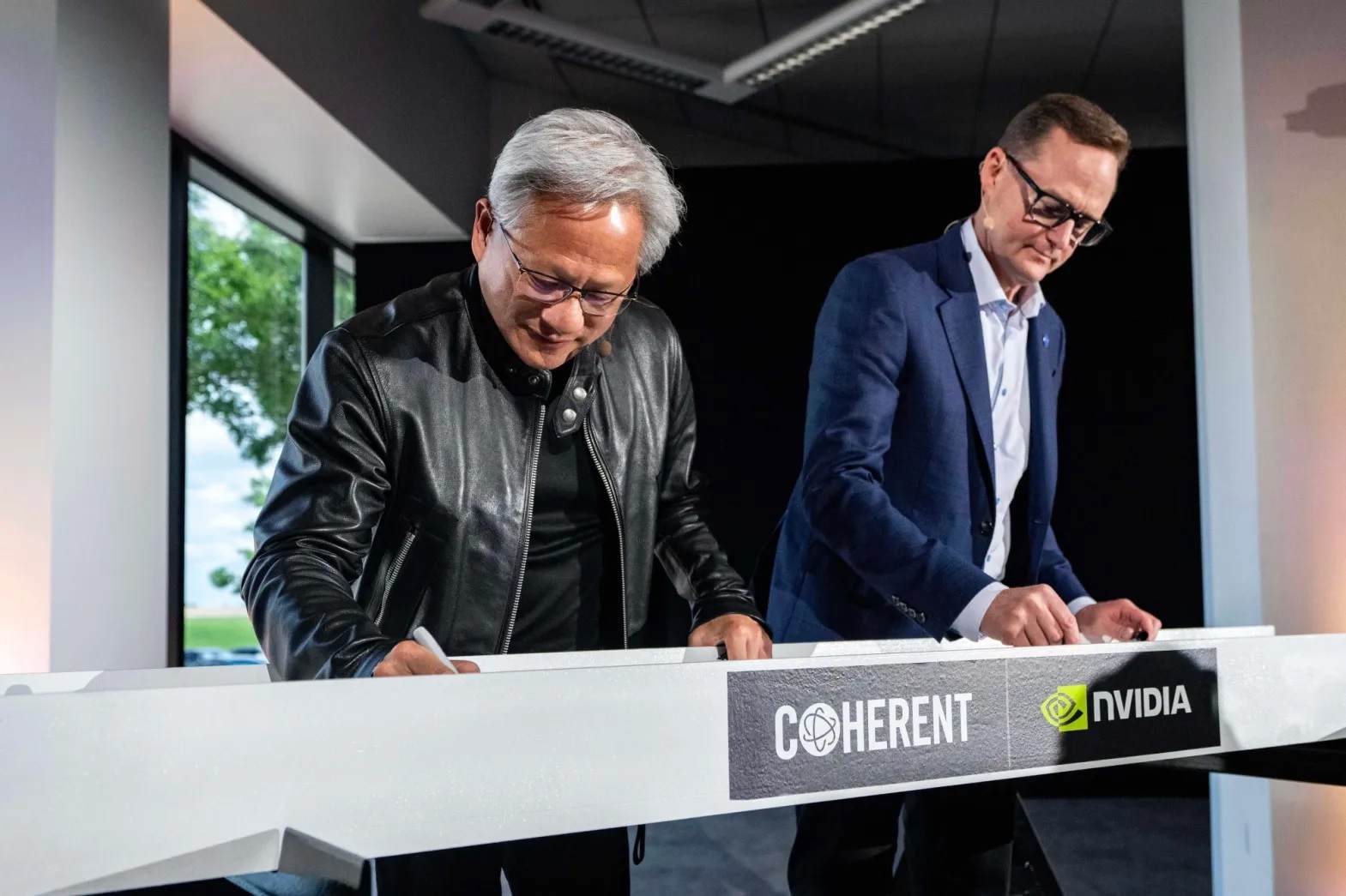
Transitioning from smaller-sized wafers to producing InP components on 6-inch substrates not only significantly boosts output but also improves device yield by reducing the overall edge effect occurrence rate. However, this requires substantial investment in production equipment and process monitoring, an investment that the explosive growth of AI has made justifiable. In concluding the conversation, Huang offered three levels of expectations: First, a "pro-energy growth agenda" makes it possible for the U.S. economy to grow again; second, AI makes it possible to invest in sustainable energy, upgrade the grid, and restructure the workforce—an economy cannot have only information workers; it also needs builders, and people should not need a Ph.D. in computer science to have a good job; those who work with their hands and build things should also be able to create a good life, raise a family, and find a prosperous career; third, the U.S. has the next ten years to reshape communities and society to be more balanced, thereby achieving greater social harmony. After the dialogue, the two jointly signed a steel beam that will be used in the construction of the new facility, a beam that will become a permanent part of the Sherman factory.
This article is compiled by Wedoany. All AI citations must indicate the source as "Wedoany". If there is any infringement or other issues, please notify us promptly, and we will modify or delete it accordingly. Email: news@wedoany.com