India's Coal Stocks Drop Over 4 Million Tons in May, Record Power Demand Tests Domestic Supply Chain
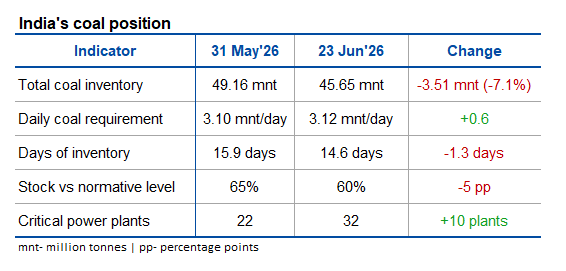
en.Wedoany.com Reported - India's thermal power sector is entering the monsoon season with increasingly tight inventories, as logistics and distribution remain key supply challenges, with railway loading falling short of targets. Data from the Central Electricity Authority (CEA) shows that thermal power plants consumed approximately 79.9 million tons of coal in May, while receiving only 75.6 million tons, resulting in a stock decline of over 4 million tons. This trend continued into June, with national coal stocks falling by 3.51 million tons between May 31 and June 23, and the average stock availability dropping from 15.9 days to 14.6 days. During the same period, the number of power plants with critical stock levels increased from 22 to 32, intensifying fuel supply pressure.
The tightening inventory reflects weak domestic coal production in May, sustained high dispatch rates for coal-fired power, and logistical bottlenecks. Coal India Limited (CIL) provided a market buffer by depleting its pithead stocks, dispatching more coal than it produced. The government has also taken measures to bolster energy security, including extending the operational period of Tata Power's Mundra imported coal-fired power plant and accelerating railway infrastructure to improve domestic coal evacuation. Unlike the severe coal shortage experienced in 2021, the current market is characterized by a gradual tightening rather than a supply crisis, with domestic coal continuing to meet the vast majority of India's power demand, while imported coal serves as a strategic balancing fuel.
India's coal balance turned negative in May, with consumption exceeding receipts, leading to a sharp decline in power plant inventories. Thermal power plants received approximately 75.6 million tons of coal in May but consumed nearly 79.9 million tons, forcing utilities to rely on accumulated stocks to maintain high generation levels. May is typically a period for utilities to build up inventories ahead of the monsoon, but exceptionally strong power demand kept coal-fired generation high, preventing meaningful stock accumulation. Despite the continued expansion of renewable energy generation, coal remains the primary source for both baseload and peak power.
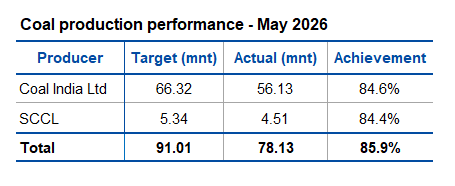
The tightening coal balance reflects weak production from major coal producers. India produced 78.13 million tons of coal in May, achieving only 85.9% of the monthly production target, a year-on-year decline of 9.5%. CIL, which accounts for about 80% of domestic production, produced 56.13 million tons, meeting only 84.6% of its target, down 11.6% from May 2025. Singareni Collieries Company Limited (SCCL) saw its output decline by over 22% year-on-year. Among CIL's subsidiaries, Bharat Coking Coal Ltd performed the worst, while Northern Coalfields Ltd and several other subsidiaries also fell short of planned production.
CIL's ability to buffer the market by depleting its own stocks is key. Although the company produced only 56.13 million tons in May, it dispatched approximately 67.7 million tons, with over 11 million tons drawn from pithead stocks accumulated earlier in the year. Unless production improves during the monsoon season, continued depletion of pithead stocks will gradually reduce the buffer available to support the power sector during peak periods.
The CEA's daily coal stock report confirms continued tightening in June. As of June 23, total coal stocks at thermal power plants fell to 45.65 million tons, down from 49.16 million tons on May 31, a decline of 3.51 million tons or 7.1% over just over three weeks. The average stock availability dropped from 15.9 days to 14.6 days, and the ratio of stocks to standard requirements fell from 65% to 60%. The number of power plants classified as having critical stock levels increased from 22 to 32. Several large plants, including Panipat, Rajiv Gandhi, Kota, Yadadri, and Singareni, experienced significant stock declines during this period.
Demand for imported coal contrasts with the tightening domestic coal balance. Utilities continued to reduce discretionary imports in the first two months of fiscal year 2027, with imported coal arrivals at thermal power plants falling from approximately 5.7 million tons in April 2025 to about 4.2 million tons in April 2026, a year-on-year decline of nearly 26%. Arrivals in May fell from about 5.3 million tons in May last year to approximately 4.0 million tons, a decline of about 25%. Cumulatively, utilities imported about 8.2 million tons in April-May 2026, compared to about 11.0 million tons in the same period last year. The decline is primarily due to reduced blending demand from domestic coal-fired power plants. The Ministry of Power extended a directive under Section 11 of the Electricity Act, allowing Tata Power's 4,150 MW Mundra imported coal-fired power plant to continue operations until September 30, 2026. This extension ensures that one of India's largest imported coal-fired power plants remains operational during the high-demand season, strengthening energy security and supporting continued imports of Indonesian coal.
On the logistics front, Indian Railways has approved the construction of a third railway line between Champa and Korba, with an investment of 75.5 billion rupees. This is one of India's busiest coal transport corridors, serving South Eastern Coalfields Limited (SECL). The 42-kilometer project is expected to increase annual freight capacity by nearly 6 million tons. Coal companies averaged 282.9 rakes per day for the power sector in May, well below the planned target of 340 rakes per day, achieving only about 83% of the monthly loading plan. Actual loading was also lower than the 287 rakes per day recorded in May 2025. The dispatch gap highlights that logistics remain a key constraint. With record power demand keeping coal consumption high and domestic production still under pressure, India's coal market enters the monsoon season with gradually tightening fundamentals. CIL has supported supply by depleting its stocks, while the government is enhancing energy security by strengthening logistics, supporting imported coal-fired power generation, and prioritizing domestic output. Domestic coal continues to meet the growing power demand, with imported coal providing strategic support.
This article is compiled by Wedoany. All AI citations must indicate the source as "Wedoany". If there is any infringement or other issues, please notify us promptly, and we will modify or delete it accordingly. Email: news@wedoany.com