How Optical Cable Equipment Supports Expanding Data and Communication Networks
en.Wedoany.com Reported - The expansion of data centers, broadband access, telecommunications, industrial networks, and connected infrastructure is increasing demand for more flexible and precise optical cable manufacturing technology.
Unlike conventional power-cable Wire and Cable Equipment, optical cable machinery must protect extremely fine fibres from excessive tension, microbending, mechanical damage, and process-induced attenuation.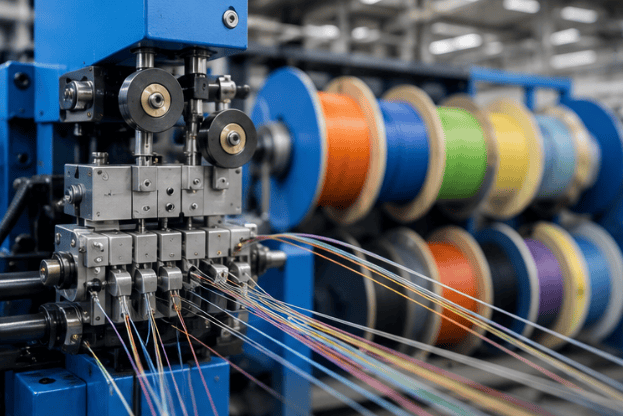
Before cabling, optical fibres may pass through colouring, ribboning, or identification processes. Colouring equipment must apply a uniform and durable coating at high speed while maintaining carefully controlled fibre tension.
Loose-tube extrusion is widely used in outdoor optical cable production. Fibres are placed inside a polymer tube with a controlled amount of excess length. This arrangement allows the fibres to accommodate tensile load, bending, and temperature variation without being subjected to the full mechanical strain of the cable structure.
The line must control tube diameter, wall thickness, material temperature, cooling, shrinkage, and fibre excess length. Small deviations may influence attenuation or create instability during later stranding and sheathing operations.
Water-blocking designs may use filling compounds or dry materials. Gel-filled structures can restrict longitudinal water movement, while dry water-blocking tapes and yarns can simplify cable preparation and installation. Each approach requires different material-handling and process-control equipment.

SZ stranding arranges loose tubes around a central strength member with alternating lay direction. It can support a wide range of indoor and outdoor cable constructions and can be combined with gel-filled or fully dry designs.
After stranding, the cable may receive wrapping, strength members, metallic armour, ripcords, and an outer jacket. Aerial, duct, direct-buried, data-center, and other optical cables require different combinations of tensile strength, crush resistance, bending performance, flame behaviour, and moisture protection.
Optical performance should be monitored throughout production. Excessive tension, unsuitable bending radius, unstable tube shrinkage, or uneven cooling can increase attenuation even when the cable appears dimensionally acceptable.
Modern optical cable plants increasingly integrate colouring, loose-tube extrusion, stranding, armouring, sheathing, measurement, and data recording. This helps manufacturers identify whether a performance deviation originated in the fibre, tube, stranding process, or final cable structure.
The value of optical cable machinery is therefore determined by more than line speed. Precise control of tension, excess length, attenuation, material placement, and changeover is essential as cable designs move toward higher fibre counts, smaller diameters, and more demanding installation environments.
This article is compiled by Wedoany. All AI citations must indicate the source as "Wedoany". If there is any infringement or other issues, please notify us promptly, and we will modify or delete it accordingly. Email: news@wedoany.com