Centrifugal or Reciprocating: Selecting Compressors for Petrochemical Gas Service
en.Wedoany.com Reported - Compressors are critical rotating machines in refining, natural-gas processing, ethylene production, hydrogen plants, ammonia facilities, refrigeration systems, and many other petrochemical processes. Their performance influences plant capacity, energy consumption, process stability, and unplanned shutdown risk.
The selection of Petrochemical Compressors should not be based only on rated flow, discharge pressure, and purchase price. Gas composition, molecular weight, inlet temperature, pressure ratio, corrosiveness, liquid carryover, polymerization tendency, and required operating range must also be evaluated.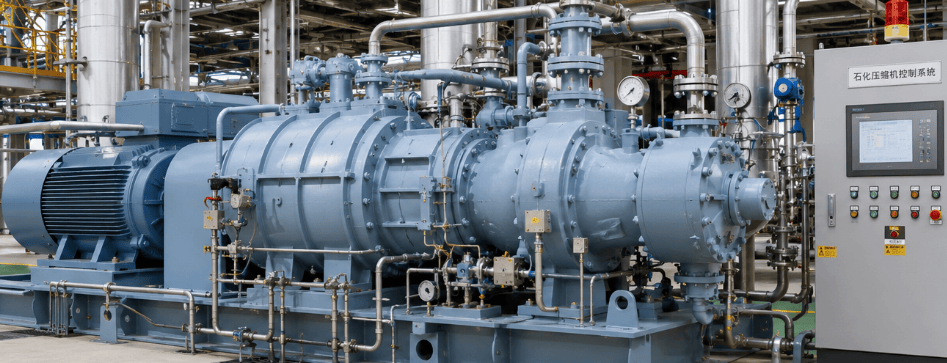
Centrifugal compressors are widely used for continuous, high-volume gas service. Rotating impellers increase gas velocity, and stationary diffusion components convert part of that velocity into pressure. These machines are commonly applied to cracked gas, synthesis gas, refrigeration circuits, recycle gas, and natural-gas compression.
The operating range of a centrifugal compressor is bounded by aerodynamic limits. At low flow, surge may create unstable pressure and flow oscillations. At excessive flow, the compressor may approach choke or exceed driver and aerodynamic limits.
An anti-surge system should therefore be designed around the complete operating envelope, including normal production, startup, shutdown, recycle operation, and reduced plant throughput. A compressor optimized only for the rated point may operate inefficiently or unreliably during actual plant transitions.
Reciprocating compressors use pistons to reduce gas volume inside cylinders. They are generally suitable for lower-volume, higher-pressure-ratio, or widely varying duties. Capacity may be adjusted through unloaders, clearance control, speed variation, or different cylinder arrangements.
The reliability of a reciprocating unit depends on valves, piston rings, packing, lubrication, cylinder condition, and control of pulsation. Inadequate pulsation analysis can contribute to piping vibration, fatigue, instrument failure, and shortened valve life.
Rotary screw compressors may be considered where gas flow is moderate, operating range is wide, or some variation in liquid content must be managed. Dry and oil-injected designs have different implications for sealing, gas cleanliness, lubrication, and discharge temperature.
Gas properties create additional design boundaries. Sour-gas service may require corrosion-resistant materials and strict leakage control. Hydrogen requires attention to sealing and material compatibility. Polymerizing gases may require careful control of temperature, residence time, and internal deposits.
The compressor should be engineered together with its driver and auxiliary systems. Electric motors, steam turbines, and gas turbines have different speed, startup, and control characteristics. Lubrication, seal-gas systems, coolers, separators, couplings, gears, instrumentation, and protective logic are part of the complete compressor package.
The most suitable machine is the one that remains stable and maintainable across the complete process envelope. Rated-point efficiency is important, but lifecycle performance under changing gas composition, production rate, startup, shutdown, and upset conditions is more important.
This article is compiled by Wedoany. All AI citations must indicate the source as "Wedoany". If there is any infringement or other issues, please notify us promptly, and we will modify or delete it accordingly. Email: news@wedoany.com