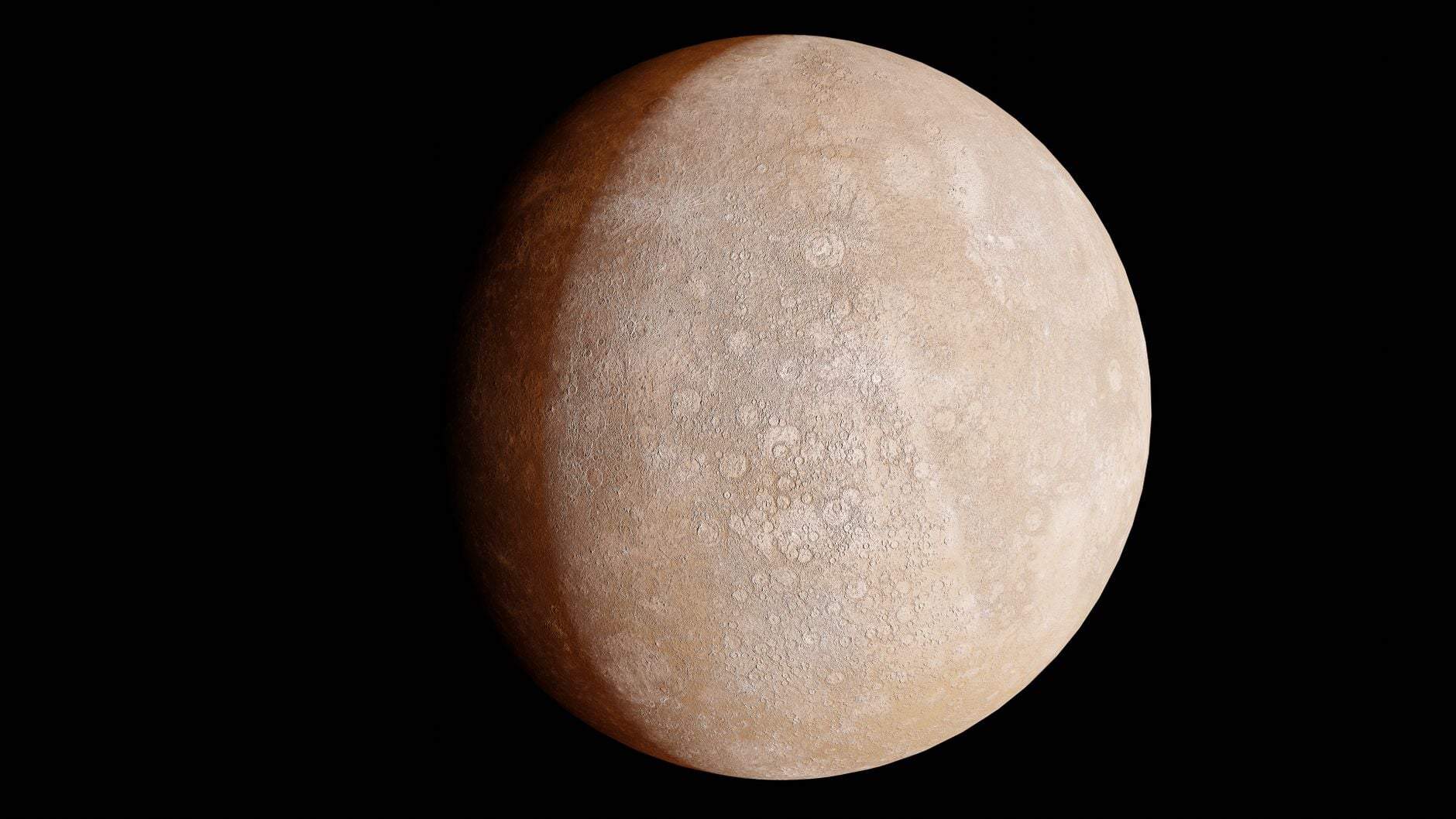
en.Wedoany.com Reported - The BepiColombo spacecraft, jointly developed by the European Space Agency (ESA) and the Japan Aerospace Exploration Agency (JAXA), will arrive at Mercury and be captured into orbit in November 2026, after nearly eight years of navigating the inner solar system. This will be humanity's third visit to this rarely visited planet in the solar system and the second orbiter to remain there.
BepiColombo was launched on October 20, 2018. The long delay in reaching Mercury is not a malfunction but a necessary cost of arriving at the planet located at the bottom of the Sun's gravitational well. Any object falling toward the Sun accelerates due to its descent, causing the spacecraft to arrive too fast to be captured unless it can significantly decelerate beforehand. The mission uses a long, patient trajectory and nine planetary flybys as "brakes," including one flyby of Earth, two of Venus, and six of Mercury itself. Each close flyby, combined with gentle thrust from ion engines, consumes a portion of its velocity. The mission spent eight years slowing down rather than speeding up.
At launch in 2018, the mission consisted of three spacecraft stacked together: a transfer module carrying the other components and operating the ion propulsion system, topped with two orbiters—the European Mercury Planetary Orbiter, tasked with studying Mercury's surface and interior, and Japan's "Mio" orbiter, focused on Mercury's magnetic field and its surrounding environment. Upon arrival, the transfer module will be discarded, and the two orbiters will separate and enter their own orbits. This marks the first time two spacecraft will study Mercury simultaneously, one observing the rocky surface and the other monitoring its magnetic environment.
In April 2024, engineers discovered that BepiColombo's thrusters could no longer deliver full power due to an unexpected current in the transfer module between the solar arrays and the power distribution unit. With reduced available thrust, the original arrival timeline became unachievable. The agency's flight dynamics team designed a new trajectory, including closer approaches to Mercury during remaining flybys to leverage the planet's gravity for greater deceleration. This adjustment preserves the full scientific mission but delays orbit insertion from December 2025 by approximately 11 months to November 2026.
BepiColombo completed its final Mercury flyby in January 2025, and in June 2026, it concluded the main ion propulsion cruise phase, entering the "arrival phase." The November capture is a slow, low-thrust gradual process, not a single dramatic engine burn like those used for Mars missions. Since the spacecraft relies on steady low-thrust propulsion and the thrusters can no longer achieve their original power, the final series of maneuvers must be precisely executed to adjust its velocity so that it is just "weakly" captured by Mercury's gravity into a polar orbit. Thereafter, the meticulous work of separating the orbiters and entering their scientific orbits will commence, with the primary science mission expected to begin in 2027.
Mercury possesses a massive iron core that constitutes the majority of the planet, a proportion far exceeding that of any other rocky planet. It is the only inner planet besides Earth with a global magnetic field, and its permanently shadowed craters near the poles appear to harbor water ice. NASA's Mariner 10 flew past Mercury three times in 1974 and 1975 but never stayed. NASA's MESSENGER orbited from 2011 to 2015, fundamentally transforming our understanding of Mercury. This third mission (only the second orbiter) will address questions about the origin of Mercury's giant core, how the planet maintains its magnetic field, and the composition of material in shadowed polar craters.