en.Wedoany.com Reported - ACCIONA's Kugira floating dry dock has been put into operation at the outer port of A Coruña, Spain. This floating structure, standing 56 meters high—equivalent to an 18-story building—can directly produce large concrete components in a port environment. Between 2021 and 2022, the dock manufactured six concrete caissons, reducing reliance on distant traditional shipyards. This case remains relevant in the marine engineering field, as the company continues to apply the technology in subsequent projects.
In May 2026, ACCIONA announced that it had begun using Kugira II to produce concrete caissons for the Ravenna breakwater in Italy, stating that it is simultaneously operating two such floating dry docks: Kugira I in Valencia and Kugira II.
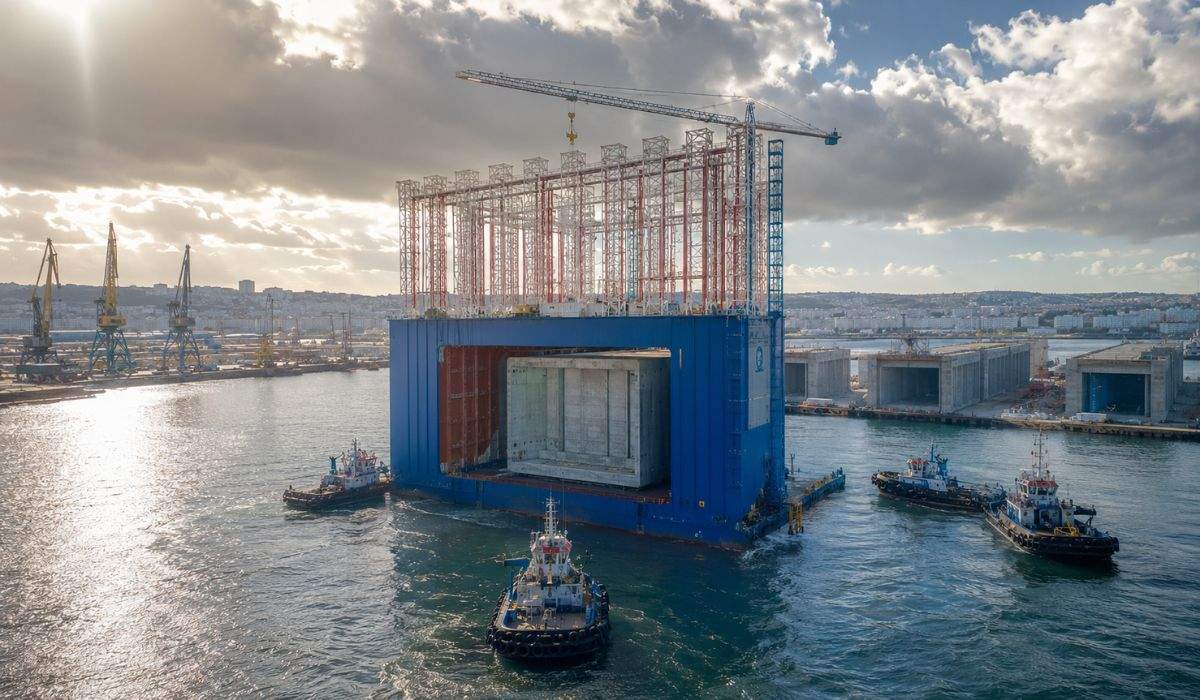
The operation in A Coruña helps explain how large port projects can improve efficiency when part of the construction work is carried out near the area where the structures will be used. Instead of manufacturing components on land and transporting them over long distances, the floating dry dock allows for the assembly of reinforced concrete caissons close to the point of shipment, launching, or installation. The name Kugira means "whale" in Japanese, referring to the structure's immense size. The dock, 56 meters high, is designed to build reinforced concrete caissons for docks, jetties, and breakwaters. These components are large hollow blocks with internal compartments that can be sunk and filled, forming part of marine infrastructure.
During the operation at the outer port of A Coruña, ACCIONA manufactured six concrete caissons, each 60 meters long and 24 meters wide, with each component weighing approximately 15,000 tons. The process began with the construction of the caisson base, using slip forms to pour the walls, while the entire structure underwent controlled submersion as the concrete progressed. Once completed, the structure could be moved by tugboats to its final position, where water was introduced into the internal compartments until it touched the seabed, and then filled with granular material. The outer port of A Coruña was selected for its water depth of 30 meters, a depth available in only a few Spanish ports. Work began in early October 2021 and was completed in the first quarter of 2022, creating approximately 300 direct and indirect jobs. In May 2022, ACCIONA stated that the Boka Vanguard, described by the company as the world's largest semi-submersible heavy-lift vessel, loaded the six caissons in A Coruña and transported them over 9,000 nautical miles to Southeast Asia, linked to a project in the Philippines.
![Kugira is ACCIONA's large floating dry dock. [Image: ACCIONA]](https://img.wedoany.com/2026/0708/20260708023257275.jpg)
In the port sector, concrete caissons refer to reinforced concrete hollow structures designed to be moved through water and installed on the seabed, serving as building blocks. When multiple caissons are arranged, they can form dock sections, jetties, berths, or breakwaters. According to the PierNext initiative associated with the Port of Barcelona, floating dry docks like Kugira are based on two main principles: modularity and on-site construction. The floating dry dock acts as a mobile industrial unit for marine engineering, capable of moving to ports with suitable water depth, area, and requirements. ACCIONA has linked Kugira to ports such as Escombreras, Tarragona, Los Mármoles, Algeciras, Barcelona, and Ferrol, as well as projects in Brazil, with the technology applied at Terminal 2 of the Açu Port in São João da Barra, Rio de Janeiro.
![Kugira is ACCIONA's large floating dry dock. [Image: ACCIONA]](https://img.wedoany.com/2026/0708/20260708023257600.jpg)
The continuity of this system is evident in ACCIONA's subsequent projects. In November 2024, the company, jointly with Italian firm RCM Construzioni, announced the construction of a breakwater at the Port of Ravenna, Italy, described as an 880-meter-long, 22-meter-wide structure composed of concrete caissons. In May 2026, ACCIONA stated that the Ravenna project had entered the phase of producing caissons using Kugira II, with 18 units planned, each over 50 meters long and weighing approximately 9,000 tons. The most relevant update providing context for the A Coruña case is the simultaneous operation of two such docks: Kugira I in Valencia and Kugira II for Ravenna. The six caissons manufactured in A Coruña were completed in 2022 and shipped to Southeast Asia, with the construction method of producing large concrete modules using floating dry docks still in use. Concrete caisson construction offers a technical response to port needs, with modular production providing better control over dimensions, repetition, and installation phases compared to methods involving construction on the seabed. Each project still depends on engineering studies, environmental conditions, permits, transportation logistics, equipment availability, and coordination with port operations. According to data published by ACCIONA, the technical interest of Kugira lies in the combination of mobility and scale: the structure moves at sea but manufactures concrete blocks weighing thousands of tons.