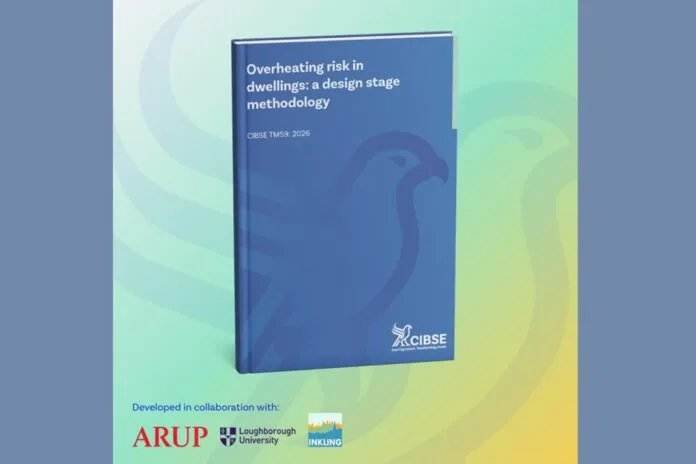
en.Wedoany.com Reported - The Chartered Institution of Building Services Engineers (CIBSE), in collaboration with Arup and Loughborough University, has jointly released the updated CIBSE TM59, "Overheating Risk Assessment in Homes."
CIBSE states that the guidance is a design-stage methodology aimed at providing the industry with revised guidance for assessing and mitigating overheating risks in new homes and residential retrofit projects. The updated publication is referenced in Part O of the Building Regulations and is widely regarded as a key industry resource for assessing overheating risk in residential buildings, reflecting the latest research, industry experience, and a deeper understanding of how to design homes to remain comfortable and adaptable in a warming climate.
Based on practical application and academic research, the revision strengthens the methodology used to assess overheating risk, supporting the delivery of adaptable, energy-efficient, and future-proof homes. The publication incorporates updated methods for assessing overheating in bedrooms, based on recent research from Loughborough University, and includes revised modelling guidance for ceiling fans as an effective low-energy measure to improve occupant comfort. The development of the updated guidance has also benefited from industry testing and application in real-world projects.
A key enhancement in the new edition is the requirement for all homes to be assessed under free-running conditions, using future weather files representing the 2050s climate. CIBSE states that this approach places greater emphasis on passive design measures during the development phase, helping designers create buildings that can maintain comfortable indoor conditions without relying on energy-intensive cooling systems. The publication is relevant to multiple fields and disciplines, including residential design, natural ventilation, building performance, sustainability, retrofit and refurbishment, climate resilience, and government policy.
The guidance was authored by Susie Diamond of Inkling, Becci Taylor, Arup Director and UK Residential Property Lead, and Antonietta Canta, Arup Associate Director, with Professor Kevin Lomas of Loughborough University serving as Executive Editor. Ahmed Hegazi, CIBSE Head of Knowledge and Digital, noted that overheating is already a reality for UK households, and the built environment sector needs authoritative, evidence-based guidance. This revision, based on rigorous research, a decade of practitioner experience, and insights into the direction of regulatory and design practice, provides a solid foundation for the industry and policymakers.
Becci Taylor added that when CIBSE TM59 was first developed, there was a lack of consistent methodology, and this updated version builds on years of practical application, new research, and industry insights. Antonietta Canta stated that the update reflects a deeper understanding of building performance in a warming climate, providing a standardised assessment method to create comfortable and future-proof homes. Professor Kevin Lomas said the new edition provides a blueprint for assessing overheating risk in new and majorly refurbished homes. Its revision was conducted within the context of Part O of the Building Regulations and incorporates recent research findings. The new standard defines conditions for bedroom overheating during sleep, introduces ceiling fans as an effective passive cooling measure, and demonstrates that UK homes can remain comfortable through to the 2050s using only passive measures.