China's QuantGroup Completes Four Rounds of Embodied Intelligence Technology Validation
en.Wedoany.com Reported - QuantGroup recently completed four rounds of embodied intelligence technology validation in commercial kitchen scenarios, covering tasks such as flexible sandwich assembly, autonomous shopping bag sorting, steak seasoning with salt retrieval across drawers, and cross-device coordination for milk tea preparation. All validations were conducted under real dynamic operating conditions, not in laboratory environments. QuantGroup's commercial positioning is as a cross-scenario, cross-embodiment open-world model provider for daily life scenarios, without binding to hardware or locking into specific scenarios, aiming to provide a universal AI capability layer for robots from different manufacturers.
The General Office of the Ministry of Industry and Information Technology and the General Office of the State-owned Assets Supervision and Administration Commission jointly issued a notice in June on the "Special Action for 2026 Humanoid Robots and Embodied Intelligence Real-Scene Training," requiring participation from 10 provinces and cities and all central state-owned enterprises. The scenarios cover three major fields: industrial, service, and special operations, including real-world scenarios such as manufacturing, inspection and analysis, warehousing logistics, catering and retail, and medical care and rehabilitation. The policy mandates "minimal intervention and reuse of existing facilities," strictly prohibiting modifications to the environment to accommodate robots; robots must demonstrate the ability to function properly under existing conditions. Each province or city must report no fewer than 20 key scenarios, and each central state-owned enterprise no fewer than 10, with validation reports due by the end of November. This policy has accelerated the industry's shift from showrooms to real-world scenarios.
Some industry views suggest that the ability for robots to quickly adapt to new scenarios is key to achieving scale. QuantGroup's logic is to push robots from "motion automation" to "task-level autonomous operation," meaning understanding task objectives and autonomously completing the full process of perception, decision-making, and execution. Its physical world foundation model does not concern itself with hardware platforms or specific scenarios, providing a universal capability for robots to understand the physical world and make real-time decisions. Once this capability is proven, it can be called upon like an API by different hardware platforms, with the marginal cost of adding each new scenario approaching zero.
The capital market has validated this logic. Physical Intelligence (PI) completed a $400 million funding round in November 2024 at a $2.4 billion valuation, with investors including Jeff Bezos, OpenAI, Sequoia Capital, and Khosla Ventures. The company does not manufacture hardware, focusing solely on general AI models. Its valuation surged from $400 million to $2.4 billion in eight months. Skild AI, founded by former Meta AI researchers, also avoids hardware. In July 2024, its Series A valuation was $1.5 billion; less than a year later, its Series B valuation reached $4.7 billion, followed by a Series C round led by SoftBank and Nvidia at a $14 billion valuation. The company's annual revenue is $30 million.
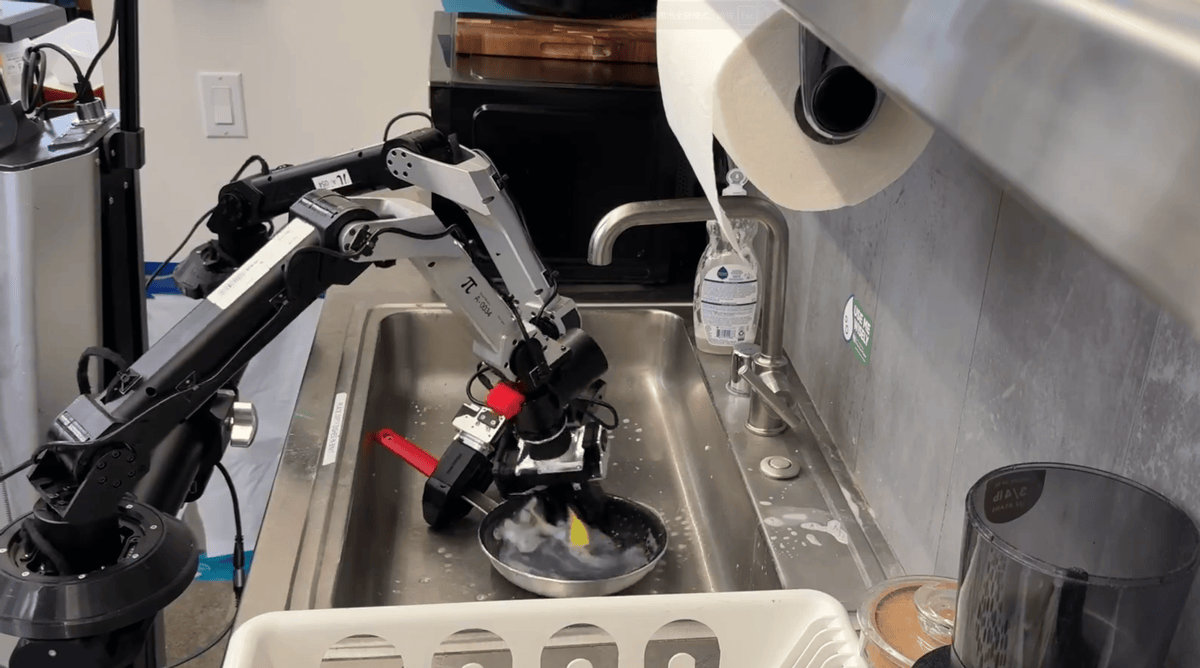
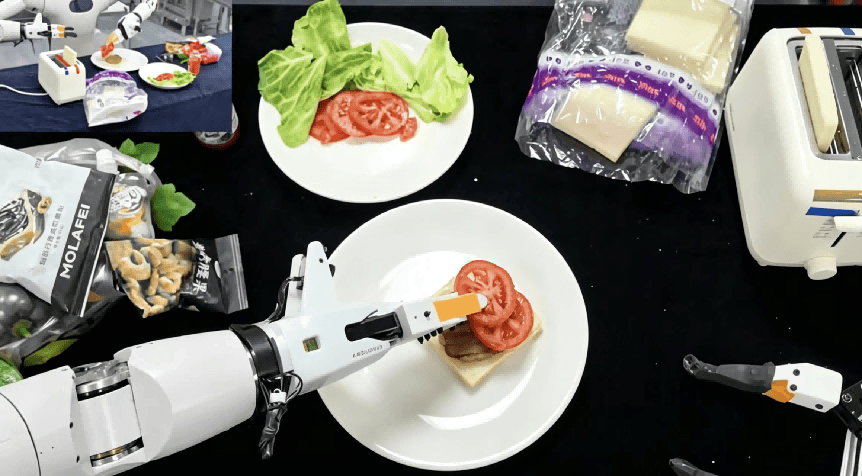
QuantGroup's positioning in the physical AI field is likened to Anthropic's role in the large language model space, allowing different hardware platforms to call upon the same AI capability layer. Its four rounds of technical validation were implemented in commercial kitchen scenarios. For example, in the sandwich-making task, the robot must handle grasping soft ingredients, spreading sauces, and arranging items; shopping bag sorting has no preset workflow, requiring the robot to identify and classify items in real time; and in the steak salting task, the robot must autonomously search multiple drawers and complete the seasoning.
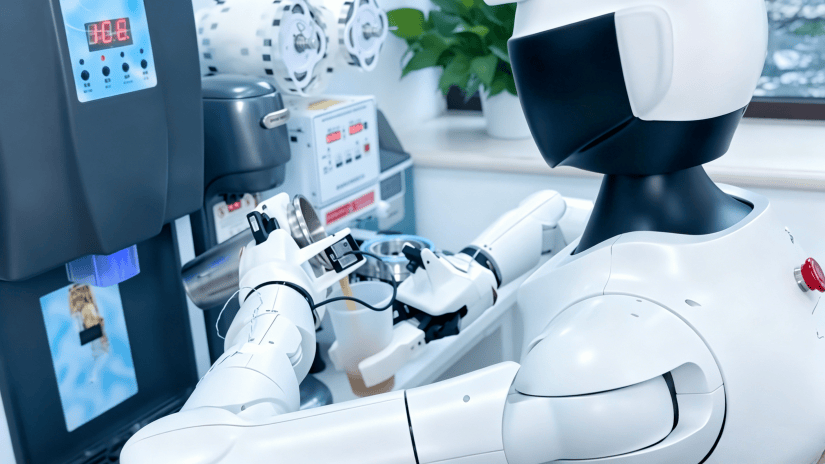
Milk tea preparation tests system coordination, as the robot must cooperate with equipment such as milk tea machines, blenders, and sealers. After the four rounds of validation, QuantGroup's next goal is cross-scenario reuse. Its technical approach involves separating software and hardware layers, with the physical world foundation model not tied to any hardware, capable of running on hardware platforms from different manufacturers. This concept is a prerequisite for scaling the RaaS (Robot as a Service) model: the model serves as a technical asset that can be continuously called upon to generate revenue.
QuantGroup's technical foundation began in areas such as automated machine learning and natural language processing (NLP), extending its digital world decision-making capabilities to the physical world. The barrier to data accumulation comes from a multi-path collection system, including B-end commercial scenario deployment, C-end smart hardware layout, user replacement-based collection, and scenario co-creation data sharing. These four parallel paths aim to transform data collection from a single point into a system. The company chose catering as its first core validation scenario, using its complexity to drive iterative improvements in the technical system.
At the policy level, the national special action requires submission of validation reports by the end of November, making "selling capabilities" rather than "selling hardware" more aligned with the industry direction, marking an inflection point in progress. QuantGroup's long-term path includes completing initial accumulation through scenario deployment and data sales, providing model calls and value-added services to smart hardware manufacturers, and then entering the computing power track, forming a revenue structure based on foundational models plus computing power. The prerequisite for this path is that the technical capability of the physical world foundation model can support cross-scenario reuse, with the core lying in the continuous strengthening of cumulative advantages.