US Robotics Company Charge Robotics Secures $22 Million to Deploy Solar Factories
en.Wedoany.com Reported - Charge Robotics, founded by MIT alumni Banks Hunter and Max Justicz, has raised $22 million to move its portable robotic assembly factory from prototype to commercial deployment. The company plans to begin its first commercial installation later in 2025.
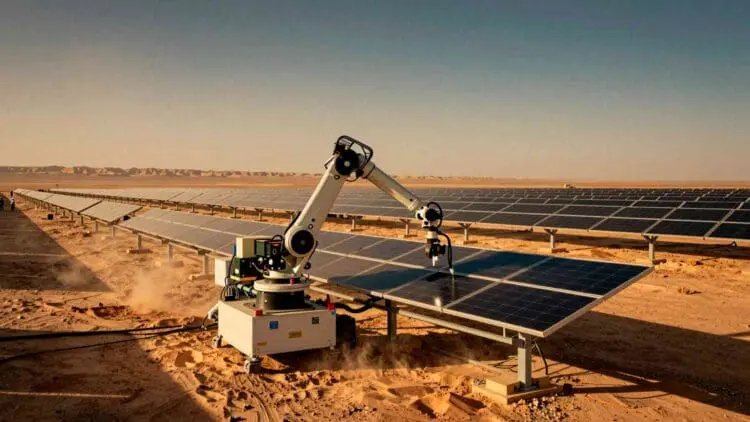
Founded in 2021, Charge Robotics has a clear goal: automating the installation of utility-scale solar farms. The company has just raised $22 million for its first commercial deployment, expected later in 2025.
This funding round follows a real-world milestone. In early 2024, Charge deployed a prototype system with SOLV Energy, one of the largest solar installers in the US, and actually used it to build a functional solar farm. This proof of concept shifted discussions from skepticism to investment.
Timing is crucial. In 2024, solar energy accounted for 81% of new electricity capacity in the US—a demand level that puts immense pressure on the industry's ability to build quickly. This is precisely the gap Charge aims to fill.
As solar panel prices have dropped significantly in recent decades, installation costs now account for a growing share of total project expenditure. Utility-scale solar farms are massive undertakings; a single site may require millions of panels, each historically assembled and secured by hand. Hunter described visiting a site in the Mojave Desert that looked like "a giant dust bowl," where thousands of workers spent months repeating the same manual tasks.
Labor shortages have worsened the situation. Hunter says every large solar company he has spoken with views labor constraints as the biggest barrier to expansion—project timelines are slowing, and some have been canceled entirely.
The Charge system functions like a portable assembly line. The factory is shipped directly to the project site, where steel rails, mounting brackets, fasteners, and solar panels are loaded in, and the production line's automated robots assemble all components. The output is a complete solar bay—a section of the solar farm about 40 feet long and weighing roughly 800 pounds. A robotic vehicle picks up each completed bay and places it in its final position in the field. The system automates all mechanical installation except for driving the initial metal stakes into the ground.
Quality control is built in. Machine vision systems scan each component as it passes through the production line, catching issues before they occur. The system is also designed to be compatible with the most commonly used solar components and panel sizes, making it suitable for a wide range of projects. Scalability is one of its biggest advantages; multiple factories can operate simultaneously on the same site, working around the clock to complete projects faster without significantly expanding the workforce.
Hunter studied mechanical engineering at MIT and, after graduating, joined Vicarious Surgical—a medical robotics startup founded by MIT alumni—as its second employee, working there for five years before co-founding Charge. Justicz majored in mechanical engineering and computer science at MIT. Both are concerned about climate change and wanted to create something with real impact. After cold-calling hundreds of industry professionals, they concluded that solar energy was the right bet—not only for its environmental potential but because its costs are falling faster than any other energy source in history.
Charge plans to partner with solar construction companies, allowing its factories to operate alongside existing teams. Workers transition from manual assembly to remotely operating robotic equipment. Materials arrive on pallets, and the system handles the rest.
Charge Robotics is entering commercial deployment at a time when the solar industry's growth is constrained by the very bottleneck it aims to solve. The prototype deployment with SOLV Energy proved the system holds up under real-world site conditions—a critical step from concept to product. The core proposition is straightforward: ship more factories to a site, run them continuously, and complete larger projects faster with the same number of people. Whether this model holds up at commercial scale remains an open question, but the funding, field results, and broader industry context all suggest a company that has moved well beyond the proof-of-concept stage.
Related Products

Strip Coating and Plating Production Line Equipment
MCC-SFRE HEAVY INDUSTRY EQUIPMENT CO., LTD.
CAP1400 main feedwater flow nozzle flowmeter.
Jiangsu Hongda Instrument Technology Co., LTD.

Pneumatic high-pressure wear-resistant ball valve
Zhejiang Deca Control Valve Meter Co., Ltd.
CLX Series Intelligent Hydraulic Gyratory Crusher
Guangdong CHUANGLI intelligent machinery Equipment Co., LTD
QLZNGJ Intelligent Steel Reinforcement Trolley
Luoyang China Railway Qiangli Machinery Co., Ltd.