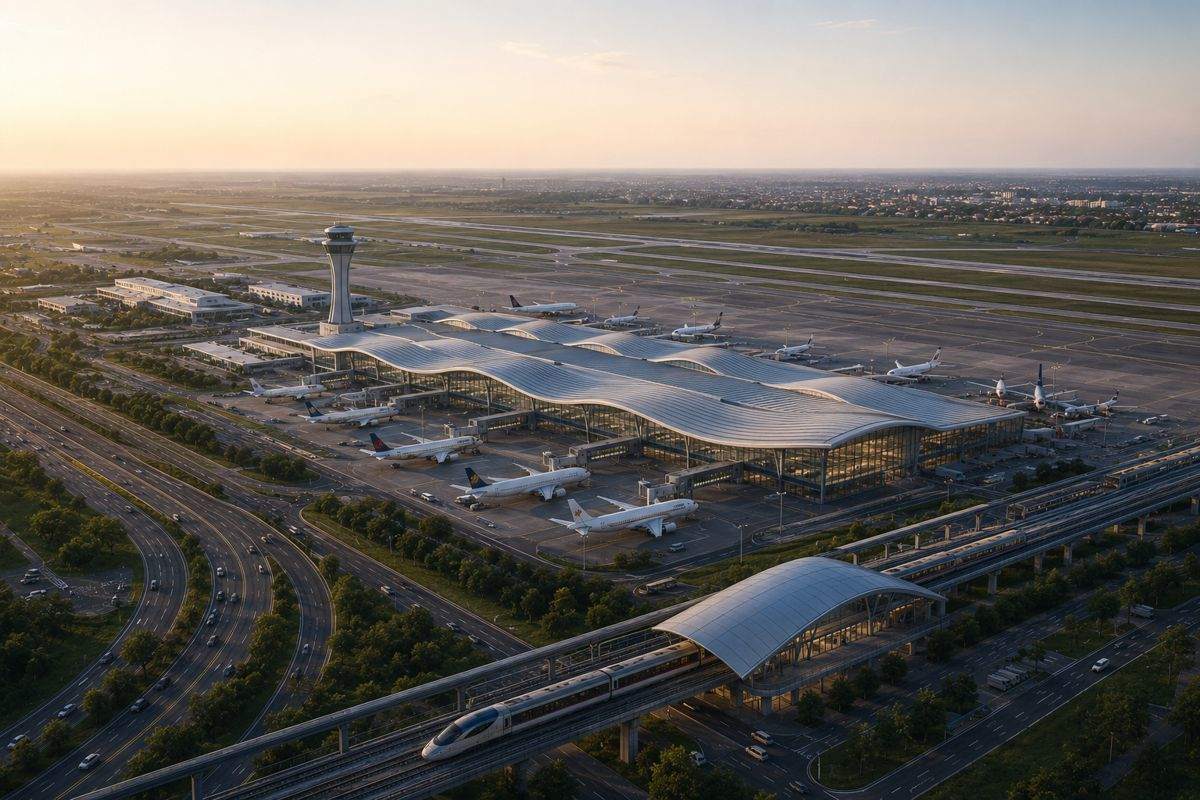
en.Wedoany.com Reported - Uzbekistan has signed a public-private partnership (PPP) project financing agreement for the construction and long-term operation of the New Tashkent International Airport, one of the largest single transport infrastructure projects in Central Asia that the country has committed to implementing. The agreement, reached between state-owned operator Uzbekistan Airports and an international consortium led by Saudi Arabia's Vision Invest, will build a greenfield airport designed to handle up to 20 million passengers annually upon opening, with a long-term capacity of 46 million passengers.
This deal is significant for the infrastructure industry tracking the next wave of aviation capital deployment, as it combines large project scale, a clear risk-sharing model, and aviation demand accumulated over the past decade. Its importance lies in both structure and geography. Tashkent's existing airport, located within the city, has a designed passenger throughput of approximately 11 million and cannot accommodate additional runways, severely limiting the capital's international connectivity. The government has decided to relocate the main gateway to an open area in the Tashkent region and bring in operators with experience managing some of the world's busiest hubs.
This approach reflects a common model in emerging aviation markets: countries retain state control over airport sites while inviting private capital and operational expertise for terminal development. The model, already proven in Saudi Arabia, Turkey, and India, is now being applied in one of the world's fastest-growing tourist destination markets. In terms of commercial structure, the private consortium holds a combined 90% stake in the project, with Vision Invest at 45%, Japan's Sojitz Corporation at 30%, South Korea's Incheon International Airport Corporation at 15%, and Uzbekistan Airports retaining the remaining 10%. Under the agreed terms, the private partners will be responsible for building, operating, and maintaining passenger terminals and forecourt areas, as well as undertaking future expansions during the 35-year concession period. Meanwhile, the government retains responsibility for developing and managing airport infrastructure such as runways, taxiways, and navigation systems.
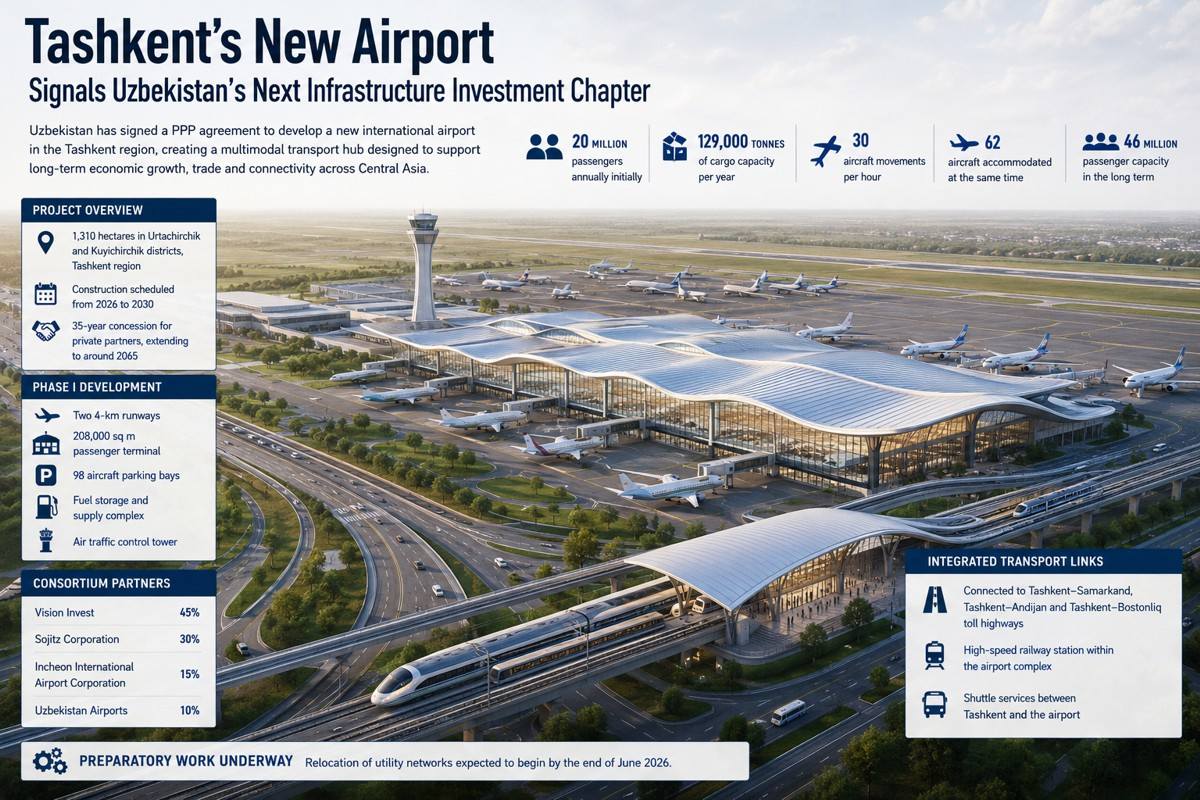
Phase one involves an initial investment of approximately $2.5 billion, and the sponsors have received recommendations for expected financial close, involving a group of senior lenders and international financial institutions. The construction will include two parallel 4-kilometer runways, enabling the airport to handle wide-body long-haul aircraft and schedule up to 30 takeoffs and landings per hour. A 208,000-square-meter terminal will support a site capable of simultaneously parking 62 aircraft, providing 98 aircraft stands upon opening. A fuel storage and supply complex and a new control tower will form the initial airport and landside support, equipping the facility from day one with the core systems needed to operate as a full-fledged international gateway. Site preparation is already underway, with engineering and utility network relocation scheduled to begin by the end of June 2026.
Long-term plans point to a terminal four times larger than Tashkent's existing facility, ultimately capable of supporting up to 46 million passengers annually, over 40 passenger boarding bridges, and 160 aircraft parking stands. The design adopts a phased construction approach, requiring modular design and delivery solutions that allow capacity increases without operational disruptions. The project also plans to integrate the airport into the broader transport network, with direct connections to the Tashkent-Samarkand, Tashkent-Andijan, and Tashkent-Bostonliq highways, as well as a dedicated high-speed train station within the complex and shuttle services between downtown Tashkent and the new airport.
The project's scale is closely tied to Uzbekistan's recent tourism performance. In 2025, the country received approximately 11.7 million foreign tourists, a year-on-year increase of nearly 47%. The UN Tourism Organization ranked it among the seven fastest-growing destinations globally, with visitor numbers up about 73% from 2019 levels. In 2025, the total passenger throughput of the national airport network reached approximately 15.5 million, a single-year increase of about 14%, with nearly 129,000 flights. Tourism service exports have climbed to around $4.8 billion. The "Uzbekistan-2030" strategy aims to attract 15 million foreign tourists annually. The project was legally established by a presidential decree dated November 25, 2025.
The composition of the consortium reflects the project's strategic weight. Incheon International Airport Corporation operates South Korea's main international gateway, handling over 70 million passengers in 2024, and is already active in Uzbekistan through a separate concession agreement. Sojitz Corporation is a Japanese trading company covering energy, infrastructure, industry, and healthcare. As the lead sponsor, Vision Invest is a Saudi developer that has built a portfolio spanning power, water, logistics, and transport, driven by Saudi Arabia's Vision 2030. With the concession agreement signed and site preparation underway, near-term milestones include financial close and contractor mobilization, targeting completion of construction within four years. The 35-year concession period means the partners bear responsibility for construction, operation, expansion, and reinvestment, with commitments extending to approximately 2065. If delivery proceeds as planned, Uzbekistan will open a gateway scaled to match its anticipated continued market growth.