en.Wedoany.com Reported - John O'Leary, CEO of Daimler Truck North America (DTNA), expects truck demand to continue accelerating in the second half of 2026.
O'Leary told Transport Topics that DTNA, which owns brands such as Freightliner and Western Star, is seeing particularly strong replacement demand from large over-the-road trucking fleets. He noted that there is some pent-up demand for replacements that is beginning to enter the market, with more expected in the future. During the freight recession of the past three years, many purchases were suppressed, and fleet aging was not intentional but rather due to weak business profitability. O'Leary added that trucks are merely tools for customers to make money, unlike passenger cars which reflect social status.
Parent company Daimler Truck said on July 8 that DTNA's truck and bus sales in the second quarter of 2026 increased 8% year-over-year, marking the first quarterly sales growth in six quarters. DTNA, headquartered in Portland, Oregon and also including Thomas Built Buses, sold 41,687 vehicles in the second quarter, compared to 38,580 trucks and school buses in the same period last year, the first quarterly year-over-year increase since the third quarter of 2024. As carriers gain confidence in the ongoing freight market recovery, DTNA's second-quarter sales rose 41.6% from the first three months of 2026. In the first half of 2026, DTNA sales fell 8% year-over-year to 71,119 trucks and buses, compared to 77,572 in the same period last year.
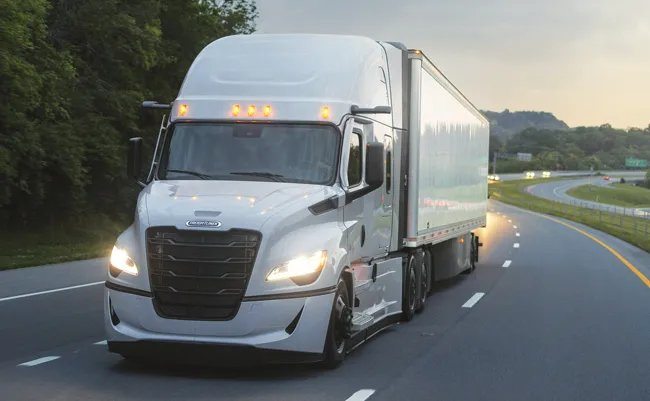
O'Leary revealed to Transport Topics at a meeting on July 9 that due to the ongoing recovery, DTNA will increase its workforce at its manufacturing plant in Mount Holly, North Carolina. The plant, which primarily produces Freightliner trucks, will rehire 400 employees laid off in July 2025, when the move was part of a reduction of 2,000 production positions across DTNA's North American manufacturing facilities. Additionally, DTNA plans to hire another 200 workers at the Mount Holly plant by the end of 2026 as part of a plan to add a second shift. The Mount Holly plant, along with facilities in Cleveland and Gastonia, forms the manufacturing core in the Carolinas for the largest U.S. manufacturer of heavy-duty trucks, with the Cleveland truck plant being Freightliner's largest manufacturing facility in the United States.
Weak sales and orders last year led DTNA to lay off 2,000 employees across five North American production sites in July 2025, affecting Mount Holly, Gastonia, Detroit, Portland, Oregon, and Saltillo, Mexico. According to data from Mexico's National Institute of Statistics and Geography, Freightliner's plants in Saltillo and Santiago Tianguistenco, Mexico, produced 9,379 trucks in June, up 9.6% year-over-year (8,554 in June 2025) and up 0.3% from 9,348 in May. In the first half of 2026, these plants produced 44,380 trucks, down 5.9% year-over-year (47,174 in the same period last year). O'Leary stated that DTNA has not yet rehired any of the Saltillo employees laid off in 2025.
When Daimler Truck released its first-quarter 2026 earnings on May 6, it stated that it still expects the North American heavy-duty truck market to range between 250,000 and 290,000 units, but the recent uptick in orders and sales could prompt a revision. The company plans to report full second-quarter results on August 7. Sales are expected to improve in the third quarter of 2026, with data released by ACT Research on July 3 showing that June orders exceeded 100% year-over-year growth for the fifth consecutive month. Preliminary ACT data shows that total North American Class 8 truck orders in June were 31,400 units, surging 231% year-over-year, marking the seventh consecutive month of year-over-year growth.
Despite this, O'Leary noted that the vocational segment of the Class 8 truck market is essentially flat, partly due to high demand in past years, but also because vocational fleets have longer replacement cycles than over-the-road fleets. Discussing the purchasing intentions of vocational fleets, he pointed out that much of the demand over the past three years was quite strong, and it is unclear how much new demand remains, as some of it has already been met.