en.Wedoany.com Reported - The global met coal market has weakened recently, mainly due to ample seaborne supply and cautious procurement by steel mills. Buyers face thin margins, slowing production, and sufficient inventories, dampening purchasing intentions.
Australian Premium Hard Coking Coal (PHCC) prices are under pressure, with discounts widening for lower-grade coals. Pulverized Coal Injection (PCI) procurement remains selective, with competitively priced Russian resources attracting Chinese buyers' attention. The met coke market is also sluggish, driven by different fundamentals in China and India.
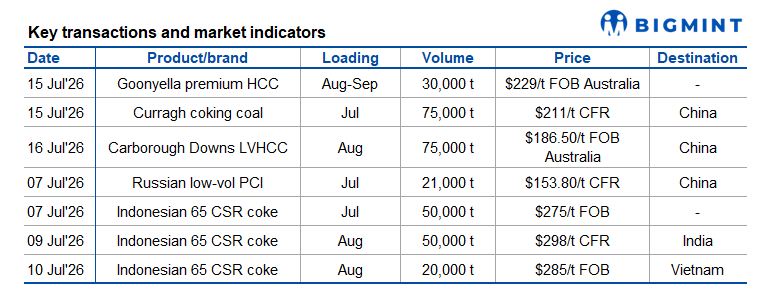
The Australian coking coal market is weakening, with buyers taking the initiative. Premium low-volatile Hard Coking Coal (HCC) closed at around $227.50/t FOB Australia and $247.50/t CFR China on July 17. Indian buyers' indicative bids were near $242-243/t CFR, below sellers' expectations, as available cargoes continued to exceed prompt demand. A 30,000-tonne cargo of Goonyella coal was traded at $229/t FOB Australia. Lower-grade coals were traded at discounts, with Curragh coal at $211/t CFR China and Carborough Downs coal sold at $186.5/t FOB Australia, below the current low-vol HCC level of around $189.50/t.
China's domestic premium coking coal market remains supported by safety inspections and prolonged mine closures, especially in Shanxi. As of July 13, 56 mines (with a combined capacity of 64.4 million tonnes per year) remained shut, many producing hard-to-replace premium grades. Mongolian coal supply is also temporarily constrained by the Naadam Festival and price standoffs between buyers and sellers. However, demand is weakening. Steel mills have scheduled blast furnace maintenance ahead of schedule, reducing raw material procurement and controlling costs due to deteriorating finished steel prices and margins. Mills are reluctant to purchase seaborne coal until domestic prices stabilize. This creates a clear divergence: domestic premium coal is supported by tight supply, but seaborne coal weakens amid ample supply; coke producers are squeezed between high coal prices and weak steel demand.
Chinese coke producers face increasing pressure as steel mills resist cost increases and maintain sufficient inventories. Some coke plants, especially in the central and western regions, are seeing coke inventories accumulate, with market expectations shifting from further price hikes to the first round of price cuts. The traditional transmission mechanism of rising coking coal costs to coke prices has weakened. As the domestic coke market softens, export prices are also under pressure.
India's met coke market remains cautious and regionally divergent. Blast furnace grade met coke prices fell to around INR 35,150/t (ex-works, Jaipur), while prices in western India held steady at around INR 34,000/t (ex-works, Gandhidham). Foundry coke prices remained at around INR 36,400/t (ex-works, Rajkot). A key constraint is the uncertainty over anti-dumping duties on imported coke, which expired on June 30 but with no final decision yet. Steel mills are delaying imports, domestic producers are avoiding aggressive price cuts, and overseas sellers lack clarity on Indian netback prices. A 50,000-tonne cargo of Indonesian 65 CSR coke was traded at $298/t CFR India on July 9. As of July 17, the market stabilized around $285/t FOB Indonesia and $297/t CFR India. Domestic coke still holds advantages in delivery speed and lower fines content, reducing the urgency for imports.
Pulverized Coal Injection (PCI) procurement remains selective, with Russian coal supply pressuring alternative grades. A 21,000-tonne cargo of Russian low-vol PCI was traded at $153.80/t CFR China, highlighting Russia's competitive advantage in the Chinese market. Indicative prices for Indian arrivals are higher, with mid-vol PCI around $157/t CFR, and forward levels at approximately $172.35/t and $177.35/t respectively. Due to differences in freight, quality, and commercial terms, these prices are not directly comparable but indicate potential pressure from low-cost supply. As blast furnace demand slows, PCI procurement is likely to remain focused on competitively priced sources and contractual volumes.
Indian steel mills remain potential buyers but lack urgency. Indicative bids for premium coal are around $242-243/t CFR, reflecting expectations of further price declines. The monsoon season, leading to weak construction and long product demand, falling finished steel prices, and pressure on mill margins, dampens restocking appetite. Falling coking coal prices have also weakened cost support for domestic coke producers. BigMint's PHCC CFR Paradip assessment fell by $9/t week-on-week to $254/t, limiting upside for domestic coke prices.
Atlantic met coal prices are more stable than in Asia, but the market remains fragmented. Some US high-vol brands have sold out spot supplies through end-2026, while other resources remain available. High-vol HCC offers are around $180/t CFR Europe, US Gulf high-vol A at around $170/t CFR India, and Allegheny coal near $130/t FOB US East Coast. This relative stability reflects selective supply tightness rather than broad demand strength. European and Brazilian steel mills continue to face pressure from weak steel economies and the price competitiveness of Chinese export resources. Freight rates also provide some downside protection: Australia-India Panamax freight is around $21.05/t, and to China $18.40/t; US East Coast-India freight remains elevated at around $52/t.
The near-term market outlook remains weak, but divergence is becoming more pronounced. Australian premium HCC is likely to continue facing pressure due to ample supply exceeding prompt demand from China and India. Lower-grade coals may face greater downside risk. China's domestic premium coal prices should find relative support from mine closures, but coke prices could weaken if blast furnace maintenance expands and hot metal output declines. India's coke market will remain cautious until the anti-dumping duty situation is clarified. PCI will remain highly origin-sensitive, with Russian resources maintaining an advantage in China. Atlantic coal may continue to outperform Asia, with some brands in tight supply, but weak steel economies will limit demand. Overall, the market is being shaped by thin steel mill margins, cautious procurement, and ample seaborne coal supply; a sustainable recovery requires stronger hot metal output and genuine restocking activity.