en.Wedoany.com Reported - Colorado's Front Range Passenger Rail (FRPR) district advanced a phased delivery plan for a long-planned intercity rail system on July 21, with the first phase building a $332 million starter line connecting Denver and Fort Collins.
The plan outlines an implementation strategy for a rail network that could cost approximately $4.7 billion, extending from Fort Collins in the north, south through Denver as a regional hub, and ending in Pueblo, covering about 190 miles.
The FRPR executive committee voted unanimously to submit Resolution No. 2026-26 to the full board, recommending approval when the board considers the proposal on July 31. The project, called the "Colorado Connector" (CoCo), is divided into three main phases. Initial service will launch in 2029, offering three daily round trips on the 72-mile segment between Denver Union Station and Fort Collins.
The second phase, estimated to cost approximately $1.7 billion, will extend the line south about 75 miles to Colorado Springs and another 44 miles to Pueblo within five years of receiving dedicated funding. Long-term expansion (about 20 years) will bring total investment to approximately $4.7 billion. The Colorado Connector will not build new tracks but will primarily rely on existing freight corridors, with construction focusing on increasing capacity, such as building new and extending passing sidings, track and roadbed upgrades, switches, signal and communication improvements, stations, and maintenance facilities to accommodate passenger service while preserving freight operations.
North of Denver, trains will use the Regional Transportation District (RTD)'s infrastructure, then access BNSF Railway's Front Range subdivision. Subsequent phases will extend south, operating via the BNSF-Union Pacific joint line and Union Pacific main line.
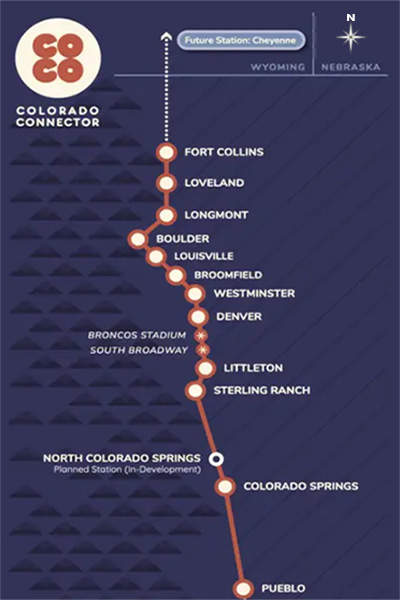
Project planners told committee members that the second phase will add necessary infrastructure to increase passenger service north of Denver from three to four daily round trips, while supporting operations south to Pueblo. Work will include station sidings to move trains off the main line, increased capacity for passenger trains to pass each other, and changes needed to preserve rail maintenance windows. These improvements will also support future service expansion.
The proposed $332 million starter phase will be funded through existing commitments from the Colorado Transportation Investment Office and RTD, with Amtrak serving as the initial operator. The district said the first phase requires no new taxes or additional federal funding. Expansion south of Denver will depend on voter approval of a proposed regional sales tax, which could appear on the ballot this November.
The district is preparing a detailed financing plan for committee review in August, after which the board will consider whether to submit the sales tax measure to voters. District officials said the board could vote on ballot language at a meeting in Pueblo on August 28.
District officials said the proposal is based on four years of planning and coordination with the Colorado Department of Transportation, RTD, BNSF, Union Pacific, Amtrak, and the Federal Railroad Administration. The delivery plan cites a term sheet establishing key terms for a 25-year BNSF access agreement between Denver and Fort Collins, as well as the project's progress into the Federal Railroad Administration's "Corridor Identification and Development Program," as milestones supporting implementation.
Committee Chair John Putnam said the plan translates complex technical issues into language the public can understand, while maintaining "very solid technical information support." If approved by the full district board, the plan will guide engineering, environmental review, rail negotiations, and procurement for Colorado's first modern intercity passenger rail corridor connecting Front Range population centers.