en.Wedoany.com Reported - Robert Friedland, founder and co-chairman of Ivanhoe Mines, said the company has weathered the flooding at its Kamoa-Kakula copper complex following the May 2025 earthquake, with operations recovery accelerating. As underground development advances and more mining areas come into production, mining rates at Kamoa and Kakula continue to improve, and the company plans to increase copper production in the second half of 2026, laying the groundwork for a stronger performance in 2027.
Ivanhoe operates three tier-one mining assets in southern Africa: the Kamoa-Kakula copper complex in the Democratic Republic of Congo (DRC), the Kipushi zinc mine, and the Platreef platinum group metals mine in South Africa. In the second quarter of 2026, sulfuric acid sales revenue covered the operating costs of the Kamoa-Kakula smelter. Friedland noted that sulfuric acid prices rose a further 80% in the third quarter, and this by-product revenue stream will provide strong momentum for the project for the foreseeable future.
The Kipushi mine set another production record amid record-high zinc prices, and the company is studying ways to unlock the mine's high-grade gallium and germanium, both metals critical to global supply chain resilience. Friedland said the balance sheet will be further strengthened in the second half of 2026, as the company monetizes unsold metal inventories amid strong metal prices (copper at $13,700 per tonne, zinc at $3,600 per tonne). Kamoa-Kakula currently holds 40,000 tonnes of unsold copper, while Kipushi holds 44,000 tonnes of unsold zinc. Friedland encouraged investors to do the math themselves.
In the second quarter of 2026, Kamoa-Kakula produced 64,328 tonnes of copper, of which 62,072 tonnes came from the Kamoa-Kakula copper smelter and 2,256 tonnes from the Lualaba copper smelter in Kolwezi. Since mid-February, the on-site smelter has operated at approximately 60% capacity (1,250 tonnes per day), producing 112,307 tonnes of sulfuric acid during the quarter. Ivanhoe Mines has lowered its 2026 copper production guidance from 290,000–330,000 tonnes to 290,000–310,000 tonnes. Friedland did not encourage investors to calculate the additional 20,000-tonne reduction in copper losses. The company maintained its 2027 copper production guidance of 380,000–420,000 tonnes.
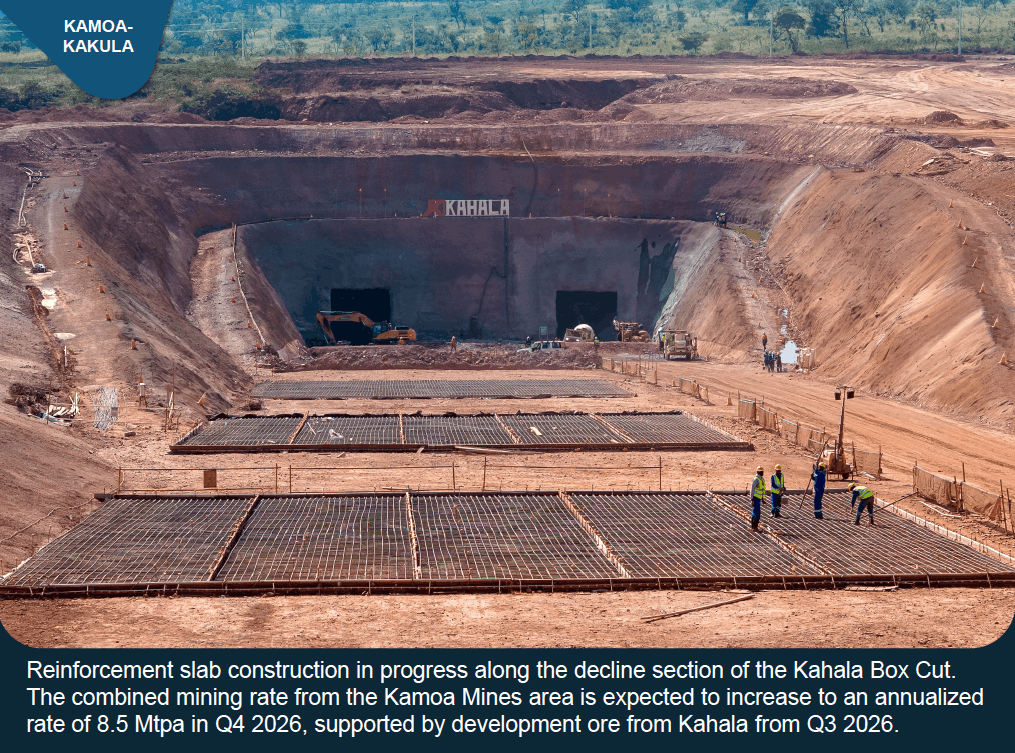
In the second half of 2026, the mining rate at the Kamoa mining area is planned to increase by 30% to 700,000 tonnes per month (approximately 8.5 million tonnes per year), supported by the deployment of additional mining crews and the commencement of bulk mining. New access is being achieved through the Kahala box cut, whose ramp has been advancing in ore since June. Another ramp, named Kansoko Sud, is under development, with the box cut completed in the second quarter; twin ramps are now being excavated, requiring a further 700 metres of advancement to reach the orebody, with completion expected in the first quarter of 2027.
The Kipushi concentrator processed 200,774 tonnes of ore in the second quarter at an average grade of 38.7% zinc, producing a record 70,177 tonnes of zinc concentrate. The newly expanded tailings storage facility has been completed, and the company maintained its 2026 production guidance for the mine at 240,000–290,000 tonnes of zinc concentrate, making it one of the world's top three zinc mines. The Platreef Phase 1 concentrator processed 37,296 tonnes of ore at an average feed grade of 2.19 g/t, producing 1,538 ounces of platinum, palladium, rhodium, and gold (3PE+Au). Phase 1 operations have not yet reached commercial production, and achieved production does not represent steady-state conditions.
Hoisting rates have improved significantly following the completion of Shaft #3. Commissioning of the shaft and its underground supporting infrastructure was completed on schedule in June, increasing flexibility for hoisting ore and waste rock, supporting the Phase 1 ramp-up to full capacity and the Phase 2 expansion beginning in the fourth quarter of 2027. Mining of higher-grade ore from the Flatreef orebody commenced at the end of the second quarter, with two stopes completed, and mining rates are expected to progressively increase throughout the second half of 2026, with commercial production expected in the fourth quarter. The expansion of Shaft #2 from its current 3.1-metre diameter to 10 metres began in early in the second quarter, with the shaft expected to be ready to hoist personnel and materials by the end of 2028 and ore by the end of 2029.