en.Wedoany.com Reported - The "2026 Global Fusion Industry Report" indicates that in the 12 months leading up to July 2026, global fusion technology companies raised a record $4.48 billion, signaling growing market confidence in fusion technology and paving the way for accelerated commercial deployment.
As the key to achieving unlimited, clean, and safe energy applications, fusion is hailed as "humanity's ultimate energy source." From the initial exploration of controlled fusion technology in the last century to the current emergence of controlled fusion technologies from laboratories in multiple countries, the path to commercialization is becoming increasingly clear. The Fusion Industry Association recently released the "2026 Global Fusion Industry Report" (hereinafter referred to as the "Report"), which states that in the 12 months leading up to July 2026, global fusion technology companies raised a record $4.48 billion, signaling growing market confidence in fusion technology and paving the way for accelerated commercial deployment.
Public-Private Partnerships Leading Development
Andrew Holland, CEO of the Fusion Industry Association, stated that while fusion technology R&D funding was previously dominated by national fiscal budgets, private financing is now expanding significantly, marking an accelerated shift toward an industry cultivation phase driven by market demand and commercial prospects.
Geographic expansion is broadening. According to the Report, 12 countries have entered the fusion field over the past year. Overall, China and the United States are the leaders in the fusion sector, collectively covering nearly all conceivable fusion approaches. Germany has shown notable performance over the past year, and India has two fusion startups emerging on the scene.
The industry is expanding significantly. There are 56 active fusion technology companies globally, employing over 16,000 people in total, with the supply chain supporting more than 21,000 jobs. An increasingly mature industrial chain with the capacity for scaled response is taking shape.
Meanwhile, the role of government is evolving. Over the past decades, governments led fusion pathways through national laboratories and public R&D programs, but leading countries are now shifting focus toward public-private partnerships, infrastructure development, supply chain security, and regulatory framework improvement.
Andrew Holland noted that private capital is driving engineering advancement and business model validation, while governments continue to play an irreplaceable role in addressing common scientific challenges such as neutron-resistant materials and tritium self-sufficiency, as well as in establishing safety regulatory frameworks. The combination of the two is making the path from laboratory to commercialization for fusion energy increasingly clear.
Beyond the technology itself, the industry's biggest bottlenecks include: the reliability and lifespan of materials under irradiation damage, the closure and self-sufficiency of the tritium fuel cycle, supply chain improvement and cost control, and the establishment of regulatory approval frameworks. These issues cannot be solved independently by any single company and require large-scale, long-term government investment and cross-industry collaboration. For this reason, the public-private partnership model has become industry consensus, with numerous companies accelerating technology validation and reducing R&D risks through collaboration with national laboratories, universities, and government agencies.
Growing Industry Confidence
The Fusion Industry Association noted that industry confidence in the feasibility of fusion technology is growing, with approximately 71% of fusion technology companies targeting the delivery of commercial power to the grid by the 2030s.
In terms of technological pathways, the industry exhibits a high degree of diversity, including magnetic confinement, inertial confinement, and magneto-inertial confinement, indicating that the market has yet to reach a consensus on a mainstream technical route. Globally, notable active players include U.S.-based magneto-inertial confinement fusion technology company Helion, U.S. fusion energy company CFS, and German fusion startup Proxima Fusion.
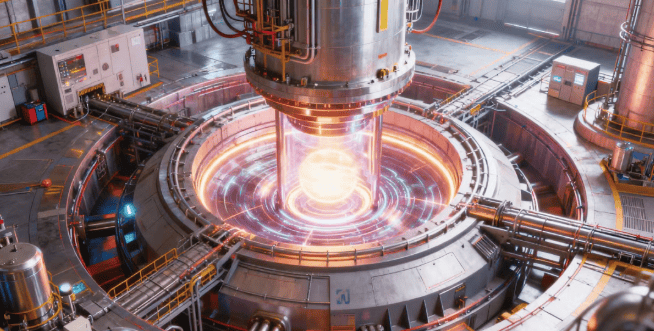
In May of last year, CFS began construction of SPARC, a fusion power prototype, at an industrial park outside Boston. SPARC is a donut-shaped tokamak device. The tokamak features a toroidal vacuum chamber at its center, surrounded by coils. When energized, a powerful helical magnetic field is generated inside the tokamak, heating the plasma within to extremely high temperatures to achieve fusion. To date, the traditional scientific consensus has held that larger tokamaks deliver stronger performance. CFS currently has a market valuation of nearly $3 billion. Early this year, it completed the installation of the first magnet for the SPARC fusion reactor, with all 18 magnets expected to be installed by the end of summer.
Proxima Fusion, with a market valuation of approximately €2.4 billion, is currently Europe's best-funded and highest-valued fusion company. It is building the Alpha stellarator demonstration device for net-energy fusion near Munich, with the goal of achieving net energy gain—where the energy output of a fusion experiment exceeds its input. If successful, it aims to build Europe's first commercial fusion power plant in the 2030s.
The Report points out that the financing structure has evolved from early reliance on a few leading companies to a more dispersed and diversified stage. In addition to five companies that have raised over $1 billion, a group of mid-sized enterprises with financing between $100 million and $500 million is growing. However, high valuations and high expectations are pushing more companies into the public eye, and some have entered public markets through mergers and acquisitions. This means companies will face daily financial scrutiny from the stock market in the future, making information transparency and performance delivery more severe tests. Industry consolidation is almost inevitable, and not all currently active companies will survive to the full commercialization stage.
AI Accelerating Commercialization
The Fusion Industry Association noted that artificial intelligence (AI) is driving the fusion commercialization process with unprecedented force. With the rapid expansion of AI training models and data centers, the global demand for stable, large-scale, low-carbon energy is growing exponentially. Against this backdrop, fusion—with its extremely high fuel energy density, zero carbon emissions, and sustainable operation—is considered the only energy form with the potential to truly meet this continuously growing demand.
"Fusion will be the most practical solution to meet the growing electricity demands of AI data centers, becoming the primary source of cheaper, cleaner, and safer energy on Earth," Masayoshi Son, founder of SoftBank Group, recently stated publicly.
Currently, major technology companies are successively supporting fusion developers. Microsoft has signed a binding power purchase agreement with Helion, while Google and NVIDIA are providing funding to CFS and Proxima Fusion.
Under the power purchase agreement between Microsoft and Helion, the latter has committed to bringing its first commercial fusion power plant online by 2028 and supplying Microsoft with at least 50 megawatts of power. If Helion fails to deliver on schedule, it will face potential financial penalties.
Last year, Helion held a groundbreaking ceremony for Orion, its first commercial-scale fusion power facility, in Washington State. The site is adjacent to the Columbia River, allowing direct connection to Washington State's main transmission grid, and is located upstream of the infrastructure powering Microsoft's large-scale cloud operations.
Currently, Orion's assembly building and office facilities are complete, and construction of the generator building has commenced. The company has also obtained a radioactive materials license and a radioactive air emissions permit from the Washington State Department of Health, granting it legal construction and operation qualifications. Helion's market valuation has reached $15.5 billion.
A survey by the Fusion Industry Association shows that six fusion technology companies have already signed site selection agreements, with another four actively evaluating candidate sites; five have signed power purchase agreements, offtake agreements, or similar commercial commitments, with two more in related negotiations. These agreements provide foundational market risk mitigation tools for financing fusion power plants, ensuring that once fusion power is available for sale, buyers are already waiting.
"The existence of site selection agreements and power purchase agreements indicates that commercial fusion energy is beginning to show promise," emphasized Andrew Holland.