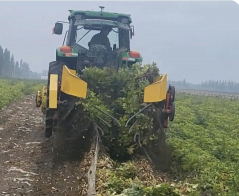
en.Wedoany.com Reported - Arizton Advisory & Intelligence (Arizton) released the "Global Agricultural Tractor Market Report" on August 5, 2026, projecting that the global agricultural tractor market will reach 2.61 million units by 2031, with a compound annual growth rate of 3.74% during the forecast period.
The report shows that after experiencing exceptionally strong demand from 2021 to 2022, the global agricultural tractor market entered a correction phase in 2025. Higher interest rates, low farm incomes, and high dealer inventories put pressure on purchasing activity in several mature markets, particularly in North America and South America. Despite weak demand for most of the year, market conditions began to stabilize in the second half of 2025, with a gradual recovery expected by 2026. The Asia-Pacific region continues to lead global demand, with strong tractor sales in India and China. Government support for agricultural mechanization, improved access to agricultural credit, and sustained investment in the agricultural sector collectively underpin equipment demand in the region. China is accelerating the replacement of older tractors with modern, higher-horsepower models.
Connectivity is becoming a key competitive factor in the agricultural tractor market. With the rapid adoption of IoT, telematics, and connected agricultural technologies, farmers are placing greater emphasis on equipment efficiency, uptime, and precision agriculture, driving rising demand for tractors equipped with connectivity features and real-time operational insights. Manufacturers are expanding their digital offerings through remote diagnostics, software updates, fleet management, and connected services. As 5G networks, satellite connectivity, and rural digital infrastructure continue to improve, connected technology is expected to become standard on more tractor models, further accelerating the shift toward data-driven agriculture.
Precision agriculture technologies are also moving down from high-end models to a broader range of tractors. Features such as GPS navigation, auto-steering, telematics, and smart sensors are gradually becoming more accessible. Manufacturers are integrating tractors with farm management platforms to support better decision-making, predictive maintenance, and improved equipment performance. With growing adoption in both developed and emerging markets, precision agriculture is expected to accelerate demand for smarter, connected tractors, driving further innovation in the agricultural tractor market.
By horsepower, tractors under 50 HP remain the largest segment globally, accounting for approximately 59% of the global market. Smallholder farmers in Asia-Pacific, sub-Saharan Africa, and parts of Europe have strong demand for compact, low-horsepower equipment, with affordability, versatility, and lower operating costs being top purchasing priorities for this user group. As agricultural mechanization expands in emerging economies, this segment is expected to continue serving as a primary driver of global market growth.