Wedoany.com Report on Feb 7th, Hugh Broughton Architects in the UK, in collaboration with NORR, has unveiled the Discovery Building, designed specifically for Antarctica. This structure features an aerodynamic design with a unique snow deflector on its roof, aimed at withstanding the harsh climatic conditions of the polar region.
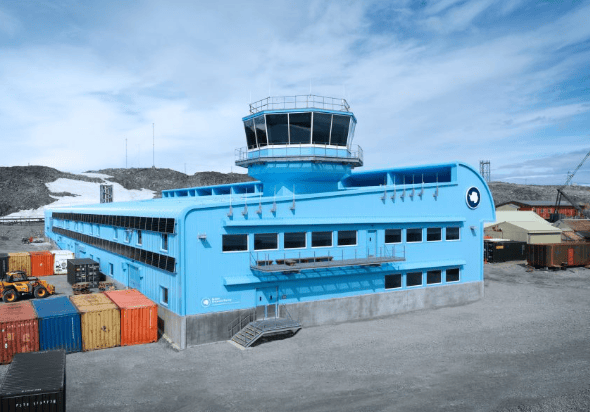
Located at the Rothera Research Station on Adelaide Island, the Discovery Building serves as the UK's primary research base in Antarctica. This 4,500-square-meter sky-blue building consolidates the station's key functions, including an air traffic control tower, replacing nine separate original structures.
Hugh Broughton, founder of Hugh Broughton Architects, stated: "The goal was to integrate almost all critical operational functions of the station under one roof. At Rothera, operations include a gravel runway and a wharf receiving research vessels, so the control tower plays a crucial role in coordinating both air and sea activities." Operators enjoy a 360-degree view from the control tower, overseeing both the wharf and the runway.
The building's ground floor houses power generation equipment, heating systems, and main storage areas. The upper levels contain operational offices, a gym, a music room, an art space, a sauna, and a climbing wall. Additionally, the building features a double-height vehicle workshop and an exhibition preparation area.
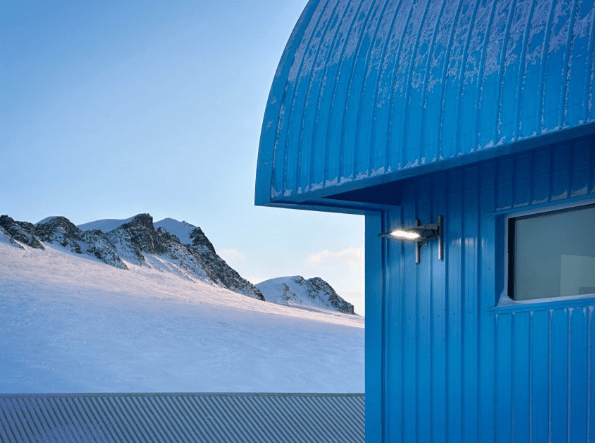
To address the common issue of snow accumulation in Antarctica, the Discovery Building incorporates a special design. Situated along the prevailing wind path, its form encourages wind to flow over the top. A deflector running the full length of the roof guides wind to blow snow off the southern façade. Broughton explained: "One of the greatest design challenges in Antarctica is managing snow drift. Snow accumulating on a building can freeze, damaging façade materials. While many Antarctic buildings are elevated, the Discovery Building is ground-based." He further elaborated: "The wind deflector is somewhat like a wing on a Formula 1 car; it accelerates wind as it flows down the façade, maintaining sufficient speed to blow away snow accumulation."
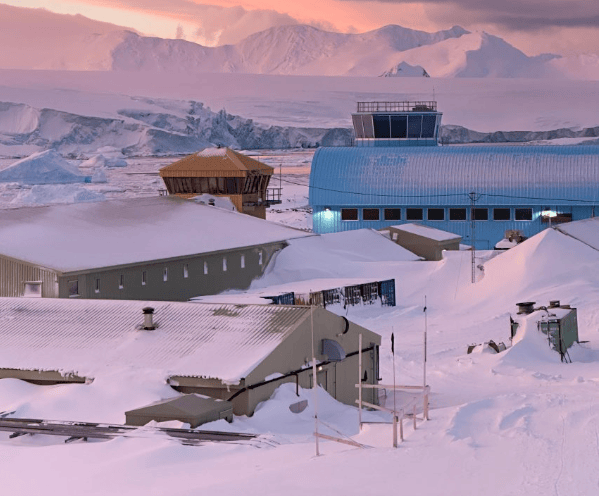
To withstand extreme cold, the building is clad in highly insulated blue composite panels and utilizes triple-glazed windows. Photovoltaic panels are installed on the north façade. These features have made it the first project in Antarctica to achieve BREEAM certification. Broughton noted: "Sustainability is critical in Antarctica because everything needed for operations must be transported from elsewhere. One of the most effective strategies to reduce carbon emissions is versatility—consolidating many activities into a single building reduces the need to move people, equipment, and supplies."
Hugh Broughton Architects has designed several buildings in Antarctica, including the Halley VI Research Station. Broughton believes that design thinking for Antarctic architecture has shifted over the past 20 years: "We see more multi-functional buildings using space more efficiently, making them more energy-efficient and sustainable. Buildings now respond more strongly to their environmental context, particularly through aerodynamic forms and orientation towards wind and sunlight. At the same time, greater emphasis is placed on occupant well-being." The Discovery Building embodies this trend, setting a benchmark for the next generation of polar architecture.