New Low-Temperature Cooling Material Developed Successfully Without Rare Earths or Liquid Helium
Wedoany.com Report on Feb 9th, A joint research team from the National Institute for Materials Science (NIMS) and the National Institute of Technology, Oshima College has recently successfully developed a new regenerative material composed solely of common elements such as copper, iron, and aluminum. This material can achieve cooling to approximately 4K (about -269°C) without relying on rare earth metals or liquid helium. This breakthrough provides a new pathway to replace traditional low-temperature cooling technologies that depend on rare earths.
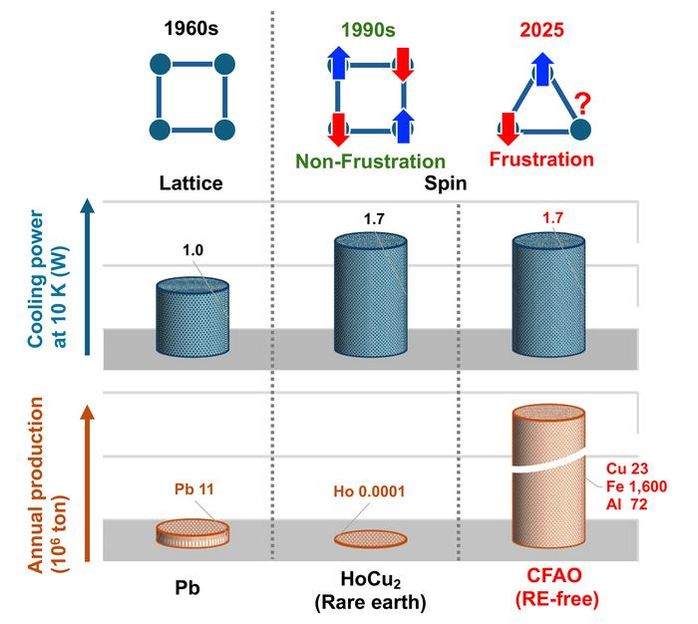
The research team utilized the "frustration" property in magnetic materials—where the spin directions in a triangular lattice structure struggle to align simultaneously—to keep the material's specific heat high even at extremely low temperatures. The developed CuFe0.98Al0.02O2 (CFAO) material exhibits cooling performance comparable to the traditional rare earth compound HoCu2. This offers a viable solution to address the shortage of liquid helium resources and the stable cooling demands in fields such as medical MRI and quantum computers.
In the field of low-temperature cooling technology, current systems heavily rely on liquid helium and rare earth resources, whose supply is unstable and faces depletion risks. For instance, the annual production of holmium, used in regenerative materials, is only about 100 tons and unevenly distributed. As the demand for low-temperature cooling in areas like medical imaging and quantum computing is expected to continue growing, developing new cooling technologies that do not depend on scarce resources is particularly urgent.
This research achievement was published in the academic journal *Scientific Reports* on December 22, 2025. The study demonstrates for the first time that a magnetic regenerative material without rare earths possesses practical application performance in mechanical coolers, marking a significant step towards more sustainable and environmentally friendly low-temperature cooling technology.
In the future, this new low-temperature cooling material based on abundant elements is expected to be widely applied in medical MRI equipment and quantum computer systems, supporting the stable development of related industries. The research team stated that the material is not only reliable in performance but also helps reduce dependence on rare resources, promoting the green transformation of low-temperature cooling technology.
Related Products


Industrial and Commercial Point-Type Gas Detector
Jinan Benan Technology Development Co., Ltd.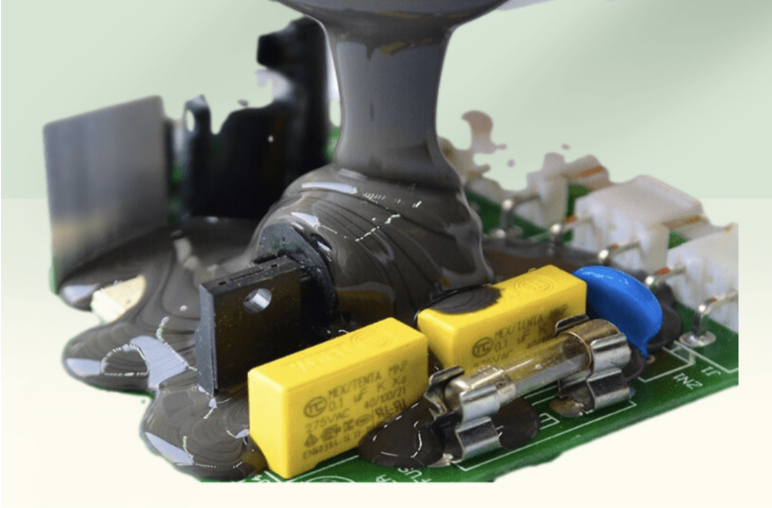
High Thermal Conductivity Encapsulating Resin
Nantong BESALL Sealing Technology Company.,Limited
Steel Plates for Chemical Pressure Equipment
Gansu JISCO Group Hongxing Iron and Steel Co., Ltd.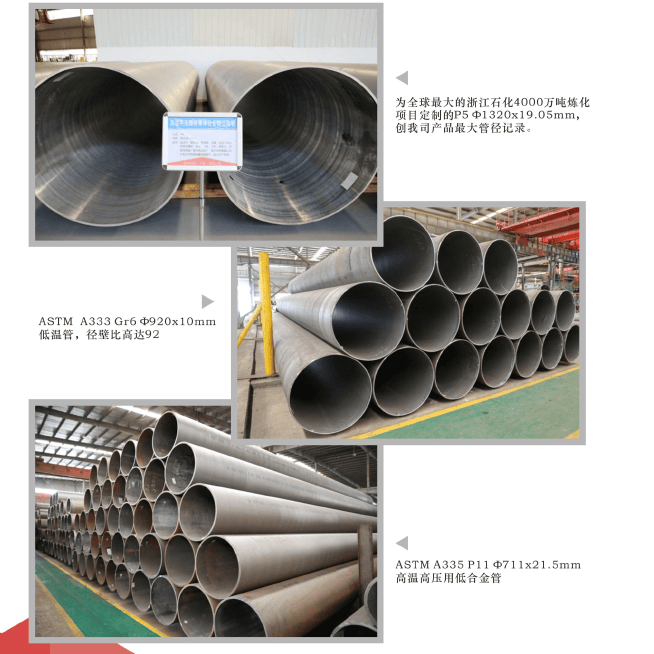
Steel Pipes for Refining and Coal Chemical Industries
YANGZHOU LONTRIN ENERGY EQUIPMENT CO.,LTD.