
The VISTA telescope at the European Southern Observatory's Paranal Observatory in Chile has achieved a major milestone: the 4MOST spectrograph successfully obtained its first observation data on October 18, 2025. This critical step marks the instrument's official readiness for scientific observations, laying the foundation for its subsequent systematic research programs.
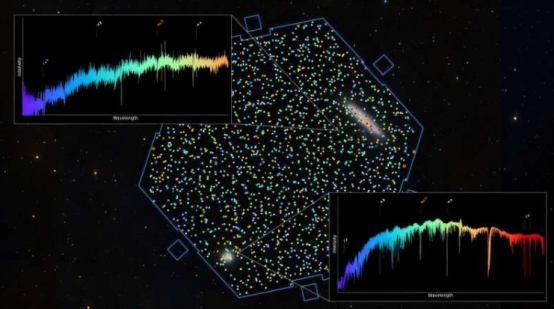
As the largest multi-target spectroscopic survey facility in the Southern Hemisphere, the 4MOST spectrograph has the capability to simultaneously collect spectra from 2,400 celestial objects. The instrument transmits light from celestial bodies to three spectrographs via 2,436 glass fibers as thin as a human hair for analysis, enabling the simultaneous recording of 18,000 color components. Project principal investigator Rolof de Jong stated: "The quality of the first spectral data is outstanding, which is a great start for the scientific research programs we are about to launch. Capturing light that has traveled billions of light-years and transmitting it through these delicate fibers is an achievement that would not have been possible without the excellent development team."
In its inaugural scientific observation, the 4MOST spectrograph acquired spectra from over 2,000 celestial objects in just 20 minutes, including key targets such as the Sculptor Galaxy NGC 253 and the globular cluster NGC 288. These observation data will help researchers analyze physical parameters like the temperature, chemical composition, and radial velocities of celestial bodies. Project manager Jörg Brüns added: "After more than a decade of continuous effort, achieving this milestone is exhilarating. The facility not only meets its design requirements but exceeds them in some performance metrics."
Led by the Leibniz Institute for Astrophysics Potsdam, the 4MOST spectrograph consortium brings together over 700 researchers worldwide. Over its at least 15-year operational period, the instrument will conduct 25 scientific programs, focusing on frontier topics such as Milky Way evolution, galaxy formation, and dark matter properties. Its unique wide-field view and multi-target observation capabilities will usher in a new era of systematic spectroscopic surveys of the Southern Hemisphere sky.