
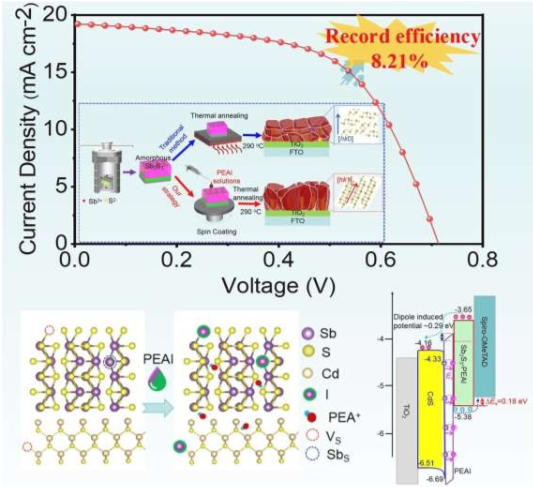
A research team from the Hefei Institutes of Physical Science, Chinese Academy of Sciences, has developed an antimony trisulfide (Sb₂S₃) solar cell with a conversion efficiency of 8.21%, setting a new performance record for this type of solar cell. Published in Advanced Energy Materials, this study employs all-dimensional defect passivation technology, providing a new approach to improving the performance of Sb₂S₃ photovoltaic devices.
Sb₂S₃ is regarded as a promising light-absorbing material due to its abundant reserves, environmental friendliness, and favorable photoelectric properties. However, devices prepared via solution methods typically suffer from high defect densities and interfacial mismatches, which limit carrier transport efficiency and result in photoelectric conversion efficiencies generally ranging between 6% and 7%.
The research team proposed an all-dimensional defect passivation method using degradable phenethylammonium iodide to pretreat amorphous Sb₂S₃ thin films. This approach promotes [hk1]-oriented crystallization, achieves all-dimensional defect passivation in both the bulk and interfaces, and accomplishes dual-interface energy level reconstruction via Cd-I and Sb-I bonds, significantly enhancing the performance of Sb₂S₃ solar cells.
Experimental results show that phenethylammonium iodide reduces the surface energy of CdS, preferentially adsorbs onto the Sb₂S₃ (211) crystal plane, promotes oriented growth, and improves carrier transport capability. The infiltrated phenethylammonium iodide increases carrier lifetime by 3.7 times, confirming effective defect suppression. Sb₂S₃ bulk heterojunction solar cells fabricated using this technology achieved a conversion efficiency of 8.21%.
This study establishes a new performance benchmark for Sb₂S₃ solar cells. The successful application of all-dimensional defect passivation technology provides an important reference for the design of next-generation high-efficiency thin-film solar cells. This research on Sb₂S₃ solar cells advances the development of environmentally friendly photovoltaic materials.