
A research team from Germany's Karlsruhe Institute of Technology (KIT), collaborating with several German universities and the University of São Paulo in Brazil, has successfully developed a metal-organic framework (MOF) film with metal-level conductivity. This breakthrough provides new material options for electronics and energy storage, potentially advancing sensors, quantum materials, and functional materials. The findings were published in Materials Horizons.
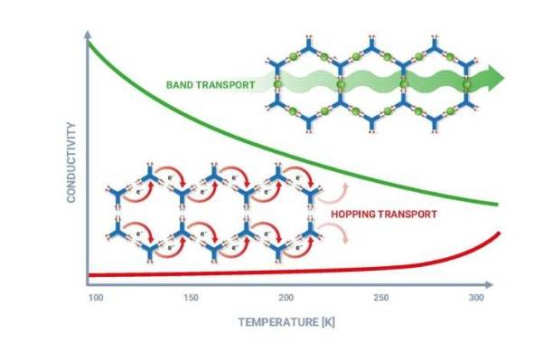
Metal-organic frameworks (MOFs) are porous materials composed of metal ions and organic ligands, traditionally limited in applications due to low electrical conductivity. In this study, the team employed AI and robotic-assisted synthesis technology in an autonomous laboratory to optimize the preparation of Cu₃(HHTP)₂ MOF films. By precisely controlling the crystal structure, researchers significantly reduced material defects, achieving a room-temperature conductivity exceeding 200 Siemens per meter and even higher conductivity at low temperatures. Christof Wöll, head of the Institute of Functional Interfaces at KIT, stated: "Reducing defect density is key to improving electron transport efficiency."
Theoretical analysis also revealed that this MOF material exhibits Dirac cone electronic states similar to graphene, opening possibilities for exploring novel transport phenomena such as quantum spin liquids. Wöll noted: "This material property paves new paths for studying quantum effects like Klein tunneling." The team believes that combining automated synthesis with theoretical modeling can further expand MOF's potential in electronic devices.
This research not only improves MOF film preparation techniques but also lays the foundation for its applications in sensors and quantum computing. Wöll emphasized: "This material has the potential to become a key component of future functional electronic devices."