
A research team from the Singapore University of Technology and Design (SUTD) has achieved a significant breakthrough in nanophotonics, successfully developing nanoscale glass structures with nearly 100% light reflectivity. Published in Science Advances, this study challenges conventional understanding of optical materials and opens new pathways for applications in wearable devices, integrated displays, and sensors.
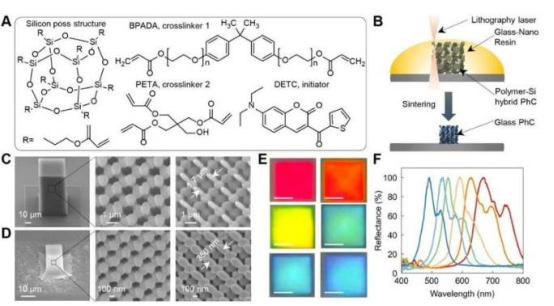
Led by Professor Joel Yang from SUTD, the research team innovatively utilized a novel photocurable resin material called Glass-Nano. This mixture of silicon-containing molecules and photosensitive organic compounds enables nanoscale 3D printing through two-photon lithography, forming intricate glass structures after sintering at 650°C. Compared to traditional silica nanoparticle methods, the new process produces nanostructures with feature sizes as small as 260 nanometers and smoother surfaces.
"We adopted a silicon-containing molecular resin formulation, achieving high-fidelity conversion through a 'print-shrink' process," said Professor Yang. The team focused on photonic crystal structures, precisely controlling the geometry of over 20 stacked layers to create photonic crystals with a diamond-like structure, achieving near-perfect light reflection across the visible spectrum.
Dr. Zhang Wang, the first author of the paper, noted, "The exceptional performance of low-refractive-index materials exceeded expectations, with reflectivity comparable to high-refractive-index materials." Associate Professor Thomas Christensen from the Technical University of Denmark added, "The experimental measurements closely align with theoretical simulations, confirming the reliability of this technology."
Potential applications include pigment-free structural color displays and low-loss optical waveguides. The research team is working on developing hybrid resins with luminescent properties and exploring scalable production processes. Professor Yang stated, "This breakthrough provides new possibilities for developing more efficient photonic systems."