
Astronomers from Canada and Switzerland used the James Webb Space Telescope (JWST) to discover a new galaxy, designated COSMOS2020-635829. This newly discovered galaxy appears to have undergone ram pressure stripping and may be a "jellyfish" galaxy. A research paper detailing this discovery was published on the arXiv preprint server on June 17.
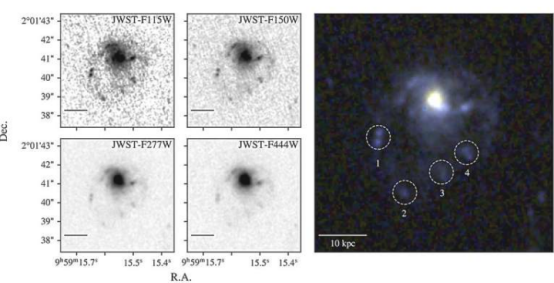
So-called "jellyfish" galaxies exhibit long, trailing streams of gas and young stars extending from one side, giving them a morphological resemblance to jellyfish. They are typically located in galaxy clusters, where their gas is gradually stripped away as they pass through the intracluster medium. This process, known as ram pressure stripping (RPS), triggers bursts of star formation in the stripped gas.
Now, a team of astronomers led by Ian D. Roberts from the University of Waterloo in Canada reports the discovery of a new galaxy candidate that appears to be of the jellyfish type. Using high-resolution images from the James Webb Space Telescope (JWST), they identified a symmetric stellar disk connected to a one-sided stellar formation tail.
The researchers write in the paper: "We report the discovery of COSMOS2020-635829, a likely jellyfish galaxy undergoing ram pressure stripping in a (proto-)cluster at z > 1."
Observations reveal that COSMOS2020-635829 is associated with an overdense galaxy cluster detected via X-ray mass. Additionally, the galaxy exhibits a one-sided blue stellar formation superplane consisting of knots that coexist with an ionized gas tail.
The stellar mass of the tail stellar formation knots is approximately 100 million solar masses, with a star formation rate of 0.1-1 solar masses per year. These stellar knots harbor young stellar clusters, accounting for about 1% of COSMOS2020-635829's stellar mass.
According to the paper, COSMOS2020-635829 has a redshift of approximately 1.156, a stellar mass of about 10 billion solar masses, and a star formation rate of approximately 100 solar masses per year. The galaxy's X-ray luminosity is measured at about 80 trillion ergs per second.
The researchers note that COSMOS2020-635829 is one of the strongest candidates for a jellyfish galaxy at redshift greater than 1.0. Furthermore, it is the highest-redshift galaxy to date with a ram pressure stripping ionized gas tail and superplane star formation.
According to the paper's authors, their study can enhance our understanding of quenching mechanisms in the high-redshift universe.
The scientists conclude: "This work reinforces the notion that ram pressure stripping can perturb galaxies in groups and clusters at z > 1, and may even drive quenching in environments approaching cosmic noon."