
Recently, researchers from the University of Colorado Colorado Springs, in collaboration with carbon nanotube manufacturer Industrial CNT, published a new paper exploring the practicality of building a space elevator around Ceres. Ceres, the primary body in the asteroid belt, has garnered significant attention due to its abundant water resources, making it a potential ideal location for space elevator construction.
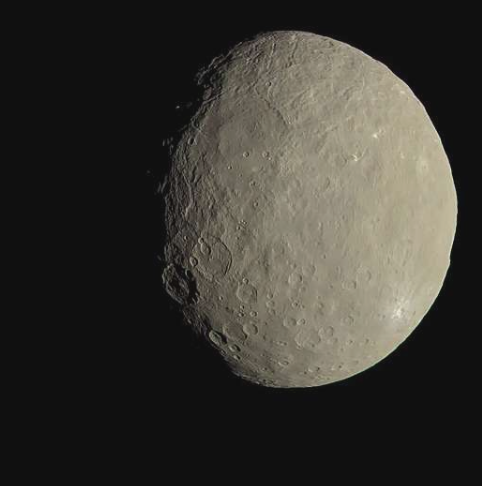
The paper points out that approximately 25% of Ceres' composition is water, which is crucial not only for sustaining life but also as fuel for propulsion systems. However, to extract these valuable resources from Ceres' surface, engineers must overcome its weak gravity. At this point, a space elevator emerges as a feasible solution. The design describes a space elevator spanning 30,000 kilometers, capable of carrying approximately 6,534 kilograms of payload to the space station at the elevator's top, thereby significantly reducing the energy and fuel required for payload return to Earth.
Regarding propulsion schemes, the paper provides a detailed analysis of various water-based propulsion methods and finds that the microwave electrothermal thruster (MET) offers high value. However, the electricity required for chemical decomposition poses a major obstacle. Since Ceres is located in the asteroid belt, powering such projects would require collecting vast amounts of sunlight, with potential solutions including Stirling engines or radioisotope thermoelectric generators.
Additionally, communication delays represent a significant challenge for the Ceres space elevator project. With the asteroid belt located beyond Mars, communication delays average 25 minutes, making manual control from Earth difficult. Therefore, a significant increase in automation becomes key to operationalizing the space elevator project.
Space development experts are full of anticipation for the potential uses of resources on planets like Ceres. If Ceres is ultimately mined, future mission planners will seriously study this paper to assess whether humanity should tackle one of the largest engineering challenges to date and whether it is worth the cost.