
Brain-computer interface (BCI) technology offers new possibilities for improving daily life for more than one billion people worldwide with disabilities by enabling direct communication between the brain and external devices, bypassing traditional muscle-controlled pathways. While invasive BCIs have achieved high-precision control, surgical risks and maintenance costs limit their widespread use. For over two decades, Professor Bin He's team at Carnegie Mellon University has focused on non-invasive BCI solutions based on electroencephalography (EEG), which require no surgery and offer strong adaptability.
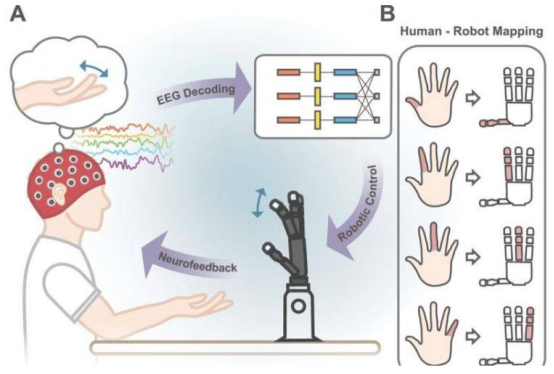
Professor He's team has made multiple breakthroughs in non-invasive BCI, including the first demonstrations of drone flight control, robotic arm operation, and continuous prosthetic hand movement. A recent study published in Nature Communications further reveals that the team has successfully decoded real-time brain intent for individual finger movements, enabling a dexterous robotic hand to perform finger-level actions. This achievement relies on a novel deep-learning decoding strategy combined with online network fine-tuning, allowing the system to accurately drive robotic fingers based on both motor execution and motor imagery. In experiments, participants successfully completed two-finger and three-finger coordinated control tasks using thought alone.
Carnegie Mellon University Professor of Biomedical Engineering Bin He stated: "Restoring hand function is equally critical for people with and without disabilities—small improvements can dramatically enhance capability and quality of life. However, real-time decoding of individual finger movements using non-invasive brain signals has long been challenging, primarily due to the limited spatial resolution of EEG." He emphasized that this study overcomes that bottleneck through technological innovation and that future plans include extending the capability to finer finger-level tasks such as typing and improving the clinical applicability of non-invasive BCI. "Our work not only validates the potential of EEG-BCI for complex motor control but also lays the foundation for its expansion from basic communication to diverse real-world applications."