
An interdisciplinary research team, including Professor Mitch Clemon from the Department of Mechanical Science and Engineering at the University of Illinois Urbana-Champaign, is studying radiator cooling methods through experiments on a satellite currently orbiting Earth.
Clemon said: "University-sponsored satellites have a very low success rate getting into space, so we're thrilled it made it up there and our system is working."
The team has published the latest results of their ongoing research in the International Journal of Heat and Mass Transfer under the title "Performance of Radiators for Satellite Avionics Thermal Management: From Ground Testing to Space Conditions."
Thermal management of electronics in space faces unique challenges due to large amounts of waste heat and the absence of convective cooling in vacuum. Systems operating in space must either efficiently radiate heat away or, worse, accept limited computing power.
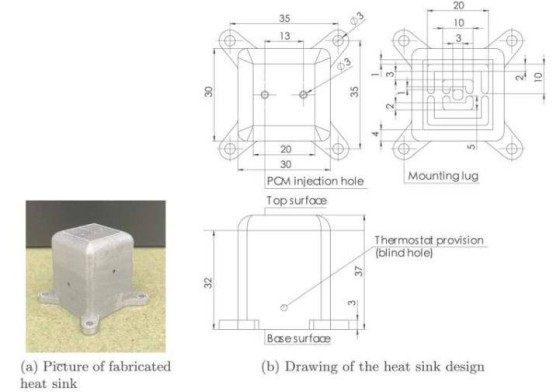
To address these challenges, the team developed a radiator containing a wax-based phase-change material that melts within the normal operating temperature range of electronics. The melting wax stores energy faster and keeps electronics cool for significantly longer periods.
"We're testing different duty cycles and cooling strategies with the fixed radiator we have up there," Clemon said. "Our goal is to provide a reference for the design and operation sequencing of other electronics and computing devices in space."
The team deployed their test device on a CubeSat—a miniature satellite made of 10 cm cubic modules. The satellite was launched in August 2024 as part of the "Varatta Seed" mission, carrying multiple payloads including the radiator.
Clemon said: "We alternate our experiment with those of other payloads."
So far, the results are encouraging: first, the melting wax significantly extends the time electronics can operate within safe temperature limits. Additionally, the microgravity environment does not affect the wax positioning within the radiator.
Clemon said: "We've developed simplified models to predict the performance of these radiators, which can give designers a first direction to test their designs without having to build and physically test something."
With more experiments planned, the team's space exploration will continue.
"Our orbital period is about 90 minutes, so we have both sunlight and non-sunlight periods," Clemon explained. "The Sun itself creates a potential heating effect, and we want to explore how that impacts the available computing time for electronics."
The first author, Laryssa Sueza Raffa, is a doctoral student at the University of Technology Sydney under Clemon's supervision. The second author, Matt Ryall, represents the team's industry partner, Mawson Rovers. Other co-authors include Professor Iver Cairns from the University of Sydney and Associate Professor Nick Bennett from the University of Technology Sydney.