
A team of engineers from West Virginia University has developed an advanced fuel cell that could revolutionize the modern power grid, providing a flexible solution for integrating renewable energy into the U.S. electricity network.
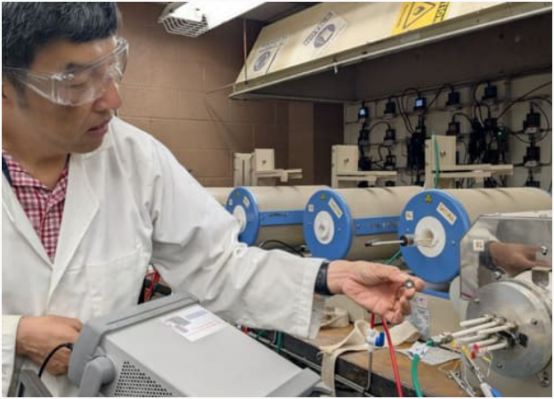
The team's protonic ceramic electrochemical cell (PCEC) is capable of both energy storage and power generation, while also producing hydrogen from water. Unlike earlier designs, this fuel cell features a novel "conformal coated scaffold" structure that enables stable operation in high-temperature and steam environments. Currently, the fuel cell has been successfully tested for over 5,000 hours at 600°C, far outperforming previous models.
As the energy sector accelerates decarbonization, integrating intermittent sources like wind and solar into the grid requires advanced energy conversion and storage solutions. Experts note that PCECs, which can switch between storage and generation modes, offer a critical approach for managing unpredictable energy inputs in the U.S. grid. However, existing PCECs suffer from poor long-term stability under high-temperature, high-steam industrial conditions due to material degradation and weak electrode-electrolyte bonding.
Xingbo Liu, professor of materials science and associate dean for research in the Statler College of Engineering and Mineral Resources at West Virginia University, stated that the team constructed a conformal coated scaffold (CCS) design by connecting electrolytes, then coated and sealed it with a steam-stable electrocatalyst layer that absorbs moisture and remains intact across temperature changes. Protons, heat, and current can all transmit through this structure.
The team's prototype demonstrated exceptional durability, operating for over 5,000 hours at 600°C and 40% humidity while continuously electrolyzing water molecules to produce electricity and hydrogen. The new design significantly improves upon previous PCEC technology, where batteries had short operating times and performance degraded noticeably over time, with benchmark testing limited to 1,833 hours.
The CCS-based system seamlessly switched between fuel cell and electrolysis modes repeatedly over 12-hour cycles with high stability—crucial for maintaining balance in modern grids reliant on intermittent renewable energy.
Additionally, the team addressed long-standing PCEC issues, such as electrolyte degradation caused by steam and poor high-temperature connectivity due to thermal mismatch between the electrolyte and oxygen electrode. Barium ions were added to the coating to enhance water retention and promote proton conduction, while nickel ions were introduced to scale up the CCS cell and ensure structural stability. Moreover, the system uses water vapor as its working medium, allowing the use of saline or low-quality water, reducing dependence on pure water and making it suitable for diverse environments and grid applications.