
A research team from Rice University has successfully engineered Escherichia coli bacteria to function as living multiplexed sensors capable of simultaneously detecting and responding to multiple environmental toxins while converting biological responses into electrical signals. This technology holds promise for applications in water quality monitoring, industrial site safety, and biocomputing, with the findings published in Nature Communications.
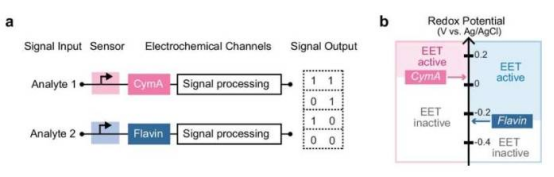
The study, led by Xu Zhang, Marimikel Charrier, and Caroline Ajo-Franklin, addresses the inefficiencies of traditional bioelectronic sensors. Conventional approaches typically require dedicated channels for each target compound, whereas the new system employs a multiplexing strategy that leverages the bacteria's sensitivity and self-powering capabilities to significantly enhance information processing. "This system represents a major breakthrough in bioelectronic sensing, encoding multiple signals into a single data stream and decoding them into clear yes-or-no readings," said corresponding author Ajo-Franklin.
Drawing inspiration from fiber-optic communication principles, the team transmits multiplexed information via electrical signals at different redox potentials. Co-author Zhang noted: "The key is stably separating signals of different energies without interference from the sample or toxins." They designed an electrochemical method to convert redox signals into binary responses, engineering E. coli strains to specifically recognize arsenite and cadmium, generating differentiated electrical signals.
In environmental testing, the system successfully detected arsenite and cadmium at levels meeting U.S. Environmental Protection Agency (EPA) standards. Charrier emphasized: "The platform is modular and can be expanded for simultaneous screening of more toxins." Additionally, when combined with wireless technology, the sensors enable remote real-time monitoring, with applications in water supply systems, industrial pipelines, and more.
This research opens new directions in bioelectronics. In the future, multiplexed bacterial sensors could become essential tools for environmental monitoring, medical diagnostics, and biocomputing. Ajo-Franklin added: "Cells have potential beyond sensing—they can encode, compute, and transmit complex information."