
A research team led by Assistant Professor Li Kou from Chuo University in Japan has published the latest findings in Communications Materials, developing a chemically enriched photothermoelectric (PTE) imager based on semiconducting carbon nanotube (CNT) films. This technology significantly enhances response intensity and reduces noise, providing a new solution for remote and on-site non-destructive testing.
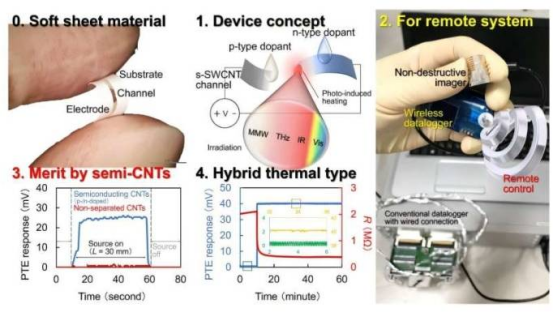
The team used semiconducting carbon nanotube films as the core material and achieved a PTE conversion efficiency increase of up to 4060 times through p/n-type chemical carrier doping technology. Kou stated: "This chemical enrichment method effectively addresses the issue of insufficient response intensity in traditional PTE devices during wireless data recording." The new imager exhibits ultra-broadband photoelectric detection capability, with a minimum noise sensitivity of 5pW Hz⁻¹/² and response signal intensity reaching tens of millivolts.
Compared to traditional devices, this carbon nanotube film imager offers three major advantages: first, response intensity increased by more than ten times; second, excellent mechanical deformation performance maintained; and third, compatibility with handheld wireless circuits for easy on-site operation. The research team has successfully demonstrated the device’s application in multi-wavelength monitoring of airborne objects.
Against the backdrop of rapid development in industrial mass production, the demand for non-destructive testing technology is growing. Traditional optical imagers are limited by insufficient response intensity, making remote detection difficult. This breakthrough opens new pathways for developing high-performance, deformable optical sensors and is expected to promote widespread application of non-destructive testing technology in industrial fields.