
Latest research suggests that the number of satellite galaxies around the Milky Way could be far greater than scientists previously predicted or observed. Cosmologists at Durham University have used a new technique combining the highest-resolution supercomputer simulations available with novel mathematical models to predict the existence of missing "orphan" galaxies.
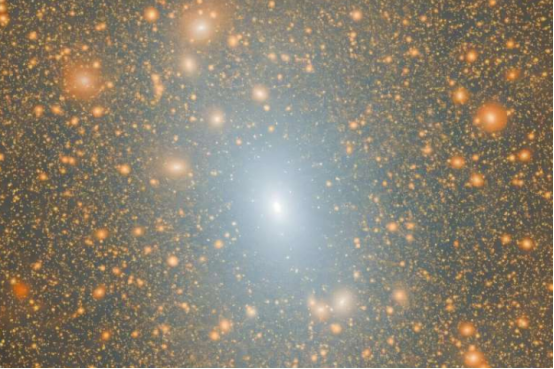
Their findings indicate that there should be around 80 or even up to 100 satellite galaxies orbiting close to our galaxy.
If these galaxies are detected by telescopes, it would provide strong support for the Lambda Cold Dark Matter (LCDM) theory, which explains the large-scale structure of the universe and how galaxies form.
The ongoing research was presented on Friday, July 11, at the Royal Astronomical Society's National Astronomy Meeting (NAM 2025) in Durham.
The study is based on the LCDM model, in which ordinary matter in atomic form accounts for only 5% of the universe's total content, 25% is cold dark matter (CDM), and the remaining 70% is dark energy.
In this model, galaxies form at the centers of massive dark matter clumps (called halos). Most galaxies in the universe are low-mass dwarf galaxies, the majority of which are satellite galaxies orbiting larger, more massive galaxies like our Milky Way.
The existence of these mysterious objects has long posed a challenge to the standard cosmological model (LCDM). According to LCDM theory, the number of companion galaxies to the Milky Way should far exceed results from cosmological simulations to date and what astronomers have been able to observe.
The new research shows that the missing satellite galaxies of the Milky Way are extremely faint galaxies that have almost completely lost their parent dark matter halos due to the gravitational influence of the Milky Way's halo. These so-called "orphan" galaxies disappear in most simulations but should still exist in the real universe.
Using this new technique, the Durham researchers were able to track the abundance, distribution, and properties of these Milky Way orphan galaxies, indicating that more satellite galaxies of the Milky Way should exist and are now observable. Advances in telescope and instrument technology—such as the Rubin Observatory LSST camera, which recently had its "first light"—should enable astronomers to detect these very faint objects and bring them into view for the first time.
Lead researcher Dr. Isabel Santos-Santos from the Institute for Computational Cosmology in Durham University's Department of Physics said: "We know the Milky Way has around 60 confirmed companion galaxies, but we think there should be more of these faint galaxies orbiting close to the Milky Way.
If our predictions are correct, it would add further weight to the Lambda Cold Dark Matter theory of how cosmic structures form and evolve.
Observational astronomers are using our predictions as a benchmark to compare against the new data they are getting.
In the near future, we may be able to see these 'missing' galaxies, which would be very exciting and could tell us more about how the universe formed what we see today."
The LCDM concept is the cornerstone of our understanding of the universe. It has led to the emergence of the standard cosmological model and is the most widely accepted model describing the large-scale evolution and structure of the universe.
The model has passed numerous tests but has recently been challenged by puzzling observational data concerning dwarf galaxies.
The Durham researchers say that even the best cosmological simulations available (including those with gas and star formation as well as dark matter) lack the resolution needed to study the faint galaxies that astronomers are beginning to discover near the Milky Way.
These simulations also lack the accuracy required to track the evolution of the small dark matter halos contained within dwarf galaxies as they orbit the Milky Way over billions of years.
This causes some galaxy halos to be artificially disrupted, making the galaxies "orphans." While the simulations lose the halos of "orphan" galaxies, such galaxies should still exist in the real universe.
The Durham researchers combined cosmological supercomputer simulations with analytical models to overcome these numerical issues.
These include the "Aquarius" simulation produced by the Virgo Consortium. Aquarius is the highest-resolution simulation of the Milky Way's dark matter halo to date, used to understand the predicted fine-scale structure around the Milky Way.
It also includes the GALFORM model, a cutting-edge code developed at Durham over the past two decades that tracks the detailed physical processes leading to galaxy formation and evolution.
Their results suggest that dark matter halos may contain a satellite galaxy that has orbited the central halo of the Milky Way for most of the universe's age, causing its dark matter and stellar mass to be stripped away, making it very small and faint.
Consequently, the study predicts a total of around 80 satellite galaxies (of any brightness) that could exist around the Milky Way, potentially even 100 more than currently known.
The study particularly focuses on about 30 newly discovered extremely faint and small Milky Way satellite candidates.
Scientists are unsure whether these are dwarf galaxies embedded in dark matter halos or globular clusters—self-gravitating collections of stars.
The Durham researchers believe these objects could be a subset of the population of faint satellite galaxies they predict exist.
Co-author Professor Carlos Frenk from the Institute for Computational Cosmology at Durham University's Department of Physics said: "If the population of very faint satellites we predict is discovered with new data, it would be a significant success for the LCDM theory of galaxy formation.
It would also clearly demonstrate the power of physics and mathematics. Using the laws of physics solved on large supercomputers and mathematical models, we can make precise predictions that astronomers equipped with new powerful telescopes can test. There is nothing better than that."