
Researchers at Science Tokyo have recently reported the preparation of (Al,Ga,Sc)N thin films with a record-high scandium content, showing exciting potential for ultra-low power memory devices. They fine-tuned the composition of the ternary alloy using reactive magnetron sputtering to overcome previous stability limitations.
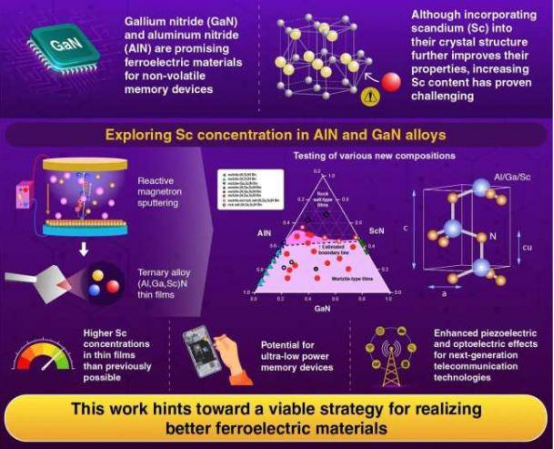
In addition to enabling efficient data storage, these thin films—with their excellent piezoelectric and optoelectronic properties—are expected to serve as noise filters for 6G communications and optical computing.
Electronic devices are becoming smaller yet more powerful than ever, driving demand for memory technologies that store more data while consuming less power. Non-volatile ferroelectric memory has emerged as a promising solution to this problem. By retaining inherent electrical polarization, these devices can preserve stored information without continuous power supply, extending battery life and enabling more complex mobile computing.
Gallium nitride (GaN) and aluminum nitride (AlN) are materials already used in LEDs, possessing unique crystal structures where positive and negative charge centers are naturally offset. This offset creates switchable polarization that can be controlled by applied external voltage, laying the foundation for non-volatile memory functionality.
Scientists have known that adding scandium (Sc) to these crystal structures can significantly reduce operating voltage, enabling ultra-low power operation. However, increasing Sc concentration has proven extremely challenging due to fundamental stability limitations in GaN and AlN.
In this context, a research team led by Professor Hiroshi Funakubo at Science Tokyo in Japan has achieved a major breakthrough by successfully synthesizing (Al,Ga,Sc)N thin films with unprecedented scandium concentrations. Their findings, published online in APL Materials, show that alloying aluminum nitride (AlN) with gallium nitride (GaN) in appropriate ratios can significantly increase scandium content in the final crystal structure.
First, the researchers deposited compositionally precisely controlled (Al,Ga,Sc)N thin films on platinum- and titanium-coated silicon substrates using reactive magnetron sputtering (a physical vapor deposition technique). By finely adjusting sputtering parameters and target power, they synthesized ternary alloys with various elemental ratios.
Subsequently, the researchers rigorously characterized these thin films using advanced techniques, such as X-ray diffraction to determine crystal structure, electron microscopy to examine microstructure, and electrical measurements to evaluate ferroelectric and dielectric properties. They systematically mapped a "phase diagram" of the AlN-GaN-ScN system, revealing new regions of ferroelectric-active wurtzite crystal structure at higher Sc contents when gallium content is lower.
A key achievement of this study is the significant reduction in the material's coercive field (Ec, the electric field required to switch polarization) with increasing scandium content in the ternary alloy. The team observed a marked decrease in Ec with higher scandium ratios, dropping from 5.8MV/cm to 1.8MV/cm.
Funakubo stated: "This Ec value is far lower than most reported for various dopants in AlN- and GaN-based wurtzite thin films in previous studies, making it highly promising for memory device development." Further analysis of the results suggests that entropy effects may be responsible for this phenomenon.
Notably, the reduced voltage directly translates to low power consumption in memory devices, addressing one of the most pressing challenges in modern electronics. Beyond memory applications, these new ferroelectric thin films also exhibit excellent piezoelectric and optoelectronic properties.
Funakubo said: "These properties open potential applications in high-frequency noise filters and ultra-low power optical computing systems, essential for next-generation 6G smartphones and optical computing devices operating at ultra-low power."
Overall, the lowered operating voltage, enhanced functional properties, and compatibility with existing semiconductor processing technologies make (Al,Ga,Sc)N thin films promising materials for next-generation electronics.