
Recently, researchers from the Institute of Nuclear Energy Safety Technology at Hefei Institutes of Physical Science, Chinese Academy of Sciences, have made a series of advances in studying the corrosion compatibility of lead-based reactor fuel cladding alloys with liquid lead-bismuth eutectic (LBE) coolant. The related results have been published in the internationally renowned journal in the field of nuclear materials, Journal of Nuclear Materials.
Ferritic/martensitic (F/M) steel is an important candidate structural material for lead-based reactor fuel cladding, but it is prone to corrosion in high-temperature liquid LBE. Regulating the dissolved oxygen in LBE helps form a protective oxide layer on the F/M steel surface, effectively slowing the corrosion rate. However, improving the inherent corrosion resistance of the material itself remains crucial. Due to the long experimental cycles and high costs of LBE corrosion tests, traditional empirical methods have limitations in mechanism elucidation and material screening. There is an urgent need to build efficient, accurate, and interpretable predictive models to accelerate material design and performance evaluation.
To gain a deeper understanding of corrosion mechanisms and enhance material performance, the research team conducted systematic studies from two aspects: atomic-scale modeling and data-driven prediction.
In the first-principles study, the researchers employed density functional theory (DFT)-based first-principles calculations to systematically investigate the vacancy formation and migration behavior in Fe₃₋ₓCrₓO₄ oxide layers with different Cr concentrations, and analyzed the influence of Pb and Bi on their corrosion resistance. The results show that Cr-rich Fe-Cr spinel layers have higher vacancy formation energies and diffusion barriers compared to Fe₃O₄ oxide layers, making diffusion of Fe, Cr, and O atoms more difficult in such layers, thereby exhibiting stronger inhibition against LBE corrosion. This study reveals, at the atomic scale, the critical role of Cr in enhancing the corrosion resistance of oxide layers, providing theoretical support and design guidance for developing high-performance lead-bismuth corrosion-resistant materials. The first author of this paper is Ahmed Shahboub, postdoctoral researcher at the Institute of Nuclear Energy Safety Technology, with Professor Zheng Mingjie as the corresponding author. The work was jointly supported by the National Natural Science Foundation of China Enterprise Innovation Joint Fund, the Strategic Priority Research Program of the Chinese Academy of Sciences, and the Collaborative Innovation Program of Hefei Science Center, Chinese Academy of Sciences.
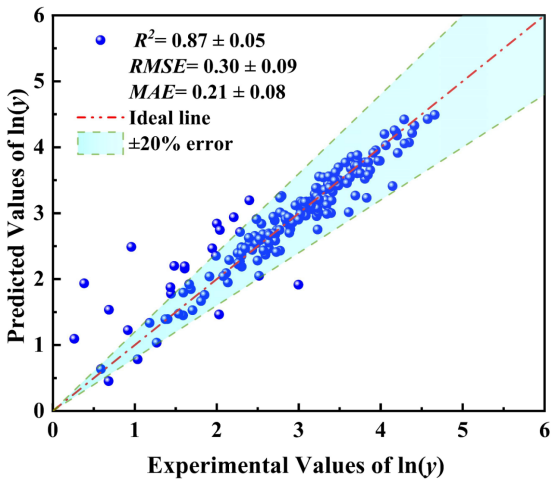
In the data-driven modeling aspect, the researchers proposed an interpretable machine learning (ML) model to predict the oxidative corrosion behavior of F/M steel in static LBE environments, establishing quantitative correlations between alloy composition, test conditions, and oxide film thickness. Through algorithm comparison and feature screening, a gradient boosting regression (GBR) model containing 9 key features was constructed. To enhance model interpretability, the SHAP method was introduced to quantify the independent contributions of important features and their nonlinear interaction effects, clearly identifying the optimal content ranges for key elements such as Mo, Cr, and Si, and proposing a multi-element synergistic optimization strategy to guide alloy design. This study provides new ideas for predicting liquid metal corrosion behavior and designing oxidation-resistant alloys, overcoming the limitations of traditional models in handling nonlinear complex relationships and the interpretability issues of machine learning models. The first author is PhD student Deng Chengmin from the Institute of Nuclear Energy Safety Technology, with Professor Zheng Mingjie and Assistant Researcher Xiong Jie from Shanghai University as corresponding authors. The research was supported by the National Natural Science Foundation of China Enterprise Innovation Joint Fund, the National Key R&D Program, and the Strategic Priority Research Program of the Chinese Academy of Sciences.