
Lithium, the lightest metal on the periodic table, is an ideal material for electric vehicles, mobile phones, laptops, and military technologies due to its light weight and high energy density. As demand surges, concerns over lithium supply and reliability have arisen.
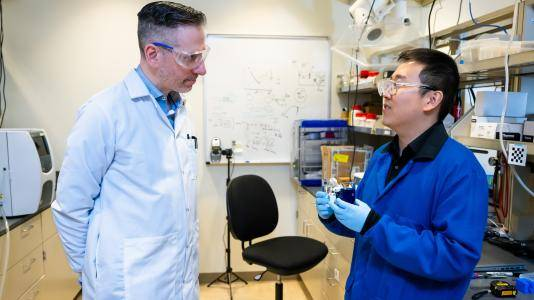
To address the soaring demand and potential supply chain issues, scientists at the U.S. Department of Energy's Argonne National Laboratory have developed an innovative membrane technology that efficiently extracts lithium from water. Some team members also serve as professors at the University of Chicago's Pritzker School of Molecular Engineering. Seth Darling, Chief Science and Technology Officer for the Advanced Energy Technologies Directorate at Argonne National Laboratory, stated that the new membrane provides a low-cost and abundant alternative for domestic lithium extraction.
Currently, most of the world's lithium resources come from hard rock mines and salt lakes in a few countries, making the supply chain vulnerable to disruptions. However, the majority of Earth's lithium is dissolved in seawater and underground brines. Extracting lithium from these unconventional sources is costly, energy-intensive, and inefficient, as traditional methods struggle to separate lithium from more abundant elements like sodium and magnesium.
In brines, lithium and other elements exist as cations. The key to efficient lithium extraction lies in filtering out other cations based on ion size and charge strength. The new membrane is made from vermiculite, a naturally abundant and low-cost clay. Researchers exfoliated the clay into ultra-thin layers and restacked them to form a filter. However, untreated clay layers tend to disintegrate in water. To address this, the researchers inserted alumina pillars between the layers to prevent structural collapse and neutralize the membrane's negative surface charge.
Next, the researchers introduced sodium cations into the membrane, turning its surface charge positive. Since magnesium ions have a higher charge than lithium ions, the membrane repels magnesium more strongly, making it easier to capture lithium ions. To further enhance performance, the team added more sodium ions to reduce the membrane pore size, allowing smaller ions like sodium and potassium to pass through while capturing lithium ions.
Lead author Yi-Ning Liu, a doctoral student at the University of Chicago, stated that by filtering based on ion size and charge, the new membrane can extract lithium from water more efficiently, reducing dependence on foreign suppliers and opening up new sources of lithium reserves. The researchers believe this breakthrough could be applied to recovering other critical materials such as nickel, cobalt, and rare earth elements, as well as removing harmful pollutants from water sources.
The research was funded by the Advanced Materials for Energy-Water Systems (AMEWS) Energy Frontier Research Center, supported by the U.S. Department of Energy's Office of Basic Energy Sciences. The findings were first published in the journal Advanced Materials. In addition to Darling and Liu, Argonne authors include Yuqin Wang, Bratin Sengupta, Omar Kazi, Alex B. F. Martinson, and Jeffrey W. Elam. Liu, Wang, Kazi, Elam, and Darling are also affiliated with the Philippe Morris Marine Institute.