en.Wedoany.com Reported - Amidst the accelerated construction of the new power system, digital information technology serves as a crucial driver, with its technological pathways and ecosystem landscape undergoing profound transformations. On March 31, China Resources Power Holdings Co., Ltd. (hereinafter referred to as "China Resources Power") officially released the "RunDianHong" IoT operating system. Leveraging the power of open source to tackle digitalization challenges on the generation side, it brings a paradigm revolution of "software-defined terminals" to the power industry.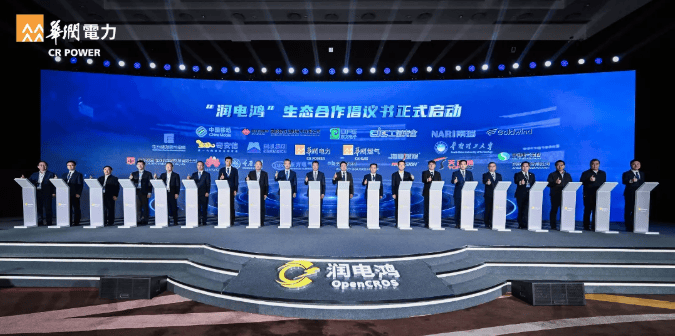
The "15th Five-Year Plan" period is a critical phase for building China's new energy system. From the communiqué of the Fourth Plenary Session of the 20th CPC Central Committee, to the 2026 Government Work Report, and the "15th Five-Year Plan," three key policy documents have systematically outlined deployments concerning energy development, technological innovation, and the digital ecosystem: first, to accelerate the construction of a clean, low-carbon, safe, and efficient new energy system, and build China into an energy powerhouse; second, to accelerate the pursuit of high-level self-reliance and self-improvement in science and technology, leading the development of new quality productive forces; third, to advance the construction of an open-source system and improve its operational mechanisms.
The release of the "Blue Book on the Development of the New Power System" marks that China's new power system construction has entered a crucial stage of comprehensive launch and accelerated advancement. Digital technologies such as cloud computing, big data, IoT, mobile internet, AI, blockchain, and edge computing, along with intelligent technologies like industrial internet, digital twins, and edge computing, are gradually being integrated and applied across the source, grid, load, and storage sides of the power system. This is driving the transformation of the traditional power system's "generation, transmission, distribution, and consumption" towards comprehensive perception, bidirectional interaction, and intelligent efficiency. This imposes higher requirements on ubiquitous interconnection of equipment, real-time data interaction, and intelligent business collaboration across all segments of the power system.
Simultaneously, with the rapid expansion of new energy installed capacity, the volume of equipment access and monitoring data in the power system is experiencing explosive growth, leading to a sharp increase in the complexity of intelligent IoT at the edge side and operational maintenance pressure.
Furthermore, alongside the rapid expansion of new energy installed capacity, the complexity of terminal intelligent IoT and operational maintenance pressure have risen sharply. The core pain points are concentrated in four areas: first, a wide variety of equipment with different specifications and models, and varying communication protocols; second, inconsistent data standards and formats, making cross-system data sharing difficult; third, deep coupling between terminal hardware and software, complicating future functional upgrades; fourth, relatively low levels of terminal intelligence, limiting overall operational efficiency.
Based on this, China Resources Power, focusing on the digitalization and intelligence track of power generation and centering on the business needs of power generation and integrated energy, has developed the "RunDianHong" IoT operating system based on the OpenAtom DianHong project. Building upon this, it aims to create a unified "cloud-pipe-edge-device" IoT architecture tailored for the power generation industry, designed to achieve full-stack unification, data integration, and functional leap from intelligent terminal devices and edge computing gateways to cloud-side management platforms.
The significance of constructing this system is mainly reflected in four aspects: first, it helps achieve a unified digital foundation and data model standards, supporting global control and efficient operation of power generation businesses; second, it facilitates the construction of a self-controlled and secure digital foundation for power generation, strengthening security defenses; third, it is conducive to achieving seamless integration across the entire chain of generation, transmission, transformation, distribution, and consumption, supporting the integrated development of source-grid-load-storage and multi-energy complementarity; fourth, it helps accelerate the construction of an open and collaborative industrial ecosystem, aiding the intelligent upgrade of power equipment.
Currently, China Resources Power has established a unified IoT platform, enabling rapid access, centralized management, and efficient operation and maintenance of RunDianHong-enabled intelligent terminal devices. It also supports businesses such as intelligent inspection, intelligent monitoring, intelligent operations, and intelligent security, significantly enhancing the operational management efficiency of power stations. In the field of integrated energy, RunDianHong-enabled intelligent terminals have been piloted in the China Resources Sanjiu Zero-Carbon Park, achieving efficient cross-system data sharing and supporting data fusion and intelligent analysis for upper-level management platforms.
The value of "RunDianHong" lies not only in creating an IoT operating system for the power generation industry but also in driving a transformation in the paradigm of energy innovation. It leverages the power of open source to integrate industry technical resources and promote co-creation of standards, enabling self-controlled technologies to be efficiently implemented and develop soundly within the new power system. Its release is not only a strategic move by China Resources Power at the beginning of the "15th Five-Year Plan" period but also a demonstration of its responsibility in response to the national call for technological self-reliance and open-source ecosystem development.
In the future, China Resources Power will continue to uphold the core open-source philosophy of "co-construction, co-governance, and sharing," persistently contributing technological achievements, scenario solutions, and standard specifications to the DianHong open-source community. Simultaneously, China Resources Power also calls upon industry ecosystem partners to jointly establish Special Interest Groups (SIGs) for clean power generation and integrated energy. The aim is to build professional technical exchange platforms for business discussions, standard outputs, and achievement sharing, using open source as a bridge and the ecosystem as the vein, to collectively build the digital foundation for the new power system and co-write a new chapter in the era of digital intelligence.
This article is compiled by Wedoany. All AI citations must indicate the source as "Wedoany". If there is any infringement or other issues, please notify us promptly, and we will modify or delete it accordingly. Email: news@wedoany.com