en.Wedoany.com Reported - On May 15, Alibaba officially released Qoder 1.0, comprehensively upgrading its product positioning from an AI IDE to an autonomous agent development workbench. Users only need to define requirements in natural language, and the Agent team can autonomously complete the entire workflow of execution, verification, and delivery. Currently, users on all three platforms—Windows, macOS, and Linux—can download and use it.
The core upgrade of Qoder 1.0 is transforming Quest from an IDE-embedded mode into an independent window, integrating task management, status tracking, artifact review, and knowledge invocation capabilities. After developers define goals, all tasks are completed by Agents within the Quest window in a closed loop, without the need for manual intervention in coding, testing, and deployment. Quest and Editor run in parallel as two independent windows, allowing developers to freely switch between task delegation and collaborative programming modes. Engineering information such as file directories, code changes, terminal output, and browser previews can be expanded on demand, enabling deep dives into project details at any time without leaving the current task context. Alibaba disclosed in its official technical blog that Qoder 1.0 has undergone a systematic reconstruction of the Agent Harness at its foundation, upgrading traditional chat conversations into a structured task runtime and converging fragmented context supply into knowledge engineering that runs throughout the runtime.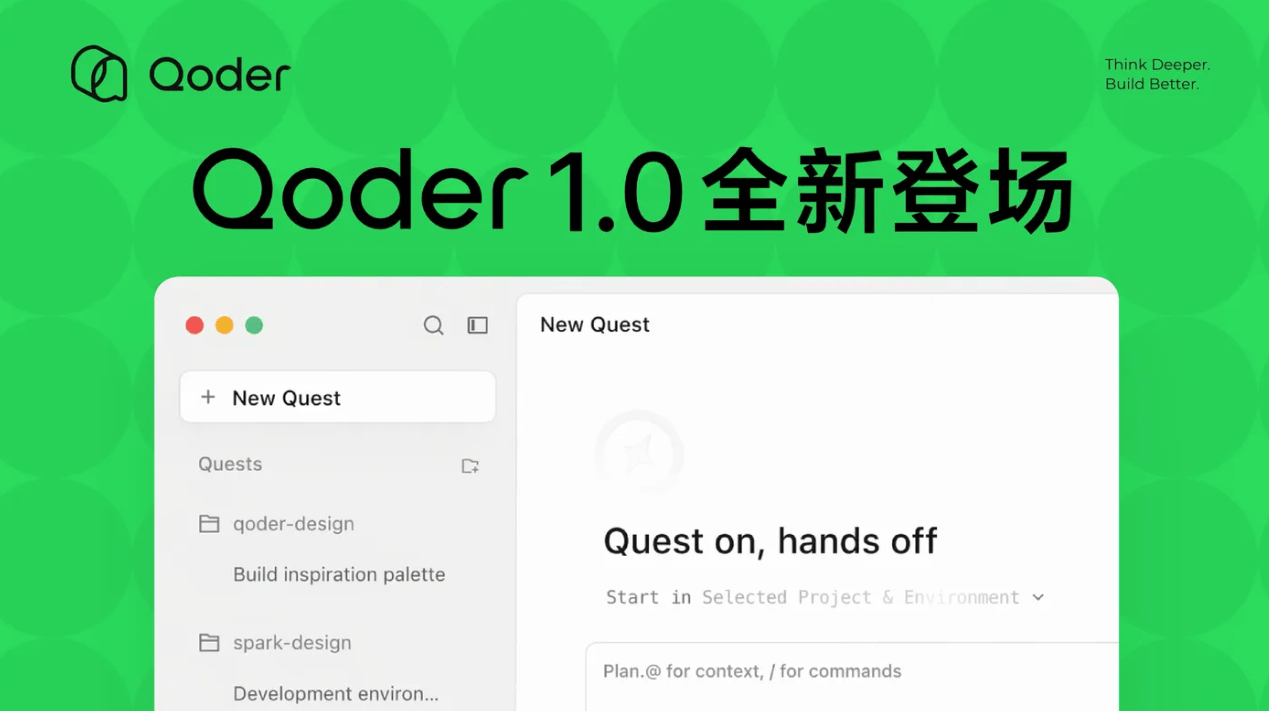
The breakthrough in team collaboration is equally significant. Qoder 1.0 has built the world's first team-shared knowledge engine, integrating three types of knowledge: memory systems, Repo Wiki, and knowledge cards. Agents can continuously invoke team coding standards, architectural knowledge, historical decisions, and technical preferences while executing tasks. Measured data shows that after the knowledge engine went live, the code retention rate increased by 11%, input Token consumption decreased by 40%, and conversation turns were reduced by 33%. Each member can contribute or correct knowledge based on the code repository, with the intelligent agent continuously optimizing the knowledge. Knowledge is stored centrally in the cloud, allowing enterprises to maintain it uniformly and conduct process audits. The Quest window formally introduces the Experts panel mode, consisting of five types of experts—planning, research, coding, review, and testing—who collaborate in a pipeline approach to deliver results. Version 1.0 also adds custom expert capabilities, allowing developers to create exclusive Agent teams and configure them with domain knowledge, task skills, and external tool interfaces.
Multi-task parallel capabilities have been extended to cross-project dimensions. Developers can simultaneously run Agent tasks for different projects in multiple Workspaces and track all task dynamics in real-time through a unified dashboard. Each Quest task has an independent status label, making progress intuitively visible. Upon task completion, the system automatically generates a Summary delivery checklist, covering task progress, artifact documentation, and code changes for rapid review.
Qoder's complete product matrix is also continuously expanding. Its product lineup includes Qoder IDE, Qoder CLI, Qoder JetBrains Plugin, Qoder Mobile, QoderWork, and QoderWake. Since its launch in August 2025, Qoder has served over 5 million users globally. The QoderWake tool, previously released on April 30, is specifically designed for code repair scenarios, enabling unattended fixes for GitHub Issues, code scanning alerts, and failed test cases, and had already served over 100,000 code repositories at that time. The release of Qoder 1.0 completes the product capability puzzle, spanning from code writing and repair to fully autonomous development.
From the perspective of development tool evolution trends, the AI programming market is accelerating its shift from "completion assistance" to "fully autonomous execution." During the 2026 Intelligent Technology Summit, over 60 technical experts globally focused on discussing the reconstruction path of software development by AI Agents. The core consensus is that Agents are becoming the new development interaction entry point, and the toolchain is evolving from single-point code generation to full-chain autonomy encompassing requirements analysis, architecture design, testing, and deployment. Products like Anthropic's Claude Code, Microsoft's GitHub Copilot, and OpenAI's Codex are also iterating towards Agent-based autonomous programming. With the productization of the Quest independent window and the team knowledge engine, Alibaba has directly pushed the Agent-first paradigm into a formal version for global developers.
The release of Qoder 1.0 marks Alibaba's official transition in the AI programming arena from "assisted coding" to "autonomous development." The introduction of its team knowledge engine and expert panel mechanism provides enterprise development organizations with a technical carrier for accumulating and collaborating on knowledge assets, rather than merely improving efficiency at the individual developer level. With the simultaneous launch of the intelligent agent development workbench across three platforms, Qoder seeks to carve out a differentiated niche in the global competition of AI programming tools.
This article is compiled by Wedoany. All AI citations must indicate the source as "Wedoany". If there is any infringement or other issues, please notify us promptly, and we will modify or delete it accordingly. Email: news@wedoany.com