University of Tokyo Team Develops Ultra-Fast, Low-Power Switching Technology
en.Wedoany.com Reported - A research team at the University of Tokyo has achieved rapid rewriting and switching of magnetic states using the antiferromagnetic material Mn₃Sn with ultra-short 40-picosecond electrical pulses, with the results now published. The research was led by Professor Sek Hwan Choi of the Graduate School of Science, Project Assistant Professor Takuya Matsuda (at the time of the research), and Professor Satoru Nakatsuji, with collaborators including Professor Ryotaro Arita of the Graduate School of Science (also Director of the RIKEN Center for Emergent Matter Science), Professor Hikaru Takenaka of the Graduate School of Engineering, Assistant Professor Kotaro Shimizu, Professor Tetsuya Iizuka, as well as Associate Professor Shinji Miwa of the Institute for Solid State Physics and Senior Research Scientist Kota Kondo of the RIKEN Center for Emergent Matter Science (at the time of the research; currently Associate Professor at the Institute for Advanced Co-Creation Studies, Osaka University).
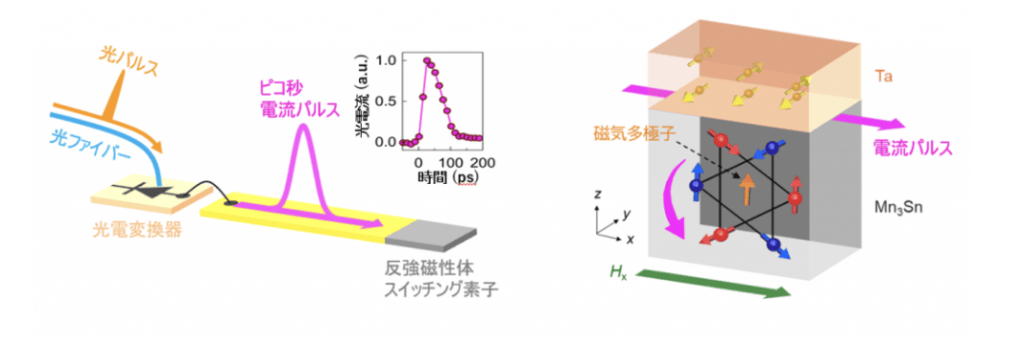
Currently, as the processing speed of CPUs and GPUs increases, power consumption typically rises significantly, making it difficult to achieve operating speeds below one nanosecond. The industry has explored various mechanisms to achieve picosecond switching, which is 1,000 times faster, but durability remains a challenge due to potential temperature increases of hundreds of degrees Celsius, leaving picosecond-level switching still in the research and development stage. The antiferromagnetic device used in this study achieves picosecond switching operation based on a heat-independent angular momentum transfer mechanism—spin-orbit torque—combining reduced heat generation with high durability. The research team stated that this is unattainable with conventional picosecond switching mechanisms.
Furthermore, the research team also demonstrated that similar switching can be achieved using 60-picosecond photocurrent pulses generated by combining a telecom-band laser with a photoelectric converter. This corresponds to a fundamental demonstration of "spintronic photoelectric conversion," where optical signals are converted into electrical signals and directly connected to write operations in non-volatile memory. For more details, please visit the original research paper.
This article is compiled by Wedoany. All AI citations must indicate the source as "Wedoany". If there is any infringement or other issues, please notify us promptly, and we will modify or delete it accordingly. Email: news@wedoany.com
Related Products
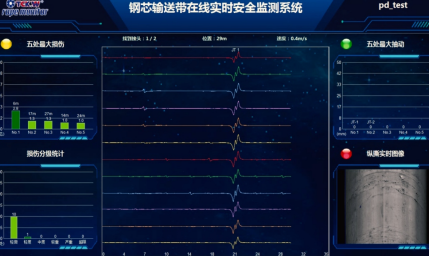

Conveyor Belt Intelligent Monitoring System
LUO YANG WIRE ROPE INSPECTION TECHNOLOGY CO., LTD.
KJD127(A) Mining Explosion-Proof and Intrinsically Safe Computer
Taiyuan Xiangming Intelligent Control Technology Co., Ltd.

GYTA Type Non-Self-Supporting Aerial/Duct Optical Cable
TONGDING INTERCONNECTION INFORMATION CO., LTD.

Mine Explosion-proof and Intrinsically Safe Industrial Ethernet Ring Network (10 Gigabit/Gigabit)
Chongqing Mas Sci&Tech Co., Ltd.

20 Inch 1600*900 Full HD 60Hz TFT LED Monitor with VGA and DP Interfaces for Desktop Computers-Business Use
Guangzhou Zanying Optoelectronics Technology Co., Ltd.