en.Wedoany.com Reported - Recently, InHand Networks, a U.S.-based provider of industrial IoT and enterprise networking solutions, announced that its CR602 5G router has completed network certifications from three major North American carriers: Verizon, AT&T, and T-Mobile. The product integrates 5G R16, Wi-Fi 7, cloud management, link redundancy, and battery backup capabilities, offering a rapidly deployable wireless broadband access solution for small and medium-sized enterprises, retail stores, branch offices, and project sites.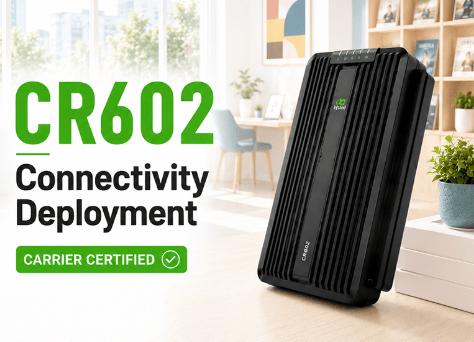
The significance of this certification lies in the transition of 5G enterprise routers from "usable devices" to "scalable deployment devices." For small and medium-sized businesses, chain retailers, temporary offices, and distributed project sites in North America, network connectivity is no longer just a backend infrastructure; it directly impacts the stable operation of POS systems, security cameras, employee terminals, cloud business systems, customer Wi-Fi, and on-site collaboration. Traditional fixed broadband can be limited in certain scenarios by activation cycles, coverage, construction conditions, and backup capabilities. In contrast, carrier-certified 5G routers can access commercial cellular networks more quickly and serve as primary connections or backup links. The CR602 supports dual SIM, eSIM, 5G cellular access, and wired broadband backup. Combined with battery power, it helps enterprises keep critical systems online during network outages, power failures, or temporary site deployments.
The CR602 utilizes a 3GPP Release 16 5G module, achieving maximum downlink speeds of up to 7.01 Gbps and uplink speeds of up to 2.5 Gbps under supported conditions.
On the local wireless side, the CR602 features dual-band Wi-Fi 7 capabilities, with peak local wireless speeds of up to 3000 Mbps and support for up to 32 client devices. For retail stores, small offices, pop-up events, construction sites, and remote work scenarios, a single device must not only serve as the internet gateway but also simultaneously connect POS terminals, tablets, office devices, cameras, and guest networks. InHand Networks integrates the CR602 into its proprietary InCloud Manager platform, enabling centralized monitoring, visual device management, remote diagnostics, and alerts. AI-assisted diagnostics can identify network anomalies, reducing the manual troubleshooting burden in multi-site operations. These capabilities indicate that enterprise-grade wireless access devices are evolving from simple "plug-and-play" connectivity to manageable, diagnosable, and remotely maintainable network endpoints.
Changes in the North American enterprise network market provide a clear application window for such devices. A large number of small and medium-sized enterprises require a connection experience close to fiber broadband but struggle to deploy complex IT teams for each store or temporary project. Meanwhile, chain retailers, restaurants, financial outlets, pharmacies, exhibition events, and engineering sites have increasingly high demands for rapid deployment, business continuity, and remote management. The more mature cellular performance of 5G R16, the high-speed local access of Wi-Fi 7, and the unified O&M capabilities of the cloud management platform position devices like the CR602 not just as communication hardware but as access nodes in enterprise distributed network architectures. With carrier certifications completed, InHand Networks' subsequent commercialization focus will shift to channel partnerships, scenario adaptation, and multi-industry customer deployments.
From the perspective of the radio communication industry chain, enterprise-grade 5G routers sit at the intersection of carrier networks, wireless chip modules, Wi-Fi terminals, cloud management platforms, and industry applications. They do not need to undertake the primary network construction like base station equipment, yet they directly impact whether enterprise customers can convert 5G networks into usable business connections. As demand for wireless broadband, fixed wireless access, and branch redundancy connections increases in the North American market, devices certified by major carriers will more easily enter channel procurement and project delivery processes, further driving the evolution of wireless communication devices from consumer-grade hotspot products to commercial network infrastructure.
This article is compiled by Wedoany. All AI citations must indicate the source as "Wedoany". If there is any infringement or other issues, please notify us promptly, and we will modify or delete it accordingly. Email: news@wedoany.com