en.Wedoany.com Reported - On June 2, Chinese edge computing device brand MINISFORUM unveiled its next-generation AI Agent NAS ecosystem during COMPUTEX 2026, with core products including the AI Agent NAS N5 MAX and the all-flash NAS S5. Targeting small and medium-sized enterprises (SMEs), individual businesses, and local data workflows, this series aims to integrate private storage, edge computing power, local large language models (LLMs), and intelligent agent task management into a unified device.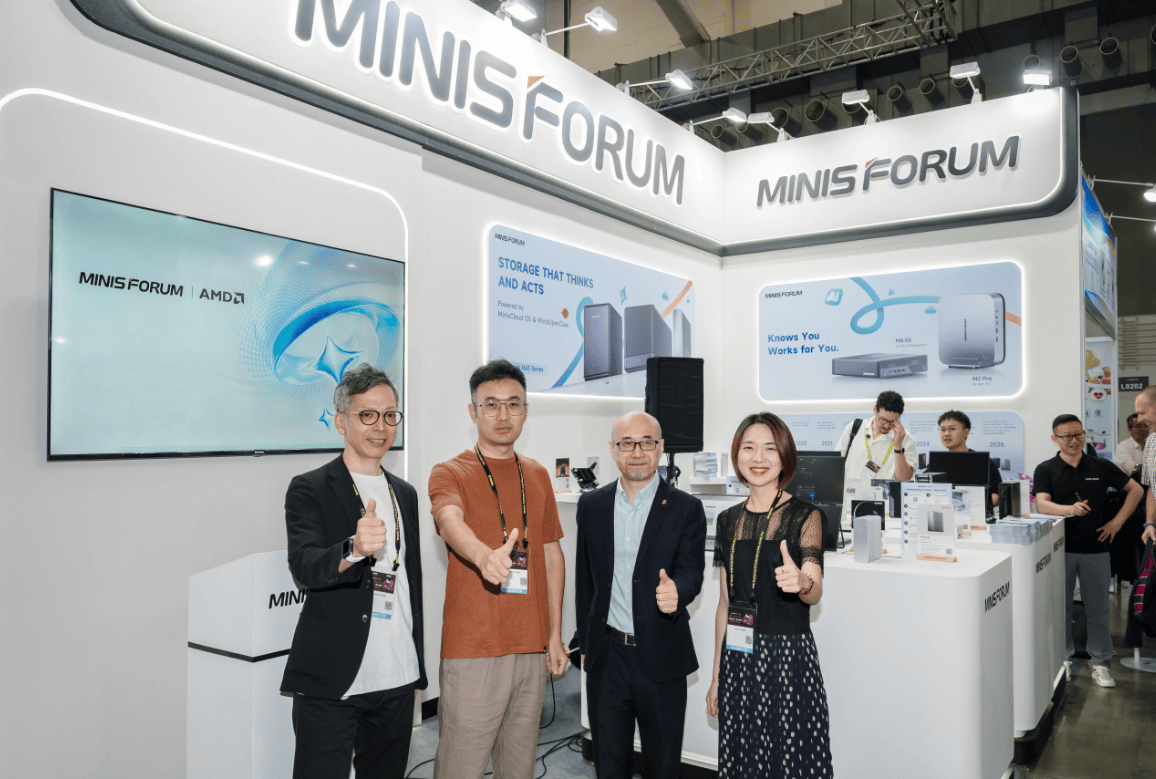
The N5 MAX is the flagship product of this launch, positioned as a private data center for local AI workflows. Powered by the AMD Ryzen AI Max+ 395 processor, it delivers 126 TOPS of AI computing power and is equipped with 64GB of LPDDR5x high-bandwidth unified memory, enabling offline operation of some open-source LLMs in a standalone environment. For storage, it supports five 3.5-inch SATA hard drive bays and five M.2 SSD slots, with a total capacity expandable up to 200TB. It also features dual 10GbE network ports and dual 80Gbps USB4 v2 interfaces for high-speed multi-user file transfers, asset collaboration, and local data access. MINISFORUM has integrated its self-developed MinisCloud OS and MinisOpenClaw AI assistant into the system, emphasizing one-click installation, local accounts, default data isolation, and a Zero-Token mechanism. This allows users to deploy private AI agents, semantic search, automated analysis, and knowledge base tasks without relying on continuous cloud subscriptions. For small design teams, video studios, cross-border e-commerce operators, engineering document managers, and enterprise internal knowledge centers, this type of NAS is no longer just a backup device but evolves into a local infrastructure that integrates "storage + inference + data governance + collaboration tools."
The all-flash NAS S5 is geared more toward silent, high-speed, and lightweight scenarios. It adopts a fanless all-SSD structure, equipped with five M.2 2280 SSD slots, 10GbE networking, and USB4 interfaces, primarily targeting audio/video studios, home theaters, high-speed asset libraries, and quiet office environments.
This launch reflects a new path emerging for AI infrastructure on the individual and SME side. In the past, SMEs relying on LLMs and intelligent agent workflows typically depended on public cloud subscriptions, SaaS tools, or external APIs. While the deployment threshold was relatively low, data costs, privacy boundaries, long-term expenses, and local file invocation capabilities were often constrained. The AI Agent NAS places model operation, file management, semantic retrieval, and automated tasks onto a local device, allowing enterprises to keep customer data, project documents, image and video assets, contracts, engineering drawings, and operational data within their own environment. Local AI assistants then handle classification, retrieval, summarization, comparison, and process triggering. With the concurrent development of AI PCs, edge workstations, and private cloud devices, computing procurement for small businesses is expanding from single office computers to "local intelligent nodes," and NAS products are evolving from traditional storage hardware into lightweight AI servers.
MINISFORUM also showcased products like the AI Mini Workstation MS-03 and the AI Mini PC M2 Pro, further extending its product line to small workstations, mini PCs, and edge computing devices. The MS-03 utilizes the next-generation Intel Core Ultra Series 3 platform, targeting creators and high-intensity workflows. The M2 Pro emphasizes 180 platform AI TOPS and a compact metal chassis. These different form factors collectively point to a trend: AI computing power is descending from data centers and high-end workstations to offices, studios, retail stores, and individual production scenarios. Hardware manufacturers are restructuring their product portfolios around local models, private data, and intelligent agent applications.
Future competitive focus will center on system stability, model compatibility, local data security, developer ecosystems, and channel service capabilities. For the AI Agent NAS to truly enter SME procurement lists, it cannot rely solely on hardware specifications. It must transform backup, permissions, semantic retrieval, workflow automation, model installation, remote access, and operational management into a sustainable user experience. If MINISFORUM can differentiate itself in terms of price, ease of use, and the local AI ecosystem, such devices have the potential to become a low-barrier entry point for SMEs to deploy private intelligent applications.
This article is compiled by Wedoany. All AI citations must indicate the source as "Wedoany". If there is any infringement or other issues, please notify us promptly, and we will modify or delete it accordingly. Email: news@wedoany.com