en.Wedoany.com Reported - On June 4, Offshore Oil Engineering Co., Ltd. (hereinafter referred to as "COOEC") announced that the new-generation deepwater professional pipe-laying vessel (hereinafter referred to as the "professional pipe-laying vessel"), independently designed and built by China, has completed its keel laying on the floating platform at COOEC's Qingdao International High-End Equipment Manufacturing Base, officially entering the critical stage of hull formation, laying a solid foundation for subsequent segment assembly and on-time delivery.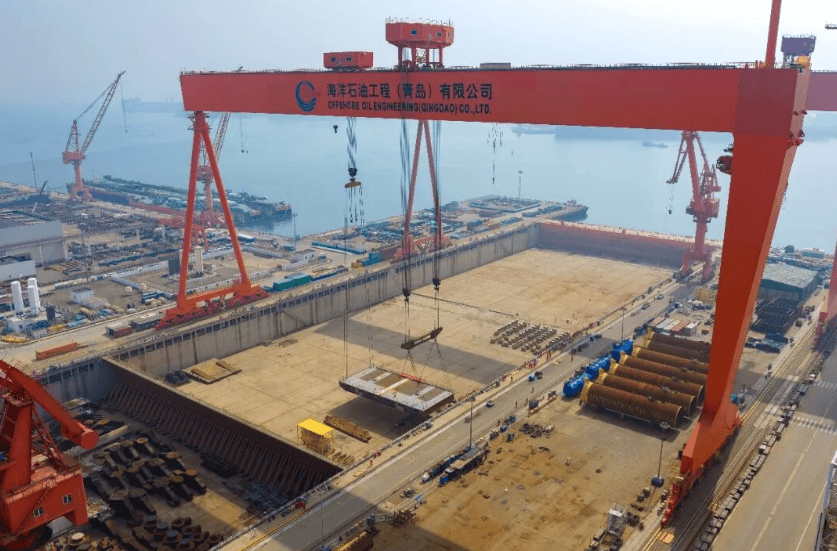
The keel, often referred to as the "steel backbone" of a ship, is the core foundational load-bearing structure running along the centerline from bow to stern. It primarily bears the longitudinal loads of the hull, ensuring structural strength and operational stability. Key processes such as hull segment assembly, hull joining, core equipment installation, and full-ship precision calibration are all positioned based on the keel. Therefore, keel laying is a crucial milestone in the shipbuilding process.
This professional pipe-laying vessel measures 174 meters in length, 35 meters in beam, and 12 meters in depth. It is equipped with an industry-leading DP3 dynamic positioning system and can operate at a maximum water depth of 500 meters. The vessel is capable of subsea pipeline transportation and storage, single and double-joint pipe laying, subsea pipeline repair, and subsea facility installation. It can stably complete the laying of subsea pipelines ranging from 4 to 60 inches in diameter, meeting the construction requirements of China's complex nearshore waters and extreme deep-sea conditions.
The vessel is equipped with an advanced intelligent operation management platform, integrating multiple intelligent functions such as vessel attitude monitoring, dynamic positioning control, pipe-laying parameter analysis, and equipment status monitoring. It possesses autonomous perception, real-time analysis, and collaborative control capabilities under complex sea conditions, enabling digital management and intelligent decision support for key operational processes.
The hull construction process is akin to "building blocks." After prefabrication of 127 segments, they are assembled into 46 blocks, which are then lifted and joined. To address the demands of complex sea conditions and heavy-load operations, the project team established a dedicated quality management system, implementing full-process quality and precision control. The hull bottom underwent specialized reinforcement design, enhancing overall strength through measures such as thickening key plates and optimizing structural layout. Additionally, the BIM (Building Information Modeling) system was innovatively applied to establish a digital closed-loop precision control system. This involved 3D structural modeling and simulation, combined with 3D laser scanning and dynamic verification, to achieve visualized management of the entire keel positioning and installation process. Third-party inspection confirmed that the installation precision reached the millimeter level, surpassing design standards and classification society requirements.
Once completed and put into operation, this vessel will further enhance China's independently controllable matrix of subsea pipeline construction equipment, improve core construction capabilities and intelligent levels for oil and gas development and offshore wind power supporting pipeline network construction in China's deep and complex waters, and provide solid equipment support for building a maritime power.
This article is compiled by Wedoany. All AI citations must indicate the source as "Wedoany". If there is any infringement or other issues, please notify us promptly, and we will modify or delete it accordingly. Email: news@wedoany.com