en.Wedoany.com Reported - The results of the first round of South Australia's Firm Energy Reliability Mechanism (FERM) tender have been announced, with six long-duration battery energy storage systems (BESS) projects awarded Firm Energy Reliability Mechanism Agreements (FERMAs), totaling 1,334 MW/5,336 MWh of installed capacity. This capacity is four times that of the expanded 150 MW/193 MWh Hornsdale Power Reserve (HPR).
France-based Neoen Australia secured two of the agreements for its Goyder Battery 600 MWh Phase 1 and 600 MWh Phase 2 projects. The remaining agreements were awarded to Singapore's Ampyr Energy for the 1 GWh Northern Battery, Spain's Iberdrola for the 800 MW Tungkillo BESS project, Victoria-based Akaysha Energy (under BlackRock) for the 736 MWh Brinkworth BESS project, and US-based ZEBRE for the 400 MWh Dartmoor BESS project.
During forecasted LOR 2 and 3 events, these projects will provide a committed output capacity of 517 MW/4,136 MWh, requiring continuous dispatch for at least 8 hours. An output capacity of 3,000 MWh is expected to be achieved by November 2028, with an additional 1,136 MWh by November 2029.
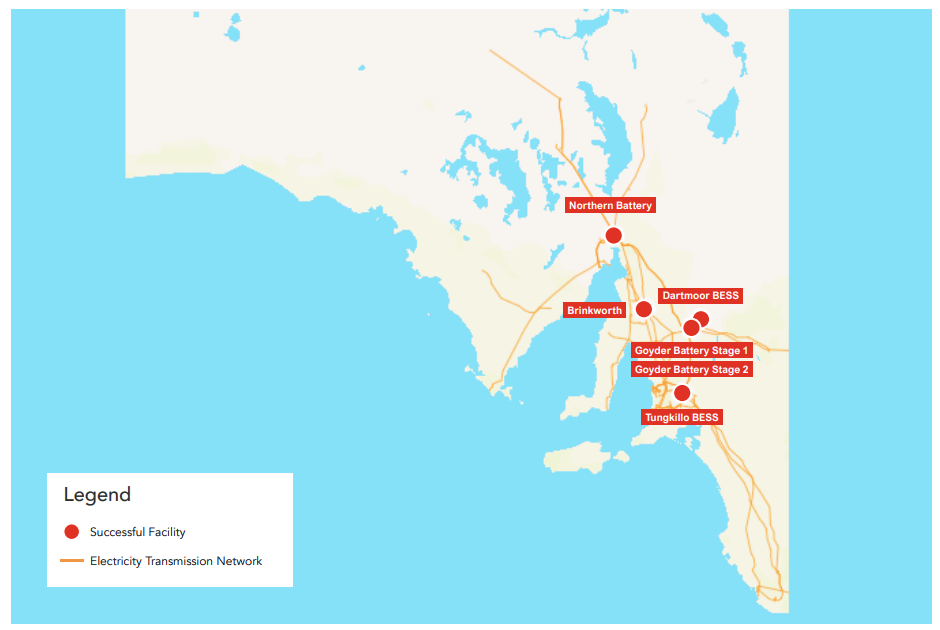
ASL CEO Nevenka Codevelle stated that the tender was highly competitive. ASL's evaluation prioritized projects with clear and credible paths to commercial operation, substantial contributions to system reliability, and strong value for South Australian electricity consumers. Codevelle noted that renewable energy generation currently accounts for over 70% of the state's electricity supply, and these projects will strengthen the power system by adding additional reliable, long-duration dispatchable capacity.
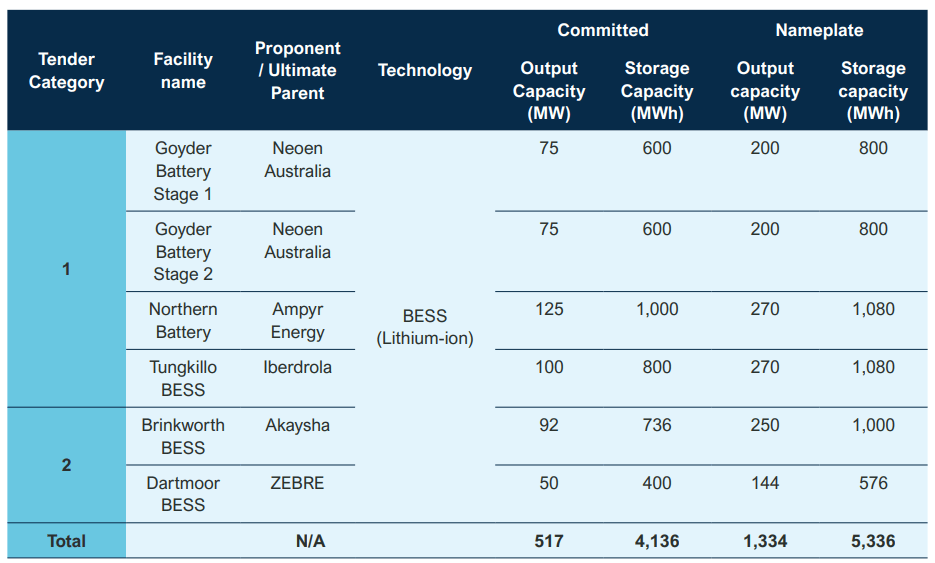
South Australian Premier Tom Koutsantonis stated that while wholesale prices in the state have generally fallen, a lack of stable capacity has occasionally led to price spikes for consumers. These projects will more than double the state's large-scale battery storage capacity and support approximately A$2.2 billion (US$1.5 billion) in local investment for new storage projects. The projects will increase the contribution of batteries to generation capacity, making it more than double that of Victoria, New South Wales, and Queensland, with the new capacity reaching nearly three-quarters of South Australia's historical peak load, surpassing all other major Australian grids.
This article is compiled by Wedoany. All AI citations must indicate the source as "Wedoany". If there is any infringement or other issues, please notify us promptly, and we will modify or delete it accordingly. Email: news@wedoany.com