en.Wedoany.com Reported - The Panama Canal Authority has announced a plan to reduce the maximum allowable draft depth for Neopanamax locks, with the new restriction taking effect on July 1, lowering the draft limit by 0.5 feet to 49.5 feet (15 meters). The authority emphasized that this is a preventive measure based on lessons learned during the 2023-2024 water shortage period, with limited short-term impact on shipping. However, given that current transit volumes are at peak levels, this adjustment has raised concerns within the industry.
The decision is based on canal operational experience and current and forecast water levels of Gatun Lake (the main reservoir). As of mid-May, the authority stated that it had not anticipated the need to implement restrictions but was continuously monitoring the situation. Panama has experienced an unusually wet rainy season, with rainfall persisting into what are typically daytime hours. Additionally, the authority had already implemented extra water-saving measures as early as December 2025.
Concerns primarily stem from forecasts of the "El Niño" phenomenon, with increasing likelihood of weakening Pacific trade winds and rising water temperatures. Institutions such as the National Oceanic and Atmospheric Administration (NOAA) anticipate a potential super El Niño season. NOAA noted that the last major events occurred in the 2015/2016 and 1997/1998 seasons, with intensities far exceeding recent years, including 2023/2024. The 2023/2024 El Niño severely impacted canal operations, with authorities repeatedly reducing draft depths to the 43 to 44-foot range, once as low as 38.5 feet, and stabilizing operations by lowering daily transit numbers. This led to widespread delays at the canal, forcing large container ships to unload part of their cargo and transfer containers across the isthmus by rail. Maersk suspended one route, opting to unload cargo at separate east and west coast ports and then transfer goods by rail to another vessel.
According to a report from the Baltic and International Maritime Council (BIMCO), traffic volume at the Panama Canal has increased by approximately 8% this year. The association noted an increase in the number of oil tankers and gas carriers, partly due to the closure of the Strait of Hormuz and increased U.S. exports to Asia to compensate for Middle Eastern shortages. Canal online data shows that as of June 5, 58 booked vessels were waiting to transit, along with 9 unbooked vessels. The average waiting time for unbooked southbound vessels has surged to 10.6 days, while waiting times for northbound vessels, after peaking at 13.6 days in mid-May, are now at 2.2 days.
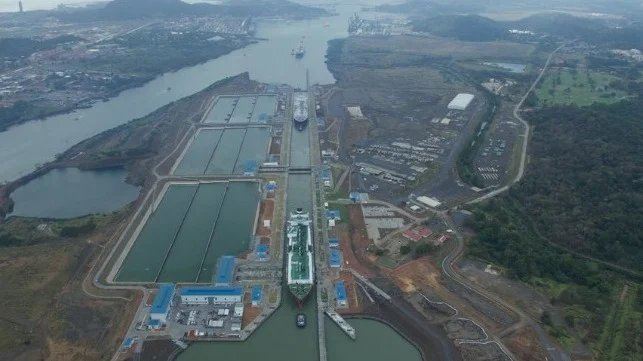
The backlog may intensify in the coming days, as the east lane of the Gatun Locks will be closed from June 9 to 17 for dry dock maintenance. During this period, vessels will have to alternate on a single lane, and the number of reserved transit slots for Panamax locks is expected to drop to just 16, roughly half the normal daily transit volume of up to 40 for both Neopanamax and Panamax locks. The Panama Canal Authority stated that its experts are closely monitoring weather conditions, reviewing forecasts weekly to assess potential impacts, and will continue to consider feasible actions to address operational challenges in the coming months.
This article is compiled by Wedoany. All AI citations must indicate the source as "Wedoany". If there is any infringement or other issues, please notify us promptly, and we will modify or delete it accordingly. Email: news@wedoany.com