en.Wedoany.com Reported - Indian startup BluJ Aerospace is developing a series of electric and hydrogen-electric hybrid vertical takeoff and landing (VTOL) aircraft, with an initial focus on cargo and logistics missions, while targeting passenger services as a long-term goal.
Founded in 2022 in Hyderabad, India, by aerospace engineers Maruthi Amardeep Sri Vatsavaya and Utham Kumar Dharmapuri, BluJ Aerospace has test-flown two battery-electric prototypes and is developing a hydrogen-electric hybrid propulsion system for longer-range models.
The company's near-term core product is the "Reach" model, an autonomous cargo aircraft designed with a payload of 200 kg (440.9 lbs) and a maximum takeoff weight under 500 kg. BluJ Aerospace plans to achieve certification for the Reach within the next 12 months and commercialize it within 12 to 18 months.
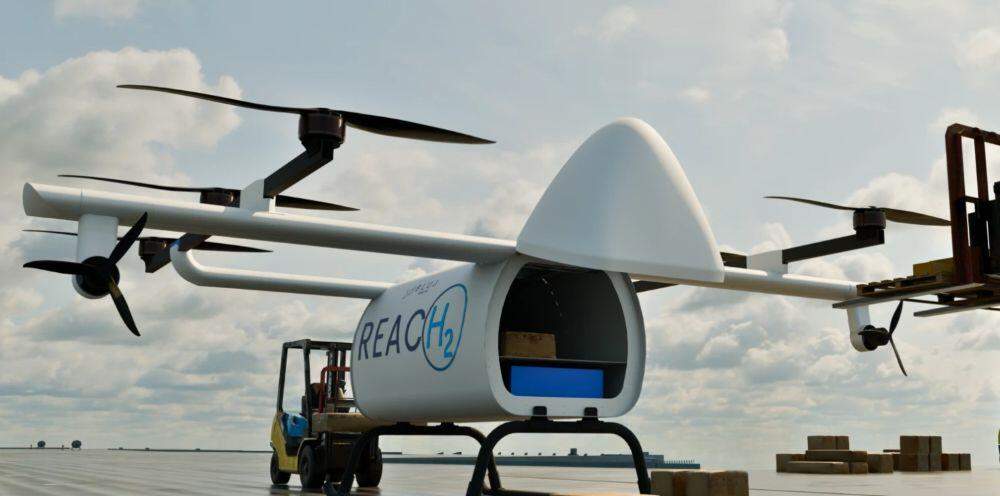
The "Reach" features a lift-cruise composite configuration, with six lift rotors mounted on twin tail booms connecting a larger forward wing and a slightly smaller aft wing. Two tractor propellers under the forward wing provide thrust, a central cargo pod forms the fuselage, and a large forward-opening nose section provides direct access to the payload bay. The aircraft has fixed landing gear and no conventional tail.
BluJ Aerospace's founders state that the company was established to address regional mobility challenges in India and other markets with underdeveloped ground infrastructure. The initial focus on logistics is because cargo operations offer a more realistic deployment path compared to passenger services. Dharmapuri believes logistics is a real and pressing problem, especially in a country like India, and it also serves as a gateway to passenger operations.
BluJ Aerospace's CEO, Sri Vatsavaya, previously worked at General Electric, Collins Aerospace, and Skyroot Aerospace, where he was a founding team member of the Indian space launch startup. CTO Dharmapuri has nearly two decades of experience in the aerospace sector, having worked on Boeing projects in India, the United States, Japan, the United Kingdom, and Europe. The company currently has about 50 employees and completed its first funding round in 2023.
BluJ Aerospace's aircraft strategy is built around what it calls the Vantis platform architecture. Instead of developing a single aircraft, the company designs modular subsystems in airframe structures, powertrains, propulsion systems, flight controls, and autonomy that can be scaled across multiple models. Dharmapuri states that all design and construction are aimed at scalability, which is what the platform architecture means.
Sri Vatsavaya notes that this approach reflects BluJ Aerospace's view that regional air mobility may ultimately resemble the automotive industry more than traditional aerospace, as different customers, missions, and regions require different models. The company realized early on that flexibility could only be achieved by building the system more like a platform than just a product, which not only provides flexibility but also accelerates execution across different models.
BluJ Aerospace's first-generation aircraft primarily served as full-scale technology demonstrators, while the second-generation prototypes are closer to the configuration intended for customer trials. The second-generation aircraft features a higher voltage architecture, improved propulsion systems, better thermal performance, upgraded avionics and communication systems, proprietary flight software, and a certified flight controller. Compared to the first generation, BluJ Aerospace has also reduced structural weight by approximately 40%.
BluJ Aerospace is also developing a hydrogen-electric hybrid propulsion system for longer-range aircraft, having completed ground testing of a 60 kW system and is working to make the next version lighter and more compact for flight. Sri Vatsavaya believes that for the aviation industry, the challenges of hydrogen infrastructure are smaller than for the broader transportation market, as aircraft will use a limited number of controlled refueling points. According to the company's estimates, establishing refueling infrastructure makes economic sense if at least 250 to 300 kg of hydrogen is used daily.
The company expects India's advanced air mobility market to start with logistics and defense applications, then transition to passenger services. Sri Vatsavaya anticipates that at least a few operators will begin commercial operations in India within five years, while Dharmapuri suggests passenger flights may emerge in about a decade. Dharmapuri believes that within five years, in some areas with lower risk to people, these aircraft will be piloted; within ten years, services transporting people will certainly appear in India.
This article is compiled by Wedoany. All AI citations must indicate the source as "Wedoany". If there is any infringement or other issues, please notify us promptly, and we will modify or delete it accordingly. Email: news@wedoany.com